
TL;DR

Get the latest gadgets delivered free with Prime
- Fast, free delivery on millions of items
- Prime Video, Amazon Music and more included
- Member-only deals all year
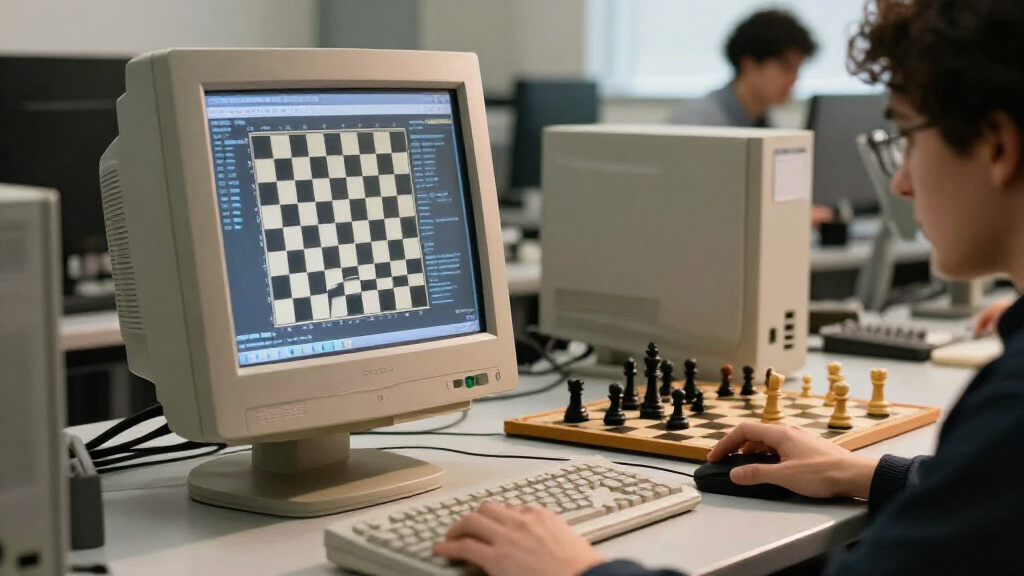
A 2026 report tested a modernized Stockfish engine on a 200 MHz Pentium Pro and estimated its strength at up to 3,180 Elo, well above Kasparov’s rating in 1996. The result suggests software advances could have mattered more than specialized hardware, but it does not establish how the engine would have performed in a match against Kasparov.
A 2026 report says a modernized version of Stockfish, adapted to run on a 200 MHz Pentium Pro, reached an estimated strength of up to 3,180 Elo—above Garry Kasparov’s rating of just under 2,800 in 1996. The experiment suggests a carefully updated chess engine on period hardware could have been formidable, but Kasparov did not play it, so the result does not prove it would have beaten him in a match.
The author tested a Pentium Pro system with 64 MB of RAM, running a custom port of Stockfish. At 30 seconds per move, the tuned engine was rated 3,180 Elo, with an uncertainty of ±80. The report also gives estimates of 2,846 ±35 at one second per move and 3,109 ±79 at 10 seconds per move. These are experiment results, not ratings from a match against Kasparov.
In a separate 100-game test, the Pentium-based modern engine scored 78 wins, 17 draws and five losses against the 1996 Crafty engine running on a modern Ryzen 7 computer. The report says a plain port of Stockfish scored about 2,496 Elo at one second per move, while changes tailored to the older processor raised its estimated strength. The figures are reported engine ratings; the source does not describe them as results from a Kasparov contest.
The article also compares the gains attributed to hardware and software. It estimates that 720 of 1,335 Elo points separating the best 1996 commodity engines from modern Stockfish came from better programming rather than faster hardware. The author’s results depend on the testing setup, engine versions, time controls and rating method; the report’s estimates include uncertainty ranges.
Software Advances on Old Hardware
The experiment speaks to a larger question about the history of chess computing: whether Deep Blue’s specialized machinery was the only route to a machine capable of challenging the world champion. The report indicates that engine design has advanced substantially, and that some of those advances can be applied even when computing power is limited.
That distinction matters when interpreting the historical counterfactual. Deep Blue’s 1996 win over Kasparov came from a system built for chess, while the test described here uses software developed with decades of later chess-engine research. A modern program running on old hardware is not equivalent to a program that could have been written and deployed in 1996. The report supports the narrower conclusion that old hardware can run much stronger modern software than contemporary programs could; it does not settle what would have happened over a full match.
Products Worth Considering

Apple AirPods Pro 3 Wireless Earbuds with Active Noise Cancellation

Amazon Kindle Paperwhite Signature Edition, 32GB (2024), Metallic Black

DJI Osmo Mobile 7P Smartphone Gimbal Stabilizer with Mic Mini Transmitter, Infinity Black
As an affiliate, we earn on qualifying purchases.
Deep Blue and the 1996 Match
On February 10, 1996, IBM’s Deep Blue became the first computer program to defeat reigning world champion Kasparov in a chess game. Kasparov won that match, but Deep Blue won their 1997 rematch by 3.5–2.5, according to the source report.
The upgraded Deep Blue used 30 processors running at roughly 120 MHz and 480 custom chess co-processors, and could examine more than 200 million positions per second, the report says. The 2026 experiment takes a different approach: it runs later software on commodity hardware from the period and adjusts the program for the Pentium Pro’s 32-bit architecture and memory limit. That makes it a test of software portability and accumulated engine knowledge, not a reconstruction of what IBM or other developers could have built in 1996.
““the majority of the Elo gains (+720 of the +1335 gained) can be attributed to better programming, and not better hardware.””
— The report’s author
No Kasparov Match Was Played
The key limitation is that Kasparov did not face the Pentium-based engine. Elo ratings estimate relative playing strength from game results and depend on the comparison pool, time control and testing method. A rating above Kasparov’s does not by itself establish that the engine would have won a particular match, especially under the conditions of 1996.
The source material does not provide a direct match result, a detailed account of every testing condition, or an independent replication of the reported ratings. It also does not establish that the same engine, code and hardware configuration could have been created and prepared for competition in 1996. The counterfactual—whether it would have beaten Kasparov—therefore remains plausible by the reported estimates, but untested.
Further Tests Could Refine the Estimate
The report presents a technical comparison rather than a scheduled competition. The next useful step would be independent testing of the port, with the engine versions, time controls, hardware and rating calculations documented so other researchers can check the estimates.
A direct match against a strong human player under specified conditions could address a different question from the one tested here. Until such results exist, the strongest supported takeaway is that modern chess programming can make a Pentium Pro run an exceptionally strong engine—not that a historical Kasparov match has been resolved.
Key Questions
Did a Pentium-based engine actually play Kasparov?
No. The report describes engine tests and a 100-game match against the 1996 Crafty engine, not a match against Kasparov.
How strong was the tuned Stockfish port?
The author estimated it at 3,180 ±80 Elo at 30 seconds per move on a 200 MHz Pentium Pro. The figure is an experimental rating estimate, not a Kasparov match score.
What did the 100-game test show?
The Pentium-based modern engine scored 78 wins, 17 draws and five losses against 1996 Crafty running on a modern Ryzen 7, according to the report.
Does this prove it would have beaten Kasparov in 1996?
No. It suggests the engine could have been strong enough to pose a serious challenge, but there was no direct match, and a rating comparison cannot determine the outcome of an unplayed contest.
Source: nicholas.carlini.com