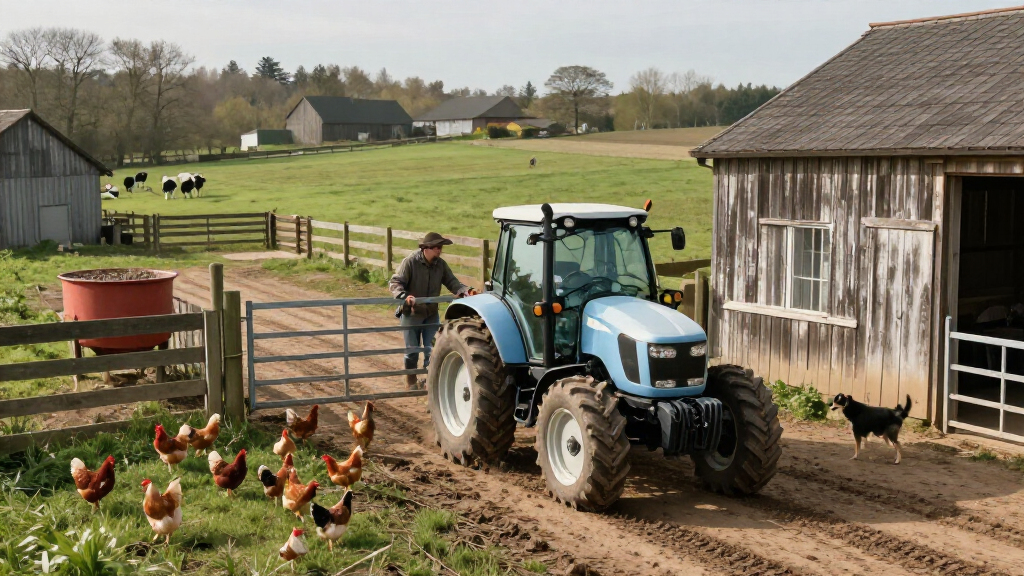

🔍 Read the full analysis: The Tractor's Arrival And The Fate Of Farm Animals on ThorstenMeyerAI.com

Get the latest gadgets delivered free with Prime
- Fast, free delivery on millions of items
- Prime Video, Amazon Music and more included
- Member-only deals all year
TL;DR
U.S. farm horses and mules peaked at 26.7 million in 1918, then fell to 3.1 million by 1960 as tractors and other machinery spread. The shift freed farmland from growing animal feed and reduced farm labor, but the comparison with human workers remains an analogy, not a prediction.
A November 4, 2026, episode of ThorstenMeyerAI.com’s “Work After Work” examines how tractors and other machinery transformed U.S. agriculture, replacing a farm population that once included 26.7 million horses and mules. The historical account traces the animals’ decline, the movement of farm workers into other jobs, and why the episode treats the horse as a comparison—not a forecast—for automation’s effects on people.
U.S. farm horses and mules reached their recorded peak on January 1, 1918, according to Department of Agriculture estimates reproduced in the Census Bureau’s 1975 historical statistics. Horses alone peaked earlier, at 21.4 million in 1915. The animals powered ploughs, seed drills, reapers and wagons, but required substantial feed: about 93 million acres of harvested cropland grew feed for them in 1915, out of 340 million harvested acres.
Tractor numbers rose sharply over the following decades. The source gives about 1,000 tractors in 1910, 246,000 in 1920 and 4.69 million in 1960. Farm horses and mules numbered 25.7 million in 1920 and 3.1 million in 1960. The figures crossed around 1955, when the account reports 4.35 million tractors and 4.31 million horses and mules. The source cautions that census dates differed somewhat across years.
The change extended beyond tractors. U.S. combine harvesters increased from about 4,000 in 1920 to more than one million in 1960, alongside corn pickers, balers and milking machines. The account says the Department of Agriculture estimated that one farm worker supplied 7.1 people in 1910 and 47.1 in 1970, a figure that includes people abroad supplied through exports. Farm employment fell from a reported peak of 13.6 million in 1916 to 4.5 million in 1970, while the overall U.S. labor force doubled.
The Land and Labor Behind Mechanization
The shift changed more than the equipment farmers used. By 1960, the acreage devoted to horse and mule feed had fallen to about 5 million acres, down from 93 million in 1915, according to the source. Land once used to feed working animals could instead support other crops, while machinery let fewer agricultural workers produce more output.
That productivity gain came with social change. The episode says new jobs were concentrated in cities, requiring many people to move. The figures chart lower farm employment, but do not by themselves establish what happened to each displaced worker, how incomes changed, or how benefits and costs were distributed. Those distinctions matter when the history is used to discuss automation today.
The episode also describes present-day agricultural automation as real but limited in scope. It cites a February 2025 John Deere autonomy kit using 16 cameras for tillage on select large tractors, and says China reported that about 74% of ploughing, sowing and harvesting was mechanized in 2023. These examples do not show that all farm work is autonomous or that current technologies will produce the same labor effects as tractors did.
Products Worth Considering

Samsung Galaxy Tab A11+ 11-Inch Tablet, 6GB RAM, 128GB Storage, Expandable, Gray

Samsung Galaxy Tab S10 Lite – 6 GB RAM, 128 GB storage, up to 2 TB microSD, 10.9‑inch LCD, Gray

Bose QuietComfort True Wireless Earbuds with Active Noise Cancellation, Black
As an affiliate, we earn on qualifying purchases.
From Fordson to Farm Machinery
Tractors existed before World War I, but the source describes early models as heavy, expensive and better suited to large farms. In 1917, Ford launched the Fordson. The Henry Ford museum calls it “the first mass-produced and inexpensive lightweight tractor” and says it was built for small farmers. On February 21, 1920, the 100,000th Fordson left the assembly line.
The historical account places the tractor within a broader shift that included harvesters and other equipment, as well as fertilizer and improved seed. It cites economist Wassily Leontief, who compared workers to horses replaced by tractors in 1983. The episode notes a limit to the analogy that Leontief himself identified: horses could not vote. The comparison raises questions about how technology affects work, but it cannot settle how modern workers, institutions or economies will respond.
The animal decline was gradual rather than a single mass event. According to the episode, farmers stopped breeding replacements, and the working population aged out. By 1960, the combined horse-and-mule count had fallen by almost 90% from its 1918 peak. The Department of Agriculture ended its annual estimates soon afterward, the source says.
“The source says Leontief compared workers to horses replaced by tractors, while pointing out that horses could not vote.”
— Wassily Leontief, as discussed in the episode
Where the Horse Comparison Stops
The historical figures document changes in farm equipment, animal numbers and employment, but they do not provide a full account of individual workers’ later jobs, pay or living standards. The source says workers moved toward city employment; it does not quantify how many relocated or identify the occupations they entered.
The episode’s current technology examples also have limits. The cited Deere system is described as an option for tillage on select large tractors, not as a general-purpose replacement for farm labor. The source gives China’s reported 2023 mechanization share but does not provide a methodology or breakdown by crop, region or task. It is therefore unclear how directly that figure compares with the U.S. historical data.
Finally, the horse analogy does not establish that machines will displace human workers in the same way, at the same speed or with similar consequences. The account presents a historical parallel and notes differences; outcomes for workers affected by present-day automation remain unsettled.
Questions for Today’s Farm Automation
The episode’s next step is interpretive rather than a scheduled policy or technology milestone: it asks how far the tractor-era history can inform discussion of driverless tractors and other automation. No new U.S. employment forecast, policy change or deployment timetable is identified in the source material.
Readers assessing future claims will need more detail about which tasks current systems can perform, where they are being used, and how adoption affects farm staffing and costs. The 2023 mechanization figure and the February 2025 Deere example provide dated reference points, but the source does not establish what has changed since those dates or how quickly use is expanding.
Key Questions
When did the number of U.S. farm horses and mules peak?
The combined count peaked at 26.7 million on January 1, 1918, according to Department of Agriculture estimates reproduced in historical statistics. Horses alone peaked in 1915.
How quickly did tractors replace working animals?
The change unfolded over decades. The source lists about 1,000 tractors on U.S. farms in 1910 and 4.69 million in 1960; it says tractors and horses and mules crossed in number around 1955.
What happened to the farm horses and mules?
The episode says farmers stopped breeding replacements and the working animals aged out. The combined population was down to 3.1 million by 1960; the source does not describe a single mass removal event.
Did mechanization eliminate farm jobs?
The historical account reports that U.S. farm employment declined from 13.6 million in 1916 to 4.5 million in 1970, while farm output per worker rose. Those figures do not show what happened to every worker or establish that machinery alone caused the employment change.
Does the horse story predict what AI will do to workers?
No. The episode presents the horse as an analogy for technological displacement, not a rule or forecast. It also points to differences between animals and human workers, including people’s ability to vote and shape public policy.
Source: ThorstenMeyerAI.com