
📊 Full opportunity report: A Look At Backyard Homes, Housing, And Zoning on IdeaNavigator AI — validation score, market gap, and execution plan.

Get the latest gadgets delivered free with Prime
- Fast, free delivery on millions of items
- Prime Video, Amazon Music and more included
- Member-only deals all year
TL;DR
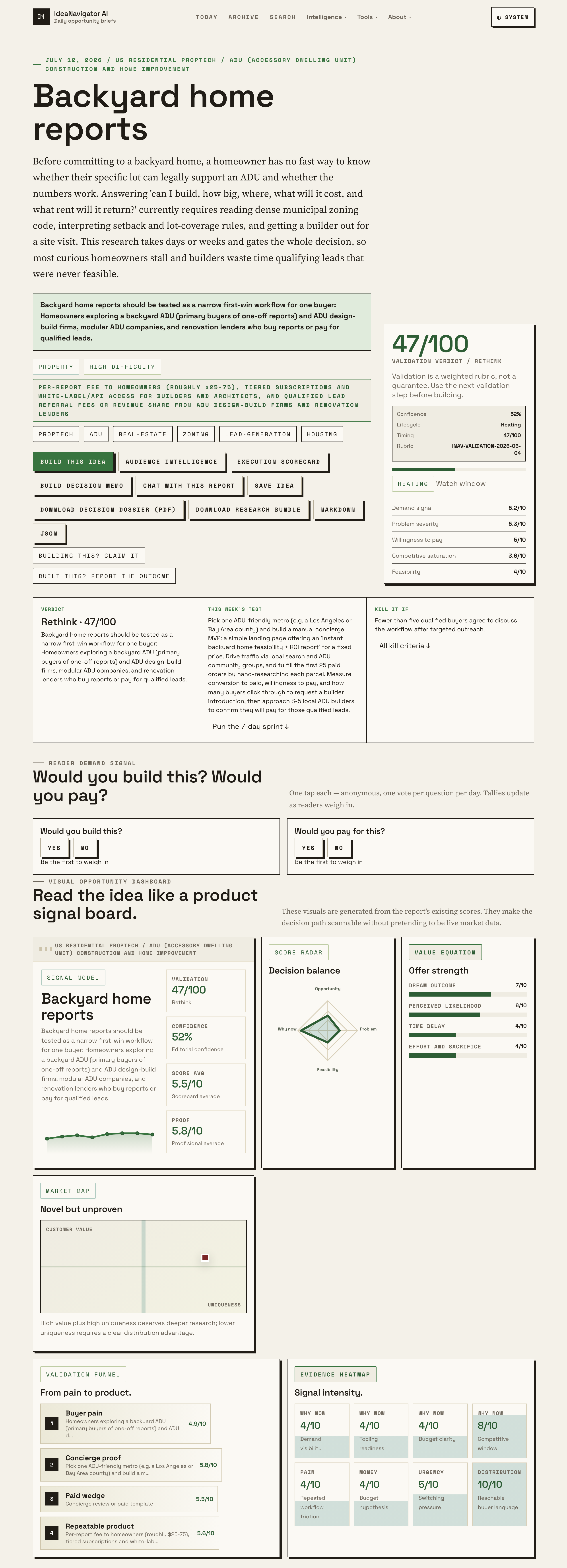
IdeaNavigator AI has outlined a business concept for paid reports that would assess whether a specific property may support an accessory dwelling unit and estimate costs and rental income. The proposal calls for a manually researched pilot in one California market; it does not report that a service has launched or that demand has been validated.
IdeaNavigator AI has outlined a business proposal for paid reports that would estimate whether a homeowner’s lot can accommodate an accessory dwelling unit, or ADU, and whether a project’s costs and potential rent may make financial sense. The proposal recommends testing the service in one California market with manually researched reports; it does not establish that a product is operating or that customers have paid for one.
The proposed service would let a homeowner enter a property address and receive a report covering local ADU rules, possible building area, estimated construction costs and projected rental income. To produce those estimates, the suggested first version would combine county parcel information, such as lot boundaries and existing building footprints, with state law and a hand-curated set of local zoning rules. The proposal describes the results as estimates, rather than approvals or construction bids.
IdeaNavigator AI says the report could help answer questions that often arise before a homeowner contacts a builder: what types of ADUs may be allowed, how large one could be, where it might fit, what construction could cost and what rent it might bring in. The proposal identifies homeowners as likely one-time buyers, while ADU design-build firms, modular-home companies, architects and renovation lenders could pay for subscriptions, branded reports or qualified customer leads.
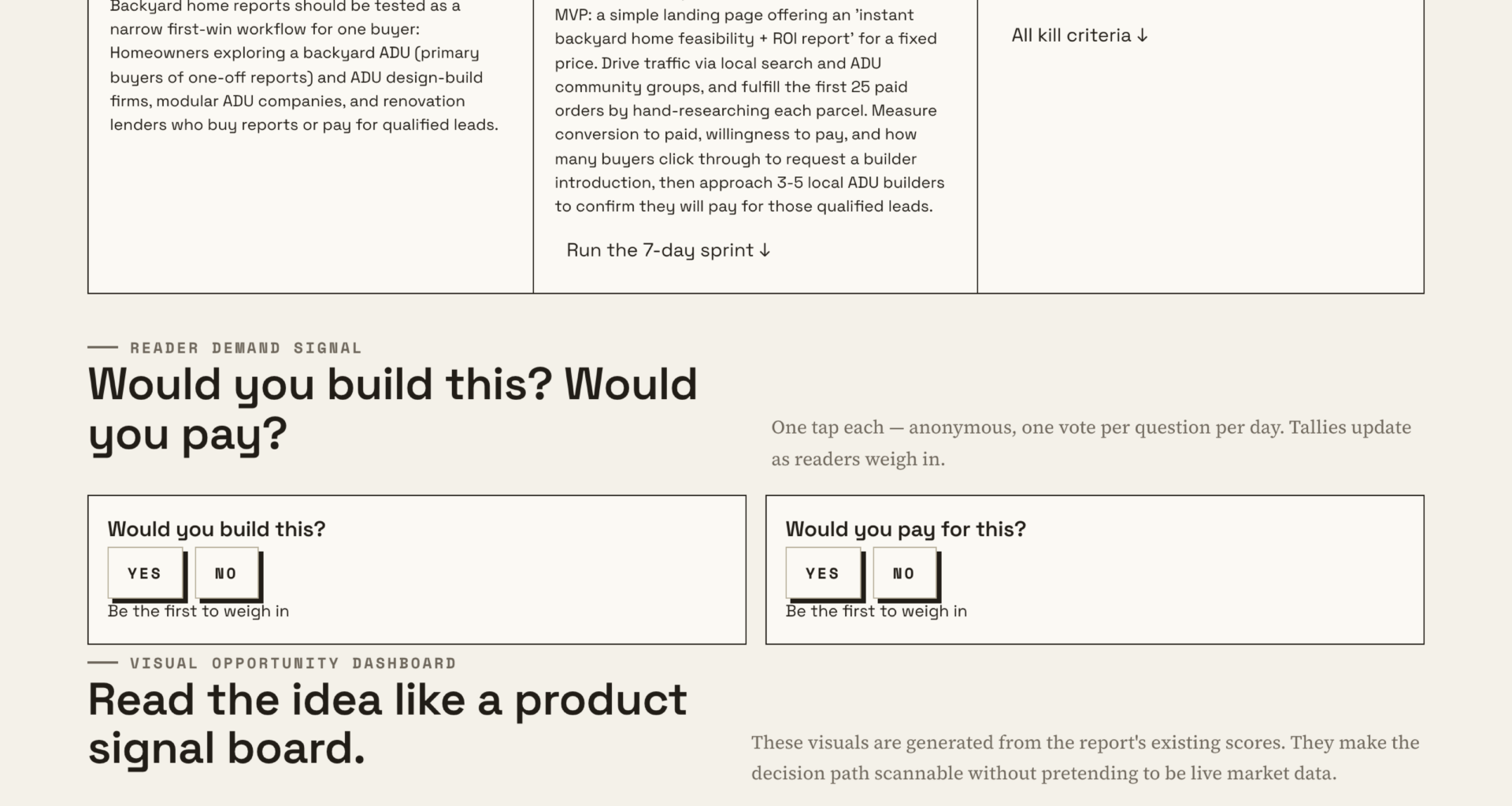
The suggested revenue model combines a homeowner fee of roughly $25 to $75 per report with possible business subscriptions, API or white-label access, and referral fees. These are proposed prices and revenue channels, not reported sales or confirmed agreements. The plan recommends first fulfilling 25 paid orders by hand, then measuring whether customers will pay and whether they request introductions to builders. It also proposes asking three to five local builders whether they would pay for such leads.
A Faster First Check for ADUs
An address-specific report could give homeowners an earlier way to decide whether to spend time and money pursuing a backyard unit. The idea addresses a practical hurdle: zoning provisions, parcel conditions and construction economics are separate questions, and a homeowner may need to investigate all three before knowing whether a project is worth discussing with a contractor. A faster preliminary screen could help some people rule out unsuitable projects or arrive at builder conversations with more focused questions.
For builders and lenders, the proposed benefit is lead quality. If a report identifies properties with plausible building space and a path through local rules, businesses may spend less time on inquiries that cannot progress. That benefit remains a business hypothesis. A report based on public records and curated rules would still need clear limits: a preliminary estimate cannot replace a jurisdiction’s decision, a site inspection or a project-specific cost estimate.
The proposal links the opportunity to housing supply, but a report itself does not add a dwelling. Its potential effect depends on whether homeowners use it to move viable projects forward and whether those projects receive permits and are built. The distinction matters for readers weighing the idea: the immediate development is a proposed information service, while any contribution to housing production would come later and is not demonstrated by the proposal.
California’s ADU Policy Setting
IdeaNavigator AI grounds the proposal in changes to ADU rules and interest in additional housing. It says California began legalizing ADUs statewide in 2016 and that state rules have been loosened repeatedly since then. The proposal also cites more than 45,000 ADU permits in Los Angeles County in 2023 and says ADUs account for roughly one in five new housing units produced in California. Those figures are presented as background for the business case; they do not show that a reporting service exists or establish how many permitted units were completed.
The proposal says other states and cities are also changing ADU rules, but it does not name particular jurisdictions or detail their policies. Rules remain local in important ways, and the suggested product recognizes that by starting with a single metro area and a manually maintained rule set. Parcel data may describe lot dimensions and structures, but translating zoning provisions into a reliable property-level assessment requires careful handling of local requirements and exceptions.
The proposed timing also rests on the availability of parcel and zoning data and language-model tools that may help parse codes. IdeaNavigator AI presents these as factors that could make an automated service more practical. It does not report a technical evaluation showing that automated code interpretation is accurate enough for customer reports. Its suggested manual pilot would test the business idea while limiting the initial geography and allowing researchers to review each parcel.
Demand and Accuracy Remain Untested
No paid pilot results, customer interviews, builder commitments or live product are described. It is not clear which county would be selected, how often local zoning rules would be updated, or how the report would handle conflicting provisions, unusual lots and site conditions that parcel records cannot show. The proposed report also includes cost and rent estimates, but the proposal gives no methodology, local comparison data or accuracy results for those figures.
There is also no stated process for correcting an inaccurate report or for explaining the difference between an initial feasibility screen and a formal determination by a local agency. A homeowner could mistake an estimate for permission to build unless the product clearly explains its limits. The proposal does not specify how customer data would be handled, how builder referrals would be screened, or what a qualified lead would mean to a paying business.
The market claims cited in the proposal provide context, but they do not establish willingness to pay for a report at the suggested price. Nor do they show that builders would pay referral fees or subscriptions. Those questions are the stated purpose of the proposed test, and remain open until the test is carried out and its results are shared.
The Proposed Pilot’s First Measures
The next step outlined by IdeaNavigator AI is to choose one ADU-friendly California metro or county and offer a fixed-price feasibility and return estimate through a simple landing page. The team behind the concept would then research the first 25 customer orders manually, using property records and local rules, instead of building a broad automated system at the outset. No pilot start date or selected location is given.
The proposed measures are whether visitors convert into paying customers, whether buyers consider the report worth its price, and how many ask for an introduction to a builder. The plan then calls for conversations with three to five local ADU builders to test whether they would pay for qualified leads. Results from those steps would help establish whether the concept merits a larger product, but the proposal does not say what threshold would count as success.
Any later expansion would depend on what the pilot shows about customer demand, report accuracy and business interest. Until those results are available, the address-based report remains a proposed service, and its cost, rental and zoning estimates should be understood as planned features rather than demonstrated outputs.
Source: IdeaNavigator AI
Key Questions
Has an ADU feasibility report service launched?
The proposal does not report a launch. It recommends testing the concept with a small, manually researched pilot in one California market.
What would a homeowner’s report include?
The proposed report would estimate possible ADU types and size, zoning and setback constraints, buildable area, construction costs and local rental income. These would be preliminary estimates, not a permit or builder quote.
How much might a report cost?
IdeaNavigator AI suggests a price of roughly $25 to $75 per homeowner report. The proposal does not show that customers have paid those amounts.
How would the idea be tested?
The proposed pilot would fulfill the first 25 paid orders by hand, track purchases and requests for builder introductions, and ask three to five local builders whether they would pay for qualified leads.
Source: IdeaNavigator AI
Halloween Picks
halloween
As an affiliate, we earn on qualifying purchases.