TL;DR

Get the latest gadgets delivered free with Prime
- Fast, free delivery on millions of items
- Prime Video, Amazon Music and more included
- Member-only deals all year
Raph Levien’s November 7, 2026 report describes a just-in-time code-generation technique for rendering bitmap text on an RP2350 microcontroller. The approach is part of a scanline-based renderer for the vic-2350 project, aiming to support proportional spacing and kerning while working within strict processing and memory budgets.
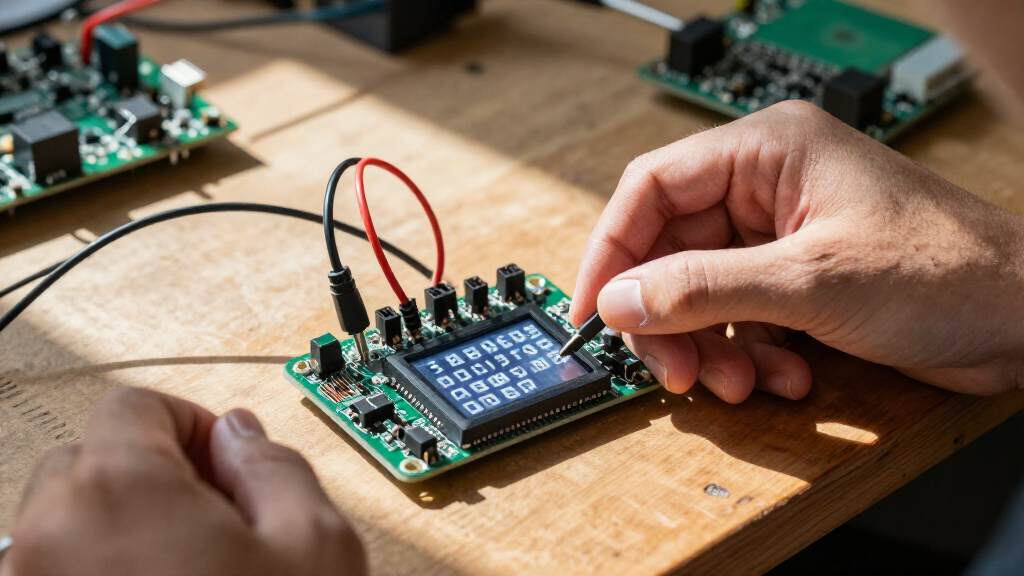
Raph Levien has described a just-in-time (JIT) bitmap text renderer for the RP2350 microcontroller, a technique intended to generate optimized code for drawing each string as it is rendered. The implementation is part of vic-2350, his reimagining of an 1980s home computer, where software must fill video output one scanline at a time while meeting tight timing and memory constraints.
In a report published by Linebender on November 7, 2026, Levien says the renderer uses JIT code generation to accelerate bitmap text drawing. He chose bitmap fonts for their efficiency and crisp appearance at low resolutions, while also seeking proportional spacing and kerning rather than a fixed-width character grid. The report presents the method as suitable for microcontrollers such as the RP2350; it does not provide independent performance testing or a comparison with other implementations.
The renderer is designed to race the video beam: it produces a video buffer one scanline at a time rather than maintaining a full-screen framebuffer. Levien estimates a budget of about six processor cycles per pixel. He says the lower the text and graphics rendering cost stays beneath that budget, the more processing time remains for other visual objects and application tasks.
Text is represented in the display list with a string, a font pointer, and foreground and background colors. The display list is double-buffered, and objects intersecting each scanline are tracked in an active list. Levien says an earlier design stored expanded text in the display list, using too much memory; the described design instead generates rendering code on the fly. The report also notes that the RP2350 has 520 kB of SRAM, making memory use a constraint when choosing between scanline rendering and a framebuffer.
Fitting Text Into Scanline Budgets
The technique addresses a practical trade-off for microcontroller graphics: fixed-cell text can be fast and economical, but limits typography, while a framebuffer offers flexibility at the cost of memory and update work. Levien’s approach seeks to combine bitmap-font efficiency with proportional spacing and kerning in a renderer that does not reserve a full-screen image in RAM.
For projects with tight real-time video deadlines, rendering speed affects more than text quality. Every cycle spent drawing characters is unavailable for other graphics or application logic. If the method performs as intended in the project, generating code for a string could help meet scanline deadlines without storing a larger, pre-expanded text representation. The report describes an engineering approach, however, not a general benchmark or proof that it will suit every microcontroller display system.
Products Worth Considering

Amazon Kindle Paperwhite Signature Edition (12th Generation, 2024), 32 GB, Metallic Raspberry

Amazon Kindle Scribe (3rd Generation), 64GB, 11-inch Display, Graphite, with Premium Pen

Apple MacBook Air 13.6-inch Laptop with M5 Chip, 24GB Memory, 1TB SSD, Midnight
As an affiliate, we earn on qualifying purchases.
From Character Cells to JIT
Earlier home computers often displayed text using fixed character cells and font ROM, allowing characters to be read as the screen was scanned. That design was responsive and needed little computing power, but typically supported only monospace text. Later systems used framebuffers, which allowed more flexible graphics and typography but required more memory and processing to update.
Levien’s project applies a different balance to the RP2350. Its HSTX peripheral can support DVI video output, but software still has to supply the image data. A framebuffer is possible, but the report notes the chip’s limited SRAM and the value of keeping memory available for the application. The project instead renders scanlines as needed, using assembly-oriented tools for performance; Levien says Rust did not meet the renderer’s performance requirement in his implementation.
“The core idea is a JIT to generate highly optimized code on the fly for rendering a string.”
— Raph Levien, Linebender report
Performance Results Still Pending
The report describes the design and its constraints, but the supplied material does not include measured rendering speeds, code-size figures, or a direct benchmark against fixed-cell rendering, framebuffer text, or other JIT approaches. It is also unclear how the technique performs across different string lengths, fonts, and display configurations, or how much setup time code generation adds.
Levien says the implementation is part of vic-2350 and that the same general technique could be used with a framebuffer. The report does not establish that it has been tested across other microcontrollers, nor does it specify a broader release plan. The estimated six-cycle-per-pixel budget is a project constraint, not a published benchmark result for the text renderer itself.
Further Renderer Work
Levien says he plans to continue optimizing the renderer, including tracking opaque spans so it can skip pixels that will later be overwritten. He describes that work as a separate optimization rather than a requirement of the text method. The next useful evidence would be implementation measurements showing scanline timing, memory use, and the cost of JIT setup under representative workloads.
The report does not give a date for those measurements or announce a release milestone. For now, the technique remains a described implementation within vic-2350; its broader usefulness will depend on code availability, reproducible results, and performance on other hardware and display workloads.
Key Questions
What is JIT bitmap text rendering?
It is an approach that generates optimized code at runtime to render a particular string using a bitmap font, rather than relying only on a general-purpose text-rendering routine.
Which microcontroller is the report about?
The implementation is for the RP2350, used in Levien’s vic-2350 project. The report says the technique could also apply to other microcontrollers, but does not provide tests on them.
Why render one scanline at a time?
Scanline rendering avoids maintaining a full-screen framebuffer, which can consume a substantial share of the RP2350’s 520 kB of SRAM. It also imposes strict timing limits because the software must produce pixels as the display is scanned.
Does the report prove the renderer is faster?
No comparative benchmark is included in the supplied report material. Levien presents the technique as a way to speed rendering, but measured performance and comparisons with alternatives remain unclear.
What comes next for the project?
Levien says he plans further renderer optimization, including skipping work on pixel spans that will be overwritten. The report does not set a timeline for additional results or a wider release.
Source: linebender.org