
🔍 Read the full analysis: Meet SimReady Central: A Resource For 3D Assets In Robotics And AI on ThorstenMeyerAI.com

Get the latest gadgets delivered free with Prime
- Fast, free delivery on millions of items
- Prime Video, Amazon Music and more included
- Member-only deals all year
TL;DR
Hugging Face announced SimReady Central, a free, ungated library containing more than 2,000 OpenUSD assets intended for robotics simulation and AI factory digital twins. Asset features vary by profile, and the announcement gives no independent performance results, asset-level licensing details or full compatibility information.
Hugging Face has announced SimReady Central, a free, ungated library of more than 2,000 OpenUSD assets for robotics simulation and AI factory digital twins. The collection is intended to give developers a shared place to find 3D models with simulation-related information, though the capabilities vary by asset and the announcement provides no independent results showing how much time the library saves.
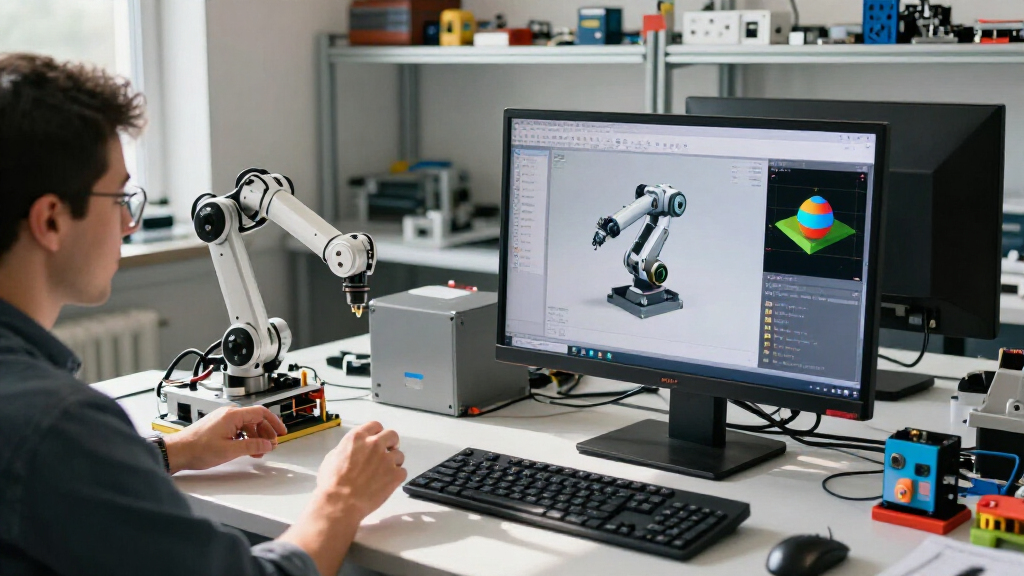
The collection includes robot arms and grippers, warehouse equipment, racks, cooling systems and other infrastructure. Hugging Face says users can inspect each asset’s supported capabilities, select models with profiles suited to their project and combine assets from different providers in an OpenUSD scene. The overall count is given as more than 2,000, but no breakdown by category, supplier or profile is provided in the source material.
Simulation-ready models may include more than visible geometry. Depending on the asset and intended use, relevant information can include collision geometry, mass, friction, joints, semantic labels, materials and sensor attributes. A detailed conventional model, including a CAD model, may still need such additions before it can serve a particular simulation workflow effectively.
The announcement identifies providers including Vertiv, Comau, FANUC, Franka Robotics, Robotiq, Standard Bots, Universal Robots, LG Electronics, Palatial and ForgeCAD. It says manufacturers and other providers can prepare assets against SimReady requirements, validate and package them, and submit them to the library. The supplied information does not set out individual asset licenses or confirm the status of every submission.
Preparing digital models for simulation can require teams to add physical and structural information that is absent from a model designed mainly for visual representation. A library with documented asset capabilities could reduce duplicated preparation work for teams assembling robot-training environments, testing scenarios or building digital twins of industrial facilities.
The library may also give equipment makers a route to make digital versions of their products discoverable to developers. A team could place a supplier’s robot, rack or cooling system into a proposed scene and explore a layout before working with physical equipment. Hugging Face presents faster testing and decision-making as potential benefits; these are stated aims, not measured outcomes in the announcement.
The practical value will depend on the quality and fit of each model. A large catalog alone does not establish that assets accurately represent real equipment, work across a developer’s chosen simulation tools or remain current as products change. For readers building simulation systems, the useful question is not only how many assets are listed, but what each one supports and how reliably it behaves in a scene.
Products Worth Considering

Jackery Explorer 2000 v2 Portable Power Station with Two 200W Solar Panels

Apple Watch Series 12 GPS 42mm Smartwatch

DJI Mini 4 Pro Fly More Combo with DJI RC 2
As an affiliate, we earn on qualifying purchases.
How SimReady Profiles Fit OpenUSD
OpenUSD is an open, extensible framework for describing and composing 3D scenes. It provides a way to assemble scene elements, but scene composition by itself does not specify all the physical behavior an autonomous system may need to train or be evaluated in simulation. That can require collision information, physical properties, articulated movement and sensor-related attributes.
The source says the SimReady Foundation defines specifications, profiles and validation tools for these requirements. A profile groups features associated with an intended use. Hugging Face advises developers to review an asset’s supported capabilities and choose models whose profiles fit their workflow. The library is presented as a discovery and distribution point for assets prepared and validated against those requirements.
The announcement also describes possible applications such as a robotic pick-and-place scenario and comparisons of AI factory layouts. It does not provide results from those examples. The news is the launch of a shared asset resource, rather than a reported demonstration that its contents have produced a particular training, testing or planning outcome.
“SimReady Central is a free, ungated library of more than 2,000 OpenUSD assets.”
— Hugging Face, as described in the announcement
Licensing and Compatibility Details
The announcement does not specify individual asset licensing terms, compatibility across simulation runtimes or whether all listed assets are available immediately. It also gives no breakdown of the catalog by category, profile, provider or validation status. Those details matter to teams deciding whether an asset can be used commercially and integrated into an existing toolchain.
No independent performance figures, adoption data or benchmark results are included. The source does not quantify preparation time saved, establish how accurately assets represent physical products or explain how data will be maintained as equipment changes. It is also unclear how consistently assets from different providers will perform together in a shared scene. These points limit what can be concluded about the library’s practical results at launch.
Asset Documentation Will Shape Adoption
According to the announcement, providers can use a SimReady Central submission skill to check assets against relevant profiles, package them and submit them for inclusion. Developers can browse the library, review supported capabilities and compose assets for a chosen simulation use case. The source does not provide a release calendar or a timetable for additions.
The next useful signals will be clearer asset-level documentation, licensing and compatibility information, along with evidence from developers using the models in working simulations. Such information could show whether the library’s profile and validation approach supports practical reuse across suppliers. Until those details and results are available, the confirmed development is the creation of a sizable shared catalog—not proof of a particular performance gain.
Key Questions
What is SimReady Central?
SimReady Central is a Hugging Face library announced as a free, ungated collection of more than 2,000 OpenUSD assets intended for robotics simulation and AI factory digital twins.
What kinds of assets are included?
The source lists robot arms, grippers, warehouse equipment, racks, cooling systems and other infrastructure. It does not provide a full category count or breakdown.
Does every asset include the same simulation features?
No. The announcement says capabilities depend on the asset and its profile. Features may include collision geometry, physical properties, joints, semantic labels, materials or sensor attributes; developers are advised to check asset-level capabilities.
Are the assets licensed for commercial use?
The supplied announcement does not specify licensing terms for individual assets. Users will need to review the terms attached to each asset before deciding how it can be used.
Has the library been shown to improve simulation results?
The announcement describes potential uses and benefits, but provides no independent performance results, benchmarks or measured time savings. Its practical impact will depend on asset quality, compatibility and the requirements of each project.
Primary source: Hugging Face · via ThorstenMeyerAI.com