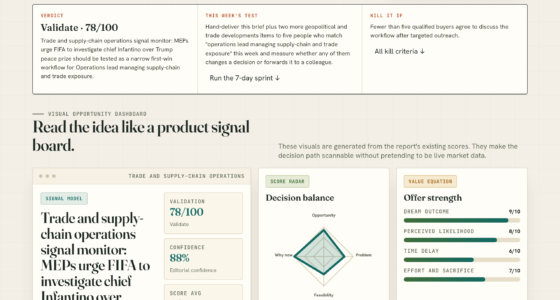

📊 Full opportunity report: Why AI Is Slow To Adopt And Even Harder To Replace on ThorstenMeyerAI.com — validation score, market gap, and execution plan.

Get the latest gadgets delivered free — and shop member deals
- Fast, free delivery on millions of items
- Access to Prime Big Deal Days deals on October 6–7
- Prime Video, Amazon Music and more included
TL;DR
Enterprises are slow to adopt AI due to organizational inertia and high switching costs, which also make incumbents difficult to displace. Despite slow adoption, established vendors remain dominant because of their embedded data and trust.
Enterprise AI adoption remains sluggish, with 95% of pilots delivering little value, yet incumbent vendors like Microsoft and SAP continue to dominate the market, embedding AI deeply into their existing platforms. This paradox highlights the structural resilience of established players, despite the widespread perception of vulnerability among traditional systems.
Research and industry analysis indicate that organizational inertia and high switching costs significantly hinder enterprise AI adoption. Many companies face internal resistance, complex legacy systems, and regulatory hurdles that slow down integration. For example, Microsoft’s Copilot and Salesforce’s Agentforce exemplify how AI is being embedded into core enterprise platforms, creating deep lock-in and making migration difficult.
Meanwhile, these same factors—such as data gravity, compliance lineage, and workflow integration—act as barriers to replacing incumbents. Industry reports, including those from BCG, confirm that established vendors are now the primary beneficiaries of AI investments, not disruptors. They have effectively become the “operational control planes” for enterprise AI, absorbing most of the innovation and value.
Incumbents are painfully slow to adopt AI — and remarkably hard to displace. How can both be true? They’re the same fact wearing two faces.
- 95% of pilots deliver nothing
- The internal customer resists
- Two-year timelines to change
- Built to resist transformation
- Absorb most enterprise AI spend
- Became the “control planes”
- Two years no rival can rip it away
- BCG: “a clear right to win”
The Structural Barriers Reinforcing Incumbent Dominance
This analysis reveals that the same organizational and technical factors slowing AI adoption also protect established vendors from disruption. The high costs of switching, combined with the embedded nature of trusted data, create a moat that makes it difficult for new entrants to gain ground. For enterprises, this means stability and risk mitigation; for disruptors, it signals a need to rethink strategies that rely solely on quick wins or early pilots.
As an affiliate, we earn on qualifying purchases.
The Evolution of Enterprise AI and Market Dynamics
Since 2023, major enterprise vendors have shifted focus from differentiation to convergence, adopting similar architectures centered on agents operating on trusted data within governance frameworks. Despite predictions of rapid disruption, the market shows a pattern where incumbents integrate AI into their core systems, making them less vulnerable to replacement. This trend aligns with findings from industry analysts like BCG, who highlight the structural advantages of established players in an AI-first world.
"The very inertia that makes an incumbent slow to change is the moat that makes it hard to dislodge."
— Thorsten Meyer
AI integration tools for legacy systems
As an affiliate, we earn on qualifying purchases.
As an affiliate, we earn on qualifying purchases.
Unclear Aspects of Disruption and Future Movements
It remains uncertain how long incumbents will maintain their dominance as AI technology evolves rapidly. While current data indicates resilience, future breakthroughs, regulatory changes, or shifts in enterprise priorities could alter the landscape. Additionally, the pace at which disruptors can overcome the high switching costs and data lock-in is still unknown.
AI compliance and security software
As an affiliate, we earn on qualifying purchases.
As an affiliate, we earn on qualifying purchases.
Next Steps for Disruptors and Incumbents in AI
Disruptors need to develop strategies that address the high switching costs and data lock-in, possibly by creating new platforms or leveraging emerging technologies to reduce dependency on existing data. Meanwhile, incumbents will likely continue to deepen their AI integrations, reinforcing their control. Monitoring regulatory developments and enterprise willingness to change will be key in predicting future shifts.
As an affiliate, we earn on qualifying purchases.
Key Questions
Why are enterprises slow to adopt AI despite its potential?
Enterprises face organizational inertia, complex legacy systems, high switching costs, and regulatory hurdles that slow down AI adoption. Internal resistance and risk aversion also play significant roles.
Why are incumbents difficult to displace in AI markets?
Incumbents have embedded trusted data, established workflows, and regulatory compliance advantages that create high switching costs and data lock-in, making migration costly and complex for clients.
What can disruptors do to overcome these barriers?
Disruptors need to innovate around reducing switching costs, such as creating interoperable platforms or offering new value propositions that complement existing systems, to break incumbents' lock-in.
Will the dominance of incumbents continue in the future?
It is uncertain. While current trends favor incumbents due to structural advantages, technological breakthroughs or regulatory changes could shift the balance over time.
Source: ThorstenMeyerAI.com
Halloween Picks
halloween
As an affiliate, we earn on qualifying purchases.