
📊 Full opportunity report: A Workspace To Manage Creator And Agency Social Media Tasks on IdeaNavigator AI — validation score, market gap, and execution plan.

Get the latest gadgets delivered free with Prime
- Fast, free delivery on millions of items
- Prime Video, Amazon Music and more included
- Member-only deals all year
TL;DR
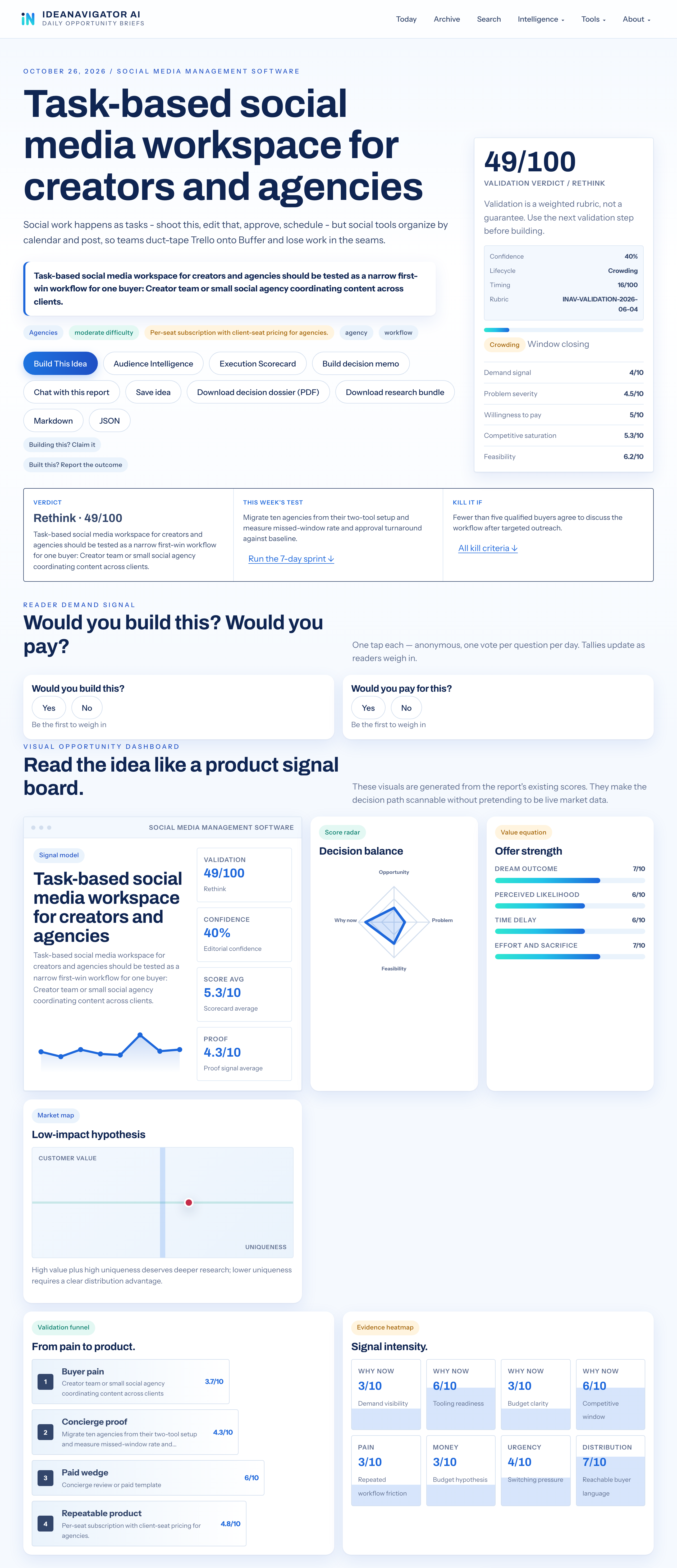
IdeaNavigator AI has outlined a product opportunity: a task-based workspace for creator teams and small social agencies that coordinates posts from brief through approval and scheduling. The proposal is not a product launch or evidence of tested results; it recommends piloting the workflow with 10 agencies and comparing missed posting windows and approval times with their current setup.
IdeaNavigator AI has proposed a task-based social-media workspace for creator teams and small agencies, organizing each post from brief and asset creation through editing, approval and scheduling. The proposal describes a product opportunity and a suggested test with 10 agencies; it does not report that a product has launched or that the proposed workflow has been validated.
The concept targets teams coordinating content for multiple clients. Its central premise is that day-to-day social work is made up of connected tasks—such as preparing a brief, producing creative assets, editing, securing approval and scheduling—while existing social tools are commonly organized around calendars and posts. IdeaNavigator AI argues that teams may bridge the gap with a social scheduling product and a separate project-management tool, leaving coordination between them to manual processes.
The proposed minimum viable product would treat each post as a task moving through stages labeled brief, asset, edit, approval and scheduled. It would include client-facing approval links and asset versioning, then connect approval to native scheduling. The intended workflow is a single pipeline from an idea to publication, rather than separate tools for task tracking and posting.
The suggested business model is a per-seat subscription, with pricing for agency clients who need access. To test demand and performance, IdeaNavigator AI proposes moving 10 agencies from their current two-tool setup and comparing the rate of missed posting windows and approval turnaround with a baseline. No agencies, baseline figures, test duration, product name, pricing or measured outcomes are identified in the proposal.
Bringing Post Work Into One Pipeline
The proposal addresses an operational issue for teams handling social content across clients: the post itself may appear in a scheduler, while briefs, files, revisions and client sign-off are tracked elsewhere. If those handoffs are not visible in one workflow, teams can face duplicated updates or uncertainty about which asset is approved. The proposed workspace is designed to make the status and next step for each post visible alongside its publishing process.
For agencies, a shared workflow could also give clients a direct way to review content without requiring the agency to rebuild its task tracking around each account. The potential value remains a hypothesis, however. The proposal supplies no evidence that a dedicated product would reduce missed deadlines, speed approvals or outperform combinations of existing tools. Its suggested pilot would need to establish whether the workflow improves those measures enough to justify another subscription and migration.
Products Worth Considering

LG 34GX90SA-W 34-inch Ultragear WQHD OLED Curved Gaming Monitor

Anker SOLIX C200 DC Portable Power Station, 192Wh, 200W

Apple AirPods Pro 3 Wireless Earbuds with Active Noise Cancellation
As an affiliate, we earn on qualifying purchases.
The Gap Between Calendars and Tasks
The concept sits within the social media management software market, but it emphasizes work coordination rather than scheduling alone. IdeaNavigator AI’s framing is that scheduling products focus on the calendar and published post, while general project-management tools can track tasks without being designed around post assets, client approvals or publication.
The proposal links the opportunity to rising content-velocity expectations, which it says have multiplied workflow demands. It does not provide market-size data, customer interviews, adoption figures or a comparison of named products. The practical question is therefore narrower than whether teams use social tools: it is whether creator teams and small agencies experience enough friction between their task and scheduling systems to adopt a purpose-built pipeline.
Demand and Results Remain Untested
No product, operating company, launch, customer commitments or working prototype is identified. The recommendation is to test a product idea, not an announcement that development is complete. There are also no reported interviews or survey results establishing how widespread the two-tool problem is among agencies or creator teams.
The proposed validation metrics—missed-window rate and approval turnaround—are not accompanied by definitions, sample results or a measurement period. It is unclear how the comparison baseline would be collected, whether the 10 agencies would represent a broader market, or how client-seat pricing would work in practice. Until a pilot is conducted and its methods and results are reported, claims about efficiency gains, willingness to pay and market demand remain unverified.
A Ten-Agency Pilot Is Proposed
The next step set out in IdeaNavigator AI’s proposal is to migrate 10 agencies from their existing two-tool workflows and measure missed posting windows and approval turnaround against each agency’s baseline. The proposal suggests that this test could indicate whether a unified task-to-scheduling process addresses a measurable coordination problem.
IdeaNavigator AI provides no pilot schedule, participating agencies or follow-up announcement. Readers should look for details on how baseline performance is defined, how long the test runs and whether results are published. Until then, the workspace remains a product proposal rather than a confirmed service or demonstrated solution.
Source: IdeaNavigator AI proposal
Key Questions
Has the social-media workspace launched?
No launch is reported. IdeaNavigator AI outlines a product concept and a way to test it, but does not identify a released product or launch date.
Who is the proposed workspace for?
The proposal targets creator teams and small social agencies coordinating content across clients.
What would the product do?
Each post would move through stages for briefing, assets, editing, approval and scheduling. The proposed features include client-facing approval links, asset versioning and native scheduling after approval.
How would the idea be tested?
IdeaNavigator AI proposes migrating 10 agencies from their two-tool setups and comparing missed posting windows and approval turnaround with a baseline. No results or test dates are given.
What remains unknown?
It is not clear whether agencies will participate, whether the workflow improves the proposed measures, or what the product would cost. The proposal also provides no market research or evidence of customer demand.
Source: IdeaNavigator AI