🔍 Read the full analysis: Steal This Approach To AI And Noctilucent Cloud Watching on ThorstenMeyerAI.com

Get the latest gadgets delivered free with Prime
- Fast, free delivery on millions of items
- Prime Video, Amazon Music and more included
- Member-only deals all year
TL;DR
ThorstenMeyerAI.com describes “Noctilucent — NLC Watch at 83 km,” an AI-built exhibition page about real high-altitude ice clouds. The fictional field journal uses an interactive solar-depression dial to alter the page’s lighting and illustrate how clouds can remain sunlit after the ground is dark; it is not a live scientific service.
ThorstenMeyerAI.com has presented “Noctilucent — NLC Watch at 83 km,” an AI-built interactive web exhibit that explains how noctilucent clouds can catch sunlight after darkness has reached the ground. The page is framed as a fictional field journal for a fictional observing project, not a real company, operational observing network or live scientific service; the clouds themselves are real.
The exhibit’s central feature is a solar-depression dial that shifts the simulated sun from six to 16 degrees below the horizon. As visitors adjust it, the experience changes several linked visual elements, including the sky’s brightness, shadows, cloud glow, ambient color, grain and horizon flare. The source says the most expressive point is near 11 degrees below the horizon. That value describes the exhibit’s visual design, not a universal threshold for seeing the clouds.
The page combines generated sky and cloud scenes with diagrams and explanatory text. Its procedural Canvas graphics render gradients, stars and wave-like cloud forms; inline SVG supplies geometry diagrams and an altitude illustration. The different cloud depictions are designed to move in distinct ways: billows use tighter crests, whirls bend into polar distortions, and bands use broader waves. The source says the visuals are made in the browser without image assets.
A later interaction asks visitors to hold a control while simulated ground-level haze recedes and a cloud band at 83 kilometres becomes clearer. The sighting fades if the visitor releases too soon, making sustained attention part of the exercise. The interaction is described as supporting pointer, keyboard and touch-like key input. A separate cream-colored field-log section shifts the tone toward written observation.
AI-built exhibition · Atmospheric field notes
Steal This Approach to AI and Noctilucent Cloud Watching
A real sky phenomenon, explored through a fictional field journal. “Noctilucent — NLC Watch at 83 km” turns the contrast between a dark ground and sunlit high-altitude ice into an interactive visual lesson.
Imagined band in the exhibit
Below the simulated horizon
AI-built exhibition pieces
No live observing network
01 / The interface idea
One meaningful variable guides the whole experience
The twilight dial is more than a hero effect. One simulated lighting state connects the artwork, diagrams, and supporting copy, making an atmospheric contrast easier to grasp.
A design example for AI-assisted web makers: let a clear input shape a coherent set of visual responses.
Move the sun
Visitors shift solar depression from six to 16 degrees below the horizon.
Shift the atmosphere
Sky brightness, shadows, cloud glow, ambient color, grain, and horizon flare respond together.
Hold for a reveal
A later interaction lets simulated ground haze recede as the cloud band sharpens; releasing too soon fades the sighting.
02 / Browser craft
Procedural scenes make the sky feel responsive
The supplied project description says the visuals are generated in the browser without image assets, using Canvas and inline SVG to build a consistent visual language.
Atmosphere
Gradients, stars, and wave-like cloud forms create the sky scene.
Geometry
Diagrams and an altitude illustration explain the scale and setting.
Distinct motion
Billows use tighter crests, whirls bend into polar distortions, and bands form broader waves.
Considerate motion
The source describes pointer and keyboard control, visibility-aware animation, and a reduced-motion state.
03 / The real phenomenon
Ice above a darkening world
Noctilucent clouds are real, high-altitude ice clouds. They can remain illuminated by sunlight after darkness reaches the surface observer.
Make the contrast tangible
The dial illustrates how a high cloud layer may catch sunlight while the lower sky and ground are dark. The exhibit’s selected range and “best” setting describe its visual design, not a calibrated forecast or universal viewing rule.
The page’s fictional observer network and station logs are creative framing. The supplied material includes no research paper, observation dataset, or scientific validation.
A field-journal mood, interactive lighting, explanatory text, and browser-rendered sky scenes.
No verified station locations, current reports, data feed, or proof of operational observing.
04 / Read the source carefully
Keep the creative brief separate from evidence
The exhibit is described as room 162 of 175 in an AI-built series. Its construction guide reportedly uses three passes: build, critique for clarity and interaction, then art-direct the experience.
Electric blue & twilight
Cloud color, seasonal framing, an imagined observer, and a paper-like field log shape the story.
Unverified details
No publication date, live page capture, independent technical review, user research, or scientific assessment is provided.
Inspect the guide
If the exhibit and guide are available, review them directly and seek separate, verifiable sources for current cloud reports.
05 / Quick answers
Questions readers may bring
Is NLC Watch a real observing service?
No. The source describes a fictional field journal and observing project, not a real company or live scientific service.
Are noctilucent clouds real?
Yes. They are high-altitude ice clouds that can remain sunlit after the ground below has become dark.
What does the twilight dial do?
It changes simulated solar depression from six to 16 degrees below the horizon and updates connected visual elements.
Does the exhibit report current sightings?
No current sightings or observation feed are described. The stations and logs are invented for the exhibit.
Turning Twilight Into an Interface
The exhibit’s design makes an atmospheric idea tangible: an observer can be standing beneath a darkening sky while high-altitude ice clouds remain illuminated by sunlight. Rather than present that contrast only in text, the dial lets visitors manipulate a simplified lighting state and see its effects across the page. That provides an accessible way to connect solar position, shadow and cloud visibility.
For readers interested in AI-assisted web design, the project is also an example of using one meaningful variable to guide a whole interface. The source’s design notes say the same lighting state informs the artwork, diagrams and supporting copy, rather than serving only as a decorative hero effect. This is a design claim about the exhibit, not evidence that the page improves scientific observation or measures real atmospheric conditions.
The distinction between a simulation and a service matters. The named stations and observing logs are invented, and the page does not report live sightings. Its value is as an educational and visual design exercise; readers seeking current cloud reports would need a separate, verifiable source.
As an affiliate, we earn on qualifying purchases.
A Fictional Watch Above the Horizon
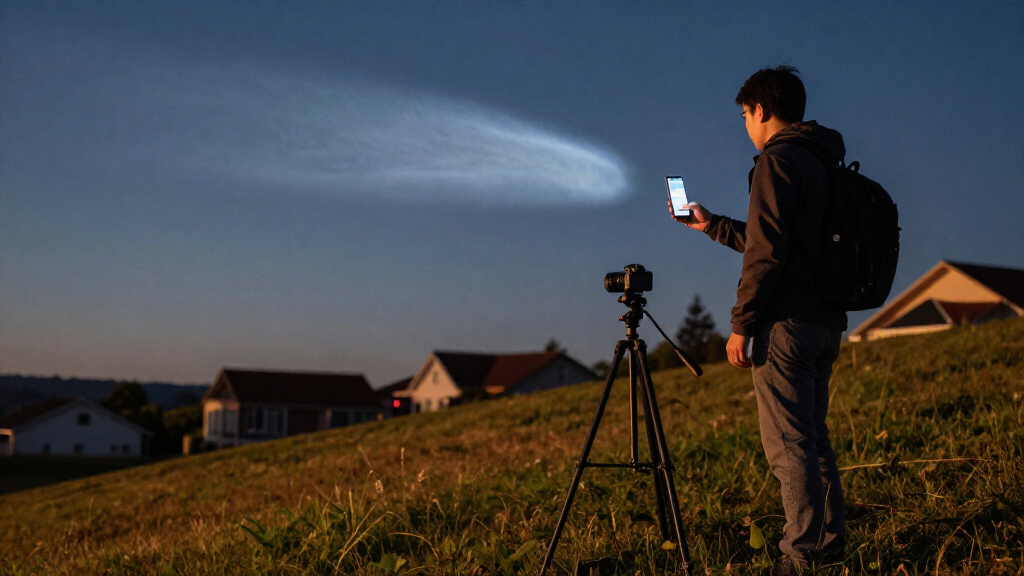
Noctilucent clouds are real, high-altitude ice clouds that can remain sunlit after the surface observer has entered darkness. The exhibit locates its imagined cloud band at about 83 kilometres altitude and uses the contrast between illuminated ice and a dark lower sky as its guiding image. The supplied source describes ice crystals and seasonal observation as parts of the page’s editorial journey, but it does not provide a research paper, observation dataset or scientific validation for the experience.
The project is identified as room 162 of 175 in a broader series of AI-built exhibition pieces. Its accompanying construction guide reportedly describes a three-pass process: build the page, critique it for clarity and interaction, and then review it as an art-directed experience. The source also describes visibility-aware animation, which pauses when the browser tab is hidden, and a reduced-motion state for visitors who prefer less movement.
The brief behind the exhibit calls for a fictional observer network, invented station logs and a specific visual style, including electric-blue clouds, twilight colors and a paper-like log section. Those details are creative choices. They should not be read as the records or branding of an actual scientific program.
astronomy telescope for noctilucent clouds
As an affiliate, we earn on qualifying purchases.
As an affiliate, we earn on qualifying purchases.
Limits of the Cloud Simulation
The supplied material does not identify the exhibit’s publication date, provide a live page capture or state whether the described page remains available. It also supplies no independent technical review, user testing results or scientific assessment of the lighting model. The dial’s visual response should therefore be understood as an illustration described by the project, not a calibrated atmospheric forecast.
The source gives no live observations, verified station locations or evidence that the fictional network collects data. It does not specify a particular scientific dataset or explain how the exhibit’s selected twilight range relates to viewing conditions across locations and dates. The real-world visibility of noctilucent clouds depends on observation circumstances; this page’s described interaction alone cannot confirm that a sighting is occurring.
skywatching accessories for astrophotography
As an affiliate, we earn on qualifying purchases.
As an affiliate, we earn on qualifying purchases.
Where the Project Goes Next
The source points readers to the exhibit’s design guide for details about its lighting model, procedural graphics, animation behavior and reduced-motion handling. It does not announce a launch schedule, scientific partnership, data feed or future development plan. The next verifiable step for readers is to inspect the live page and its guide, if available, and distinguish the interactive demonstration from any independently sourced cloud observations.
Any future claims that the project has become a real observing service, or that its visual model has been validated for scientific use, would require separate confirmation. For now, the material presents a fictional exhibit about a real atmospheric phenomenon.
As an affiliate, we earn on qualifying purchases.
Key Questions
Is NLC Watch a real observing service?
No. The source explicitly describes it as a fictional field journal and observing project, not a real company or live scientific service.
Are noctilucent clouds real?
Yes. The source describes them as high-altitude ice clouds that can remain sunlit after the ground below has become dark.
What does the twilight dial do?
It shifts the exhibit’s simulated solar depression from six to 16 degrees below the horizon, changing connected elements such as sky brightness, shadows and cloud glow. It is an interactive illustration, not a measurement instrument.
Does the exhibit report current sightings?
The supplied material describes invented stations and logs and says the project is not a live scientific service. It provides no verified current sightings or observation feed.
Source: ThorstenMeyerAI.com
Halloween Picks
halloween
As an affiliate, we earn on qualifying purchases.