An emergency communication kit for natural disasters should keep weather updates and basic radio access available when power and mobile networks fail. My best overall pick is the Midland ER310PRO for shoppers who want a dedicated portable weather radio, while the Mesqool 12000mAh and FosPower A1 stand out for substantial backup capacity and a balanced mix of charging methods, respectively. The main tradeoff is between battery reserve, charging flexibility, portability, and ease of use; no single radio excels at all four. Alert features and power claims also matter only if the device is charged, configured, and able to receive a usable signal. Read on for how the 11 options differ and which type of kit may fit your disaster plan.

Get the latest gadgets delivered free with Prime
- Fast, free delivery on millions of items
- Prime Video, Amazon Music and more included
- Member-only deals all year
Complete the kit



Key Takeaways
The lineup splits between dedicated radio use and battery-as-backup use. The Midland ER310PRO is the clearest pick for shoppers prioritizing a portable weather radio, while higher-capacity models such as the Mesqool and 10000mAh options also appeal to people who want reserve power for compatible devices.
Multiple charging methods reduce dependence on one power source. Solar and hand-crank options appear across much of the lineup, but they are contingency methods rather than a replacement for charging the radio before an outage.
Battery capacity is not the same as communication reliability. A larger stated capacity may help with device charging, but signal reception, alert setup, battery condition, and access to the right broadcast matter just as much.
Simple feature sets can suit occasional users better. Compact radios with a flashlight and SOS alarm may be easier to store and operate, while buyers who need broader functionality should compare power sources and alert controls before choosing.
The best choice depends on the job you need it to do. A household power reserve, a portable weather-alert radio, and a basic emergency light-and-radio kit are different priorities; the products in this roundup do not serve them equally well.
| Hand Crank Radio with LED Flashlight, 2000mAh NOAA AM FM Emergency Radio |  | Best Compact Pick | Battery capacity: 2000mAh | Power sources: Hand crank, solar panel, built-in rechargeable battery | Radio bands: AM, FM, NOAA | VIEW ON AMAZON | See Our Full Breakdown |
| Mesqool Emergency Weather Radio NOAA Alert with Battery Backup 12000mAh |  | Best for Extended Outages | Battery capacity: 12000mAh lithium-polymer battery | Power sources: Solar panel, hand crank, battery, Type-C input | Radio bands: NOAA, FM, AM | VIEW ON AMAZON | See Our Full Breakdown |
| LiebeWH Hand Crank NOAA Weather Radio with Solar Charging, 2000mAh Battery, LED Light and SOS Alarm |  | Best for SOS Signaling | Battery capacity: 2000mAh | Charging methods: Hand crank, solar, USB-C | Radio bands: AM 520–1710 kHz, FM 87–108 MHz, weather band 162.400–162.550 MHz | VIEW ON AMAZON | See Our Full Breakdown |
| FosPower NOAA Emergency Weather Radio A1 – 7400mWh Solar Hand Crank (Orange) |  | Best for Battery Flexibility | Power bank capacity: 7400mWh (2000mAh) | Power sources: Solar, hand crank, four AAA batteries | Radio bands: AM, FM, weather band | VIEW ON AMAZON | See Our Full Breakdown |
| Emergency Radio with Hand Crank & Solar, NOAA Weather Band, AM/FM, 12000mAh |  | Best Weather-Ready Feature Set | Battery capacity: 12000mAh | Power sources: Solar panel, hand crank, USB-C, three AAA batteries | Solar panel: 8500mm² monocrystalline | VIEW ON AMAZON | See Our Full Breakdown |
| Midland ER310PRO Portable Emergency Bluetooth Weather AM/FM Radio |  | Best for Phone Backup and Everyday Use | Power bank capacity: 10,000 mAh | Battery type: Lithium polymer | Power sources: Solar, hand crank, battery | VIEW ON AMAZON | See Our Full Breakdown |
| Kaito KA500 Emergency Radio with Solar, Hand Crank, and NOAA Weather Alerts |  | Best for Broad Radio Coverage | Power sources: Solar, hand crank, 3 AA batteries, USB, AC/DC adapter | Radio bands: AM, FM, shortwave, NOAA weather | Antenna: Telescopic, extends up to 14.5 inches | VIEW ON AMAZON | See Our Full Breakdown |
| Emgykit Hand Crank Radio with AM/FM/NOAA Weather Band, Emergency Portable Radio with LED Flashlight and SOS Alarm |  | Best Compact Pick | Dimensions: 5.1 x 2.1 x 2.4 inches | Weight: 0.51 lb | Battery capacity: 2,000 mAh | VIEW ON AMAZON | See Our Full Breakdown |
| Emergency NOAA Weather Radio with 10000mAh Battery, Solar and Hand Crank Power, AM/FM/NOAA |  | Best for Outage Readiness | Battery capacity: 10,000 mAh | Battery type: Lithium rechargeable; replaceable internal battery | Power sources: Solar, hand crank, USB Type-C, backup batteries | VIEW ON AMAZON | See Our Full Breakdown |
| Eoxsmile Emergency Radio with NOAA Weather Alert, Solar Hand Crank Portable |  | Best for Multi-Band Listening and Camp Lighting | Battery capacity: 5,000 mAh | Power sources: Solar, hand crank, 3 AAA batteries, USB | Radio bands: NOAA weather, AM, FM, shortwave | VIEW ON AMAZON | See Our Full Breakdown |
| Emergency Radio with Flashlight & Reading Lamp, NOAA/AM/FM Weather Radio |  | Best for Lighting and Backup Charging | Battery capacity: 14800mWh (4000mAh) | Power sources: Micro USB, solar, hand crank, built-in battery | Radio bands: AM, FM, NOAA | VIEW ON AMAZON | See Our Full Breakdown |
| emergency communication kit for natural disaster | Radio bands | Power sources | Battery capacity | Dimensions |
|---|---|---|---|---|
| Hand Crank Radio with LED Flas | AM, FM, NOAA | Hand crank, solar panel, built-in rechargeable battery | 2000mAh | 5 × 1.8 × 2.4 inches |
| Mesqool Emergency Weather Radi | NOAA, FM, AM | Solar panel, hand crank, battery, Type-C input | 12000mAh lithium-polymer battery | 6.8 × 2.9 × 4.7 inches |
| LiebeWH Hand Crank NOAA Weathe | AM 520–1710 kHz, FM 87–108 MHz, weather band 162.400–162.550 MHz | — | 2000mAh | Approximately 5.12 × 2.36 × 1.97 inches |
| FosPower NOAA Emergency Weathe | AM, FM, weather band | Solar, hand crank, four AAA batteries | — | — |
| Emergency Radio with Hand Cran | Seven NOAA weather bands, AM, FM | Solar panel, hand crank, USB-C, three AAA batteries | 12000mAh | 6.81 × 2.91 × 4.76 inches |
| Midland ER310PRO Portable Emer | AM, FM, weather | Solar, hand crank, battery | — | 8.1 x 2.8 x 3.4 inches |
| Kaito KA500 Emergency Radio wi | AM, FM, shortwave, NOAA weather | Solar, hand crank, 3 AA batteries, USB, AC/DC adapter | — | — |
| Emgykit Hand Crank Radio with | AM, FM, NOAA weather | Hand crank, solar, Type-C | 2,000 mAh | 5.1 x 2.1 x 2.4 inches |
| Emergency NOAA Weather Radio w | AM 520–1710 kHz, FM 87.5–108 MHz, weather band 162.4–162.55 MHz | Solar, hand crank, USB Type-C, backup batteries | 10,000 mAh | 7.5 x 3.7 x 2.3 inches |
| Eoxsmile Emergency Radio with | NOAA weather, AM, FM, shortwave | Solar, hand crank, 3 AAA batteries, USB | 5,000 mAh | — |
| Emergency Radio with Flashligh | AM, FM, NOAA | Micro USB, solar, hand crank, built-in battery | 14800mWh (4000mAh) | — |
More Details on Our Top Picks
Hand Crank Radio with LED Flashlight, 2000mAh NOAA AM FM Emergency Radio
For a go-bag where space and weight matter, this radio stands out for its 0.5-pound body and three ways to restore power: hand crank, solar, or its built-in battery. It receives AM, FM, and NOAA broadcasts, giving you access to weather information without relying on mobile service. The 2000mAh battery can provide a limited phone charge, but it is better treated as a backup than a substitute for a dedicated power bank. Compared with the Mesqool Emergency Weather Radio, this model is much easier to pack, while Mesqool’s 12000mAh battery is better suited to longer outages. Its tradeoff is modest capacity and only water-repellent protection, so I would keep it sheltered from heavy rain and plan on manual or solar charging when power is unavailable.
Pros:- Compact 0.5-pound design is easy to stow in a go-bag.
- Hand-crank, solar, and rechargeable power offer alternatives when outlets are unavailable.
- Receives AM, FM, and NOAA broadcasts.
- Built-in LED flashlight and USB output add basic lighting and backup charging.
Cons:- The 2000mAh battery offers limited capacity for charging a phone.
- Water-repellent protection is not a substitute for waterproofing.
- Manual cranking or sunlight may be needed to replenish power during an extended outage.
Best for: Hikers and households building a lightweight go-bag who mainly need weather broadcasts, a flashlight, and a small emergency phone boost.
Not ideal for: People preparing for a prolonged outage who need a larger phone-charging reserve or a radio they can use in heavy rain.
- Battery capacity:2000mAh
- Power sources:Hand crank, solar panel, built-in rechargeable battery
- Radio bands:AM, FM, NOAA
- Dimensions:5 × 1.8 × 2.4 inches
- Weight:0.5 lb
- Flashlight:1W LED
- Maximum output power:3 watts
- Water resistance:Water repellent
Our verdict“Choose this compact radio when portability and broadcast access matter more than extended battery capacity.”
Mesqool Emergency Weather Radio NOAA Alert with Battery Backup 12000mAh
When the priority is staying informed through a long power cut, the Mesqool’s main advantage is its 12000mAh battery, backed by solar charging and a hand crank. That capacity gives it a stronger role as a household communication hub than the Hand Crank Radio with LED Flashlight, whose smaller 2000mAh battery is easier to carry but offers less charging reserve. Mesqool also combines NOAA, AM, and FM reception with a flashlight and adjustable reading light, so it can support updates and basic indoor visibility from one device. The tradeoff is portability: at 1.6 pounds and nearly seven inches long, it is less suited to a minimalist kit. I would also charge it before storing it, as the product description recommends a full initial charge for best performance.
Pros:- 12000mAh battery provides more backup capacity than the compact 2000mAh options in this lineup.
- Solar, hand-crank, and Type-C charging provide several ways to replenish power.
- NOAA, AM, and FM reception supports weather alerts and general broadcasts.
- Flashlight and adjustable reading light serve different lighting needs.
Cons:- At 1.6 pounds, it takes more space and weight in a portable emergency kit.
- The product calls for a full charge before first use.
- The listed water-resistance details do not specify a protection rating.
Best for: Households that want a higher-capacity emergency radio for a home shelter or extended outage, with lighting and backup phone charging in one unit.
Not ideal for: Ultralight hikers and people with very limited kit space who would prefer a smaller radio like the Hand Crank Radio with LED Flashlight.
- Battery capacity:12000mAh lithium-polymer battery
- Power sources:Solar panel, hand crank, battery, Type-C input
- Radio bands:NOAA, FM, AM
- Frequency:162.4 MHz
- Dimensions:6.8 × 2.9 × 4.7 inches
- Weight:1.6 lb
- Maximum output power:5 watts
- Type-C input:5V/2A
Our verdict“Pick the Mesqool for a home-focused emergency kit where battery reserve matters more than carrying weight.”
LiebeWH Hand Crank NOAA Weather Radio with Solar Charging, 2000mAh Battery, LED Light and SOS Alarm
The LiebeWH earns a distinct place for pairing NOAA, AM, and FM reception with an SOS alarm in a compact, 8.1-ounce body. In a disaster kit, that alarm adds a way to call attention to your location if speaking or reaching help is difficult; it is a different emphasis from the Hand Crank Radio with LED Flashlight, which lists a 1W flashlight but no SOS alarm. USB-C joins hand-crank and solar charging, giving you a wired option before an outage and two alternatives off-grid. Its 2000mAh battery is still small, so I would not choose it for frequent phone charging; the Mesqool’s larger battery is a better fit for that job. The IPX3 rating means splash protection, not submersion or dependable shelter in driving rain.
Pros:- SOS alarm adds an audible signaling option beyond radio reception and lighting.
- Hand-crank, solar, and USB-C charging give several power paths.
- Receives NOAA weather band as well as AM and FM broadcasts.
- Compact 8.1-ounce weight suits portable kits.
Cons:- The 2000mAh battery limits its usefulness as a phone-charging source.
- IPX3 splash protection does not protect against immersion or heavy water exposure.
- The listed 850mA output current is modest for charging external devices.
Best for: Campers and emergency-kit builders who want a lightweight NOAA radio with an SOS alarm and multiple charging methods.
Not ideal for: Buyers who need a large phone-charging reserve or protection for use in heavy rain, since the battery is 2000mAh and water protection is limited to IPX3.
- Battery capacity:2000mAh
- Charging methods:Hand crank, solar, USB-C
- Radio bands:AM 520–1710 kHz, FM 87–108 MHz, weather band 162.400–162.550 MHz
- Output current:850mA
- Maximum power:3W
- Water resistance:IPX3
- Dimensions:Approximately 5.12 × 2.36 × 1.97 inches
- Weight:Approximately 8.1 oz
Our verdict“Choose the LiebeWH if a portable SOS alarm matters more than high-capacity device charging or stronger water protection.”
FosPower NOAA Emergency Weather Radio A1 – 7400mWh Solar Hand Crank (Orange)
The FosPower A1 stands apart for offering AAA batteries alongside solar and hand-crank power. That gives me a practical option for keeping a radio ready with replaceable cells, rather than depending only on a rechargeable battery that may be depleted when an outage starts. It covers AM, FM, and weather broadcasts, with a flashlight and reading lights for basic nighttime use. Compared with the LiebeWH Hand Crank NOAA Weather Radio, the A1 trades USB-C charging for the flexibility of AAA cells; the LiebeWH is lighter and lists an SOS alarm, while the FosPower provides more varied backup power choices. Its 7400mWh (2000mAh) power bank is limited for prolonged phone charging, and the product does not specify charging speed. The stated water resistance also should not be read as protection against heavy rain.
Pros:- Solar, hand crank, and four AAA batteries provide varied ways to power the radio.
- Receives AM, FM, and weather-band broadcasts.
- Includes a flashlight and reading lights for basic emergency illumination.
- 7400mWh power bank provides a built-in rechargeable reserve.
Cons:- The listed 2000mAh capacity is limited for extended phone charging.
- The product does not specify smartphone charging speed.
- Water resistance is not described with a rating for judging exposure to heavy rain.
Best for: Preparedness-minded households that keep spare AAA batteries and want an emergency radio with both replaceable-cell and renewable charging options.
Not ideal for: People who need substantial phone-charging capacity, USB-C input, or clearly specified protection from heavy rain.
- Power bank capacity:7400mWh (2000mAh)
- Power sources:Solar, hand crank, four AAA batteries
- Radio bands:AM, FM, weather band
- Output power:2 watts
- Batteries:Four AAA batteries required
- Connectivity:USB-C
- Display:Tuner
- Water resistance:Water resistant; no rating specified
Our verdict“Choose the FosPower A1 if you value replaceable AAA backup power more than a large battery or modern charging details.”
Emergency Radio with Hand Crank & Solar, NOAA Weather Band, AM/FM, 12000mAh
This model combines a 12000mAh battery with an IPX6 water-resistance rating, making it the strongest choice here for buyers who want substantial backup capacity and more defined weather protection. Its solar panel, hand crank, USB-C, and three AAA batteries offer several power routes, while the flashlight, reading lamp, and SOS alarm cover basic communication-support tasks around a shelter. Compared with the Mesqool Emergency Weather Radio, it lists the same battery capacity and a similarly hefty 1.6-pound weight, but adds an IPX6 rating and AAA battery support. The tradeoff is that NOAA stations require manual tuning, so getting the right channel may take attention during a fast-moving alert. Its bulk also makes it less appealing for a small go-bag than the 0.5-pound compact radio.
Pros:- 12000mAh battery offers substantial backup capacity for a radio in this lineup.
- IPX6 water-resistance rating gives clearer guidance for wet-weather use than unrated models.
- Solar, hand crank, USB-C, and three AAA batteries provide multiple power options.
- Includes a flashlight, reading lamp, and SOS alarm.
Cons:- NOAA stations require manual tuning.
- At 1.6 pounds, it is bulky for a lightweight go-bag.
- Three AAA batteries add another battery format to keep track of.
Best for: Households preparing for storms or flooding who want a high-capacity radio, several backup power options, and a stated IPX6 water-resistance rating.
Not ideal for: Minimalist hikers and buyers who want quick, automatic access to NOAA stations rather than manual tuning.
- Battery capacity:12000mAh
- Power sources:Solar panel, hand crank, USB-C, three AAA batteries
- Solar panel:8500mm² monocrystalline
- Radio bands:Seven NOAA weather bands, AM, FM
- Water resistance:IPX6
- Dimensions:6.81 × 2.91 × 4.76 inches
- Weight:1.6 lb
- Speaker output:5W
Our verdict“Pick this model for a storm-focused home kit if IPX6 protection and multiple backup power options outweigh easy portability and automatic station access.”
Midland ER310PRO Portable Emergency Bluetooth Weather AM/FM Radio
The ER310PRO earns this spot by pairing NOAA weather alerts with a 10,000 mAh power bank and Bluetooth audio. During an outage, that capacity gives it a clearer phone-charging role than the Emgykit’s 2,000 mAh battery, while Bluetooth makes it useful beyond emergency broadcasts. Solar and hand-crank charging add options if mains power is unavailable, though the supplied details do not say how quickly either method replenishes the battery.
The tradeoff is size: at 8.1 inches long, it is less convenient to pack than the compact Emgykit. Its listed bands cover AM, FM, and weather broadcasts, not the Kaito KA500’s shortwave, so I’d choose the Kaito for broader radio listening. The Midland is the better fit when phone backup and familiar Bluetooth use matter more than shortwave coverage or a smaller pack footprint.
Pros:- 10,000 mAh power bank capacity can provide a useful phone-charging reserve during outages.
- Solar and hand-crank options add ways to keep the radio supplied when grid power is unavailable.
- NOAA weather scan and alert support storm updates.
- Bluetooth streaming adds everyday listening utility beyond emergency broadcasts.
Cons:- Its 8.1-inch length makes it less packable than the Emgykit.
- It does not list shortwave reception, unlike the Kaito KA500.
- The supplied details do not specify battery runtime or charging rates for solar and hand-crank use.
Best for: Households that want a weather radio with a substantial phone-charging reserve and Bluetooth for everyday listening.
Not ideal for: Backpackers prioritizing low weight or buyers who want shortwave reception; the radio is relatively large and lists only AM, FM, and weather bands.
- Power bank capacity:10,000 mAh
- Battery type:Lithium polymer
- Power sources:Solar, hand crank, battery
- Radio bands:AM, FM, weather
- Connectivity:Bluetooth
- Flashlight:Built in
- Emergency features:SOS flashlight beacon, rescue dog siren, NOAA weather scan and alert
- Dimensions:8.1 x 2.8 x 3.4 inches
Our verdict“Choose the ER310PRO if you want a weather radio that can also serve as a high-capacity phone backup and Bluetooth speaker.”
Kaito KA500 Emergency Radio with Solar, Hand Crank, and NOAA Weather Alerts
The KA500 is the lineup’s strongest choice for listeners who want more than local AM/FM and weather broadcasts: it adds shortwave reception and a 14.5-inch telescopic antenna. That broader band selection distinguishes it from the Midland ER310PRO, which adds Bluetooth and a larger stated power-bank capacity but omits shortwave. For a disaster kit, the KA500’s NOAA channels, signal-strength indicator, and multiple power options make it easier to seek available broadcasts when conditions disrupt normal communication.
Its flashlight, reading lamp, and SOS beacon also cover several basic camp and outage needs. The tradeoff is a more involved power setup: three AA batteries are not included, and the AC/DC adapter is sold separately. It also lacks a stated battery capacity, so buyers who prioritize a defined phone-charging reserve may prefer the Midland. I’d pick the Kaito for listening range, not compactness or the simplest charging arrangement.
Pros:- Shortwave joins AM, FM, and NOAA weather channels for broader broadcast options.
- Solar, hand crank, USB, AC/DC adapter, and AA battery options offer flexibility.
- Reading lamp, flashlight, and SOS beacon serve multiple needs during an outage.
- Telescopic antenna extends up to 14.5 inches, and a signal-strength indicator helps with reception setup.
Cons:- Three AA batteries are required but not included.
- The AC/DC adapter is sold separately.
- The product data gives no battery-capacity figure, making phone-charging reserves harder to judge.
Best for: Preparedness-minded listeners who want NOAA alerts plus shortwave coverage and several ways to power the radio.
Not ideal for: Buyers who need a clearly specified high-capacity phone backup or a compact radio; the AA cells and wall adapter are separate, and the unit may feel bulky.
- Power sources:Solar, hand crank, 3 AA batteries, USB, AC/DC adapter
- Radio bands:AM, FM, shortwave, NOAA weather
- Antenna:Telescopic, extends up to 14.5 inches
- Device charging output:5V USB port
- Emergency lighting:LED flashlight and reading lamp
- Emergency signal:S.O.S. beacon
- Housing:Impact-resistant, water-resistant ABS
- Battery requirement:3 AA batteries; not included
Our verdict“Choose the KA500 if shortwave coverage and multiple radio-power options matter more than Bluetooth or a stated large power bank.”
Emgykit Hand Crank Radio with AM/FM/NOAA Weather Band, Emergency Portable Radio with LED Flashlight and SOS Alarm
At 0.51 pounds and 5.1 inches long, the Emgykit is the most packable option among these five. Its hand crank, solar panel, and Type-C charging give a small emergency kit several ways to power the radio, while the 140-lumen flashlight supplies useful light without a separate lamp. Compared with the larger Midland ER310PRO, it gives up the Midland’s 10,000 mAh power bank and Bluetooth, but takes less space in a go-bag.
The compromise is endurance. Its built-in battery is only 2,000 mAh, so I would treat its device-charging feature as a limited backup rather than a way to keep a phone running for an extended outage. It also lacks stated water resistance, unlike the Kaito KA500’s described water-resistant housing. This is a focused choice for portable weather updates and basic light, not a full-featured communications hub.
Pros:- Compact 5.1-inch body and 0.51-pound weight suit a small emergency bag.
- Hand crank, solar, and Type-C charging provide several ways to replenish power.
- 140-lumen flashlight offers a defined brightness level for outage lighting.
- SOS alarm adds a way to signal for help.
Cons:- The 2,000 mAh battery offers a modest reserve compared with the Midland ER310PRO.
- No water-resistance rating is provided.
- It lists basic AM/FM/NOAA functions rather than the Kaito KA500’s shortwave coverage.
Best for: Go-bag builders and day hikers who want a lightweight radio with weather reception, emergency light, and several charging methods.
Not ideal for: Households expecting prolonged outages or frequent phone charging; the 2,000 mAh battery is much smaller than the Midland ER310PRO’s stated capacity.
- Dimensions:5.1 x 2.1 x 2.4 inches
- Weight:0.51 lb
- Battery capacity:2,000 mAh
- Power sources:Hand crank, solar, Type-C
- Radio bands:AM, FM, NOAA weather
- Flashlight brightness:140 lumens
- LED configuration:3 LED beads, 3W
- Emergency signal:SOS alarm
Our verdict“Choose the Emgykit when low weight and compact storage matter more than long-lasting phone charging or expanded radio bands.”
Emergency NOAA Weather Radio with 10000mAh Battery, Solar and Hand Crank Power, AM/FM/NOAA
This radio is a practical outage-focused pick because it pairs a stated 10,000 mAh rechargeable battery with replaceable-battery backup and solar, hand-crank, and USB Type-C charging. That layered power approach gives it an edge over the Emgykit’s smaller 2,000 mAh cell for households preparing to keep a radio running and provide some phone charging. It also includes NOAA alerts, a warning light, a high-lumen flashlight, and a headphone jack for private listening when quiet matters.
The tradeoff is simpler audio and connectivity: the radio is mono and has no Wi-Fi or Bluetooth, unlike the Midland ER310PRO’s Bluetooth feature. The product data also conflicts on backup cells, listing both 3x AA and 3 AAA in its power details; I would confirm the required size before relying on that backup. Its listed dimensions are smaller in length than the Midland’s, though it is wider.
Pros:- 10,000 mAh rechargeable battery provides a substantial stated reserve.
- Solar, hand crank, USB Type-C, and replaceable-cell backup offer multiple power routes.
- NOAA alerts, warning light, and flashlight support storm preparedness.
- Headphone jack allows private listening.
Cons:- Mono audio and no Bluetooth or Wi-Fi limit entertainment and wireless connectivity.
- The product data conflicts on whether backup cells are 3 AA or 3 AAA.
- The provided details do not specify the flashlight brightness or battery runtime.
Best for: Households building a blackout kit that prioritize a large stated battery, multiple charging routes, and private weather-radio listening.
Not ideal for: Buyers who want Bluetooth, stereo listening, or unambiguous backup-battery instructions; it is mono and the listed AA/AAA details conflict.
- Battery capacity:10,000 mAh
- Battery type:Lithium rechargeable; replaceable internal battery
- Power sources:Solar, hand crank, USB Type-C, backup batteries
- Radio bands:AM 520–1710 kHz, FM 87.5–108 MHz, weather band 162.4–162.55 MHz
- Maximum output power:5W
- Audio output:Mono; headphone jack
- Dimensions:7.5 x 3.7 x 2.3 inches
- Warranty:2 years
Our verdict“Choose this radio for a blackout kit centered on battery capacity and backup power options, provided you verify the required spare-cell size.”
Eoxsmile Emergency Radio with NOAA Weather Alert, Solar Hand Crank Portable
The Eoxsmile stands apart with AM, FM, shortwave, and NOAA weather reception, plus both a flashlight and an adjustable reading lamp. That makes it a stronger fit for a campsite or household that wants more listening choices and area lighting than the compact Emgykit provides. Its 5,000 mAh rechargeable battery sits between the Emgykit’s 2,000 mAh and the 10,000 mAh capacities listed for the Midland ER310PRO and the other emergency radio in this group.
Solar, hand-crank, USB, and optional AAA power give it several supply routes, and the product data lists up to 13 hours of FM runtime. That figure helps set expectations, though use of the lights or phone-charging port may change runtime. The tradeoffs are that the AAA cells and power plug are not included, and it is less compact than the Emgykit. I’d choose it for mixed radio and lighting needs, not maximum battery reserve.
Pros:- Shortwave reception adds listening options beyond AM, FM, and NOAA weather.
- A 3W flashlight and adjustable-brightness reading lamp cover different lighting tasks.
- Solar, hand crank, USB, and AAA battery options provide flexible power.
- Product data lists up to 13 hours of FM radio runtime.
Cons:- Three AAA batteries and the power plug are not included.
- Its 5,000 mAh battery is smaller than the 10,000 mAh capacities listed for the Midland and B0GTNLV6CK radio.
- The supplied details do not state whether the housing is water-resistant.
Best for: Campers and households who want shortwave alongside NOAA updates, plus separate flashlight and reading-lamp lighting.
Not ideal for: Buyers who need the longest stated battery reserve or a ready-to-use wall-charging setup; the listed capacity is 5,000 mAh and the power plug is not included.
- Battery capacity:5,000 mAh
- Power sources:Solar, hand crank, 3 AAA batteries, USB
- Radio bands:NOAA weather, AM, FM, shortwave
- Frequency range:AM 520–1710 kHz, FM 88–108 MHz, shortwave 7–19 MHz
- FM runtime:Up to 13 hours
- Flashlight:3W LED
- Reading lamp:2.5W, two adjustable brightness settings
- Additional features:Compass, hand strap, USB phone-charging port
Our verdict“Choose the Eoxsmile if shortwave reception and two types of built-in lighting matter more than a maximum-capacity battery.”
Emergency Radio with Flashlight & Reading Lamp, NOAA/AM/FM Weather Radio
I’d choose this model when an outage plan needs to cover both weather updates and basic phone backup. Its 4,000mAh battery is larger than the 2,000mAh capacity listed for the LiebeWH Hand Crank NOAA Weather Radio, while solar, hand-crank, and Micro USB charging offer several ways to replenish it when one source is unavailable. NOAA alerts address the core communication need; the added flashlight and reading lamp make the radio more useful during a power cut after the alert arrives.
The tradeoff is its 1-watt maximum output, which is better suited to personal or small-group listening than broadcasting updates across a crowded shelter. The description also calls for batteries, though the listed power options and included lithium-polymer batteries make the exact replacement routine unclear. I’d favor this over simpler, lower-capacity crank radios for a household that values lighting and phone charging, but not for buyers who need loud audio for a large group.
Pros:- NOAA weather alerts provide a direct source of emergency information.
- Solar, hand-crank, and Micro USB charging offer alternatives when grid power is unavailable.
- The 4,000mAh battery can serve as backup power for a smartphone.
- A flashlight and reading lamp support movement and reading in dark conditions.
Cons:- The 1-watt maximum output may be too quiet for large groups.
- The description says batteries are required, but does not clarify replacement expectations alongside the built-in charging options.
Best for: Households preparing for outages who want NOAA alerts, multiple charging methods, a built-in reading light, and backup phone charging in one portable radio.
Not ideal for: Large households or group coordinators who need high-volume audio to share alerts across a crowded room, or buyers seeking a device with clearly specified battery replacement requirements.
- Battery capacity:14800mWh (4000mAh)
- Power sources:Micro USB, solar, hand crank, built-in battery
- Radio bands:AM, FM, NOAA
- Maximum output power:1 watt
- Batteries:2 lithium-polymer batteries included
- Water resistance:Water resistant
- Enclosure material:ABS
- Display:LCD
Our verdict“Choose it for a household emergency kit that needs flexible charging and useful lighting, but pick a louder radio for group listening.”
How We Picked
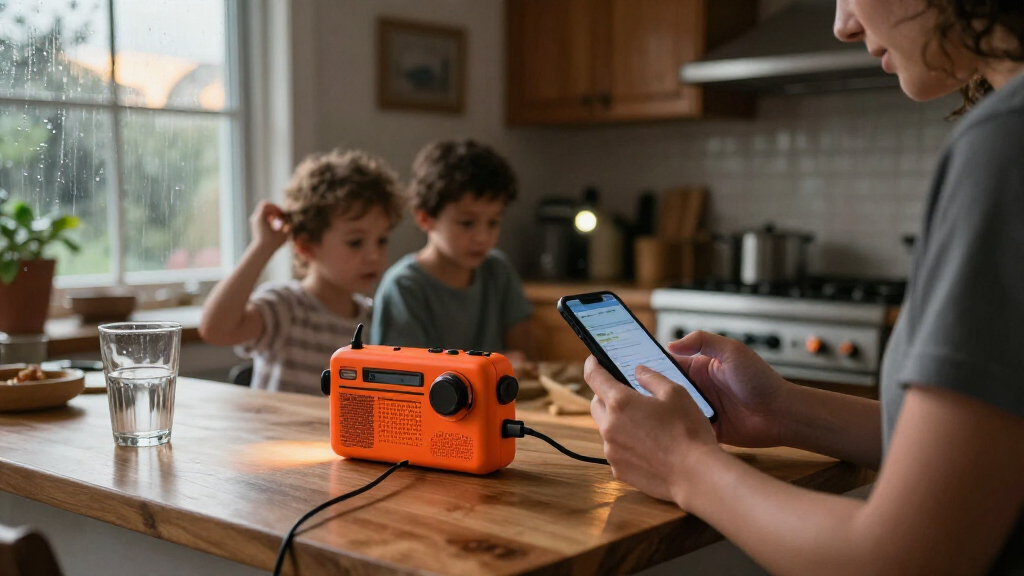
I ranked these 11 radios by how well their stated features support communication during a natural disaster: access to NOAA and AM/FM broadcasts, alert capability, backup power, and practical controls. I also weighed the variety of power sources, stated battery capacity where provided, lighting and SOS functions, portability cues, and whether the product description makes its intended role clear. These factors help distinguish a radio intended mainly for weather updates from one that also emphasizes charging other devices or providing light.
The order reflects those differences rather than treating every extra feature as equally useful. Models with a clearer balance of radio functions and backup-power options rank ahead of products whose descriptions provide fewer details or emphasize a narrower set of functions. Product names and listed specifications alone cannot confirm reception quality, runtime, charging speed, alert performance, or durability; I treat those as items for buyers to verify in the manual and through independent information. I also favor choices that can complement a broader household plan, not stand in for one.
Factors to Consider When Choosing Emergency Communication Kit For Natural Disasters
Choosing a disaster radio is less about collecting the most functions and more about matching the device to the way your household will use it. I would decide what information you need, how you will power the radio after an outage, and who must be able to operate it before comparing extras.
Choose the Information You Need to Receive
Start by identifying which broadcasts matter where you live: NOAA weather alerts, local AM/FM stations, or both. A radio that lists NOAA reception still depends on being within range of a usable signal, so check local coverage and identify the stations you would tune to before an emergency. Alert functions can be helpful when nobody is actively listening, but they need correct setup and a suitable signal to serve that purpose. Do not assume a siren or SOS alarm contacts emergency services; on many devices it is a nearby attention signal, not a call for help. If your household has limited hearing, vision, or dexterity, assess the alert style, screen, controls, and instructions as carefully as the band list. Prioritize the information path you can actually use over a long feature list.
Plan for Power Before You Need It
Hand cranks and small solar panels are backup methods, not effortless substitutes for wall charging or fresh batteries. Cranking can take time and physical effort, while indoor solar charging may be slow or ineffective; weather and storage location can also limit sunlight. Treat a built-in battery capacity as one part of the power plan, and check the manual for runtime, charging input, and whether the radio can charge a phone while receiving broadcasts. That last detail can affect how much energy remains for listening. Keep the radio charged, store any required spare batteries properly, and periodically check that the charging cable and ports are in working condition. A realistic plan layers stored power with a manual backup rather than relying on a single method.
Separate Radio Backup From Phone-Charging Needs
A radio advertised with a large battery may offer a useful reserve for a phone, but that does not make it a full substitute for a power bank. Check which devices and charging standards it supports, how many charges the manufacturer claims under stated conditions, and whether using the output reduces radio runtime. Phone charging is most valuable for short, essential tasks such as contacting family or checking official updates, not continuous use. If several people will share one device, a separate power bank may make the kit easier to manage. Avoid choosing by milliamp-hour figures alone: capacity figures do not tell you how much energy reaches a connected phone or how quickly it arrives. Match the radio’s output to the devices your household actually carries.
Match Size and Controls to the People Using It
A device kept in a central emergency cupboard can be larger than one intended for an evacuation bag. Think about who will tune stations, change modes, connect a charging cable, and operate the crank; small or unfamiliar controls can slow down a stressed user. A flashlight or reading lamp can reduce the need to find a separate light, but it may add bulk and compete for battery power. If multiple household members may need the radio, practice turning it on, finding a station, and checking the alert settings before storing it. Simple controls may be a better fit for occasional users than features that require setup or repeated mode changes. For evacuation, check the actual dimensions and carry weight rather than assuming that a product labeled portable will suit every bag.
Build a Kit Around the Radio, Not Around Its Marketing
A radio covers only part of emergency communication: it can receive broadcasts, while contacting family or emergency services usually requires another working device and a viable network. Pair it with a printed contact list, a written meeting plan, spare charging cables, and any batteries the manual calls for. Keep a battery-powered flashlight and a whistle available even if the radio has a light and SOS alarm, since those functions may fail when the radio battery is depleted. Store instructions with the kit and note local broadcast frequencies so nobody has to search for them during an outage. A common mistake is buying the radio and leaving it uncharged, unconfigured, or inaccessible. A small, maintained kit is more useful than an elaborate one with untested parts.
Check the Details Behind Alert and Durability Claims
Before buying, confirm what kind of weather alert the device supports, whether alerts can be configured for your location, and how it signals a warning. Product names may use similar terms while the actual controls and alert behavior differ. Read the manual for water resistance, impact guidance, operating temperature, and charging limitations; do not infer ruggedness from an emergency label or bright casing. Also check warranty support and whether the manufacturer makes replacement cables or instructions available. If you live in a flood- or storm-prone area, storage in a dry, accessible container may matter as much as the radio’s body design. The goal is a device whose limits are clear before conditions turn difficult.
Frequently Asked Questions
Can an emergency radio replace my phone during a natural disaster?
No. These radios are primarily for receiving broadcasts, and a USB output on some models may provide limited backup charging rather than reliable phone service. Cellular networks can be unavailable even when a phone has power, while a radio may still receive local or weather broadcasts if a suitable signal is available. Keep an independent way to contact household members, plus printed numbers and a meeting plan. Treat radio updates and two-way communication as separate needs in your kit.
Is a 12000mAh radio always a better choice than a 2000mAh model?
Not automatically. A larger stated capacity may be useful if you want the radio to charge compatible devices, but capacity alone does not tell you radio runtime, charging speed, or how much power reaches a phone. A smaller model may be easier to pack and adequate if your main need is receiving updates and using a light. Compare the manual’s runtime and output details, then decide whether extra battery reserve justifies greater size or weight. Do not treat a high capacity number as proof of better reception or alert performance.
Are hand-crank and solar charging enough to keep a radio working through a long outage?
They can provide backup power, but I would not plan around them as the only power source. Cranking takes sustained effort, and solar charging depends on useful sunlight, panel placement, and time. Charge the radio from a reliable source before storing it, then use crank or solar as contingency options. Check the manual for charging guidance and test the process before an emergency. For a long outage, spare compatible batteries or a separate power source can reduce dependence on favorable conditions.
Do NOAA alerts work automatically as soon as I switch on the radio?
Not necessarily. Alert behavior varies by model, and some devices require you to set a location, enable alert mode, or tune the radio properly before warnings can come through as intended. Reception also depends on local signal coverage and the radio’s position. Read the specific manual, configure the device at home, and test its controls without assuming an alert feature is already active. Keep another official warning channel available when possible, especially if your area has weak radio reception.
Should I buy one radio for the household or a separate radio for each go-bag?
That depends on whether your household is likely to shelter together or evacuate separately. One central radio can be easier to maintain and share during a power outage, while separate compact radios reduce the chance that someone leaves without access to updates. A second unit also helps if the first is lost, damaged, or being used to charge another device. Balance redundancy against the work of keeping every unit charged and configured. At minimum, make sure each person knows where the radio is and how to use it.
Conclusion
For most households seeking one device for a disaster kit, I would start with the Midland ER310PRO as the best overall because its dedicated portable weather-radio focus suits people who prioritize receiving updates. The FosPower A1 is my best value-style choice for shoppers who want solar and hand-crank power in a more balanced emergency-radio setup, while the Mesqool 12000mAh is the best fit for buyers who prioritize battery reserve. For beginners, I would favor the option whose controls and instructions are easiest to understand after checking the manual; a long feature list is not a substitute for simple operation. For households needing a small, basic radio-and-light backup, compare the compact-feature models, including the Emgykit and Eoxsmile, against your portability needs. Choose the radio that fits your power plan and users, then add contact information, spare cables, and a practiced household communication plan.