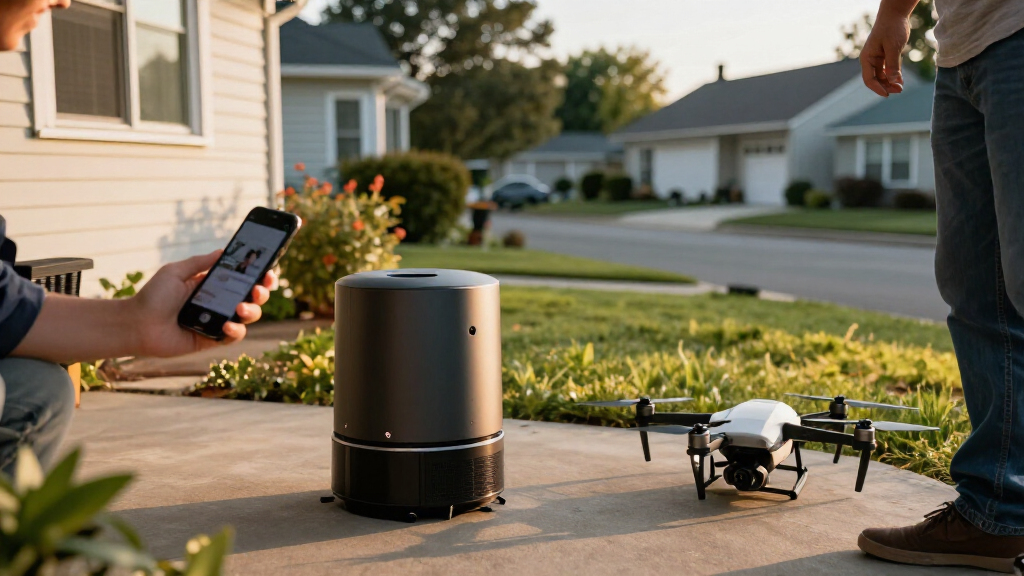
🔍 Read the full analysis: Ring’s Flying Home Drone And Patrol Robot: Balancing Monitoring And Privacy on ThorstenMeyerAI.com

Get the latest gadgets delivered free with Prime
- Fast, free delivery on millions of items
- Prime Video, Amazon Music and more included
- Member-only deals all year
TL;DR
Ring announced two mobile security devices on November 10, 2026: a flying camera for homes and a wheeled patrol robot for businesses. The products are priced at $249.99 and $999.99, but the drone still needs FCC authorization before it can be sold, and privacy concerns remain part of the discussion.
Amazon’s Ring announced Ring Robotics on November 10, introducing two mobile security cameras: the Drone Cam, designed to fly inside homes, and the Rover Cam, a wheeled patrol robot aimed at businesses. The products extend Ring’s camera system beyond fixed locations, while raising questions about recording in occupied spaces, cloud dependence and the drone’s pending federal authorization.
Ring lists the Rover Cam at $999.99, with U.S. shipping scheduled to begin December 16, 2026. The company lists the Drone Cam at $249.99, with U.S. shipping scheduled for January 27, 2027. Ring says scheduled patrols require a compatible Ring Protect plan. Its announcement also states that the drone has not been authorized as required by Federal Communications Commission rules and may not be sold until authorization is granted.
Ring says both products use AI Pilot to map spaces, propose patrol points and steer around obstacles. The devices can respond when another Ring camera, sensor or alarm is triggered. Ring describes the drone as flying on a schedule or on demand, with a 148-degree field of view, 360-degree rotation, 2K video and two LED lights. The company says its camera is off while the drone is docked. The Verge reported that the drone depends on an internet connection and can only land if Wi-Fi is unavailable.
The Rover is designed for workplaces such as shops and offices. Ring says it can patrol on a schedule, travel to a triggered device and scan 360 degrees when it arrives. Its features include an adjustable mast camera, siren, light tower and two-way audio. Ring says the robot records in up to 4K while moving or patrolling and can begin recording after detecting motion even when docked. The Verge reported an estimated battery life of about 30 minutes, coverage of around 5,000 square feet and operation limited to a single floor; those figures were reported by the outlet, not stated in Ring’s announcement.
Mobile security cameras bring new reach—and new questions
Ring’s Drone Cam and Rover Cam can move beyond fixed camera views. Their launch also raises questions about privacy, connectivity and the drone’s approval for sale.
Two devices, different settings
The drone is designed for homes; the wheeled robot is aimed at businesses.
Drone Cam
Flies indoors on demand or a schedule. Ring says its camera is off while docked.
Rover Cam
Patrols workplaces and can scan when it reaches a triggered device. Ring says it can record while moving or docked.
What customers should weigh
Mobile cameras can reach areas fixed devices cannot, while changing where recording may happen.
- Check spaces beyond a fixed camera’s view.
- Respond to alerts from Ring cameras, sensors or alarms.
- How privacy controls work for people in recorded spaces.
- How the drone behaves when Wi-Fi is unavailable.
Availability depends on approval
Ring announced the products on November 10, 2026, with U.S. shipping dates listed for December 16, 2026, for Rover and January 27, 2027, for Drone Cam.
The drone has not received the required authorization and may not be sold until it does.
Ring lists U.S. shipment dates, but the drone’s date depends on authorization.
Scheduled patrols require a compatible Ring Protect plan.
Privacy claims remain debated
Ring describes privacy controls and TAKE encryption; the Electronic Frontier Foundation says TAKE falls short of end-to-end encryption.
Mobile Cameras Change Where Recording Happens
The devices change a basic feature of home and business surveillance: rather than capturing only what falls within a fixed camera’s view, a mobile unit can travel to another part of a property. That may help users check areas a fixed camera cannot cover, but it also means cameras can move through rooms or workplaces where people may not expect them. Ring says it will use indicators and privacy modes to signal when devices are active; how those measures work in everyday use will matter to customers and people recorded by the devices.
The products also rely on Ring’s broader connected-camera system. AI Pilot can respond to alerts from other Ring devices, while the drone’s reported reliance on an internet connection may limit its usefulness during a Wi-Fi outage. For businesses, the Rover’s listed price, battery life and single-floor limit are practical factors in deciding whether a mobile patrol robot can replace or supplement fixed cameras or staff checks.
Privacy assurances are especially relevant given Ring’s history with regulators and criticism of its encryption approach. The Federal Trade Commission brought a 2023 case alleging that Ring allowed employees and contractors to access private customer videos and failed to use basic privacy and security protections. The FTC’s allegations are not a finding about these new products, but they form part of the record customers may weigh when deciding whether to put additional cameras in their homes or businesses.
Products Worth Considering

DJI Mini 4K Drone with 4K UHD Camera

Logitech MX Mechanical Wireless Illuminated Keyboard, Tactile Quiet, Graphite

LG UltraGear 32GX850A-B 32-inch 4K UHD OLED Gaming Monitor
As an affiliate, we earn on qualifying purchases.
Ring’s Earlier Mobile Security Efforts
Ring has explored mobile home surveillance for several years. It previewed an indoor drone called the Always Home Cam in 2020, according to CNBC, and The Verge reported that founder Jamie Siminoff said development began in 2016. The new Drone Cam is the company’s latest attempt to bring that concept to market, now under the Ring Robotics name.
The Rover also follows Amazon’s earlier effort to sell a mobile security robot to businesses. The Verge reported that Amazon launched Astro for Business in 2023 and discontinued it a year later. Ring says the Rover drew on feedback from Astro customers who valued its roving security features. These precedents provide context for the new launch, but do not establish how the Ring devices will perform or how long they will remain available.
Ring says privacy is the default. It describes the Drone Cam as recording after a flight is triggered and says its camera is off in the dock. The Rover’s Sleep Mode, Ring says, retracts its periscope and turns off its microphone. Both devices have recording indicators. Ring also says video is protected with its Throw Away the Key (TAKE) encryption, announced in August 2026. Ring says its servers receive temporary access to encryption keys to run cloud features, then delete them; full end-to-end encryption remains an optional setting.
“For years, customers told us they wanted eyes in the places a fixed camera couldn’t reach, and peace of mind in the spots they’d never want one.”
— Jamie Siminoff, Ring founder and chief inventor, in the company announcement
Approval and Privacy Questions Remain
The Drone Cam’s FCC authorization remains a condition of sale, and Ring’s announcement does not say when that approval may be granted. Its listed January 2027 shipping date is therefore not a guarantee that the drone will be available then. The company has not provided, in the supplied announcement details, a fuller account of how the drone behaves in all network or power-failure situations beyond the reported Wi-Fi limitation.
Questions also remain about how customers and people captured by the cameras will experience the privacy controls. Ring describes the drone as recording only after a flight is triggered, but has not established in the cited material how the system handles every alert, interruption or recording edge case. The Rover can record while moving and, Ring says, can start recording on detected motion while docked. The practical limits and visibility of those behaviors are not fully detailed here.
The privacy debate around TAKE is unresolved. Ring says servers temporarily access keys to support cloud services, while the EFF argues that this falls short of end-to-end encryption. The supplied information does not include independent security testing of the new devices or details about how long video is retained under different account settings. Ring’s assurances and the EFF’s assessment should be understood as their respective positions, not as a settled independent verdict on the products.
FCC Decision and Shipping Dates
The next concrete milestone is whether the FCC authorizes the Drone Cam for sale. Ring’s stated U.S. shipment dates are December 16, 2026, for the Rover and January 27, 2027, for the drone, although the drone date depends on authorization. Buyers will also need to check Ring Protect plan requirements for scheduled patrols and review the available recording and encryption settings before adopting the devices.
Further details may emerge as reporters and customers examine the products beyond the launch announcement, including how mobile patrols work in real homes and businesses, how the systems respond when connectivity fails, and how the privacy controls function in practice. Ring’s launch announcement does not answer those questions or provide a record of independent testing.
Key Questions
What did Ring announce?
Ring announced Ring Robotics, beginning with the indoor Drone Cam for homes and the wheeled Rover Cam for business security.
How much do the devices cost, and when are they expected to ship?
Ring lists the Rover Cam at $999.99, with U.S. shipping scheduled for December 16, 2026. The Drone Cam is listed at $249.99, with U.S. shipping scheduled for January 27, 2027, subject to required FCC authorization.
Can the Drone Cam be sold now?
Ring says the drone has not received the authorization required under FCC rules and may not be sold until it does. The announcement does not give a date for a decision.
What privacy protections does Ring describe?
Ring says the drone’s camera is off while docked, the Rover has a Sleep Mode that retracts its camera and turns off its microphone, and both devices use recording indicators. Ring says the videos use TAKE encryption, which can involve temporary server access to keys for cloud features; full end-to-end encryption remains optional.
Does a scheduled patrol require a subscription?
Ring says scheduled patrols require a compatible Ring Protect plan. The supplied announcement details do not specify every plan tier or feature limitation.
Source: ThorstenMeyerAI.com