When selecting a carbon monoxide air monitor for home, you must decide whether you need a dedicated safety alarm or a broader air quality tracker. My top overall pick is the Kidde Smart Carbon Monoxide Detector because it combines certified CO detection with smart home integration. For those needing pure safety without digital distractions, the Kidde COP Plug-In offers reliable battery backup at a lower cost. If you want detailed air metrics beyond just CO, the GoveeLife Smart Air Quality Monitor provides extensive data on CO2 and VOCs. The main tradeoff here is between certified life-safety compliance and the granular data provided by general air quality sensors. Continue reading to see how these options stack up against one another for your specific household needs.

Get the latest gadgets delivered free with Prime
- Fast, free delivery on millions of items
- Prime Video, Amazon Music and more included
- Member-only deals all year
Complete the kit



Key Takeaways
- Dedicated CO alarms like the Kidde COP are strictly safer for life-safety compliance than multi-sensor air quality monitors, which often lack UL certification for CO specifically.
- Plug-in models with battery backup, such as the Kidde Plug-in with 9V Backup, offer the best balance of convenience and reliability during power outages.
- General air quality monitors like the AirKnight provide valuable context on ventilation and VOCs but should not replace a dedicated CO alarm in bedrooms or near fuel-burning appliances.
- Smart Wi-Fi capabilities, found in GoveeLife and SwitchBot models, allow remote alerts but introduce dependency on home network stability.
- Battery-operated units like the First Alert combo alarm are ideal for renters or older homes where wiring constraints make plug-in units difficult to install.
| Kidde Carbon Monoxide + Explosive Gas Alarm, Plug-in with 9V Battery Backup, Digital Display, 85 dB Alarm |  | Best for CO and Combustible-Gas Coverage | Sensor technology: Electrochemical | Power: 120V AC with 9V battery backup | Detection: Carbon monoxide, natural gas, propane, methane, and sewer gas | VIEW ON AMAZON | See Our Full Breakdown |
| First Alert Battery-Operated Combination Smoke & Carbon Monoxide Alarm |  | Best for Simple Smoke-and-CO Coverage | Model: SMICO100 | Power: Battery powered | Detection: Smoke and carbon monoxide | VIEW ON AMAZON | See Our Full Breakdown |
| Indoor Air Quality Monitor 5-in-1 Portable CO2, Temperature, Humidity, HCHO, TVOC Detector |  | Best for Broader Indoor-Air Tracking | Measurements: CO₂, HCHO, TVOC, temperature, and humidity | CO₂ sensor: NDIR | HCHO and TVOC sensor technology: Electrochemical | VIEW ON AMAZON | See Our Full Breakdown |
| GoveeLife Smart Air Quality Monitor CO2 Detector H5140, Display & Alarm |  | Best Smart CO₂ Monitor | Sensor: SCD4x photoacoustic NDIR CO₂ sensor | Measurements: CO₂, temperature, and humidity | CO₂ accuracy: ±(40 ppm + 5%) | VIEW ON AMAZON | See Our Full Breakdown |
| Kidde COB Carbon Monoxide Detector, AA Battery-Powered |  | Best Compact, Flexible-Placement CO Alarm | Model: COB | Detection: Carbon monoxide | Power: 2 AA batteries, included | VIEW ON AMAZON | See Our Full Breakdown |
| Kidde Carbon Monoxide Detector, Plug-in with Battery Backup |  | Best for Simple, Backup-Powered Protection | Power: 120V AC | Battery backup: 2 AA batteries | Alarm sound: 85 dB | VIEW ON AMAZON | See Our Full Breakdown |
| Kidde Carbon Monoxide Detector, Plug-In with 9V Battery Backup, Digital Display, 85 dB Alarm, LED Indicators |  | Best for Reading CO Levels | Power: 120V AC with 9V battery backup | Alarm sound: 85 dB | Display: Digital LED; CO levels from 30–999 ppm | VIEW ON AMAZON | See Our Full Breakdown |
| Kidde Smart Carbon Monoxide Detector with Indoor Air Quality Monitoring |  | Best Smart CO and Air-Quality Pick | Model: COPDLQW | Power: 120V plug-in with two AA backup batteries | Connectivity: 2.4 GHz Wi-Fi | VIEW ON AMAZON | See Our Full Breakdown |
| Kidde COP Plug-In Carbon Monoxide Detector with AA Battery Backup |  | Best Straightforward Outlet Alarm | Model: COP | Power: 120V AC | Battery backup: 2 AA batteries, included | VIEW ON AMAZON | See Our Full Breakdown |
| Air Quality Monitor with 7.5″ Color Display, CO2, PM2.5, PM1.0, PM10, TVOC, Temperature & Humidity |  | Best Large-Screen Indoor Air Monitor | Display: 7.5-inch color screen | Sensor: Swiss-made Sensirion sensor | CO₂ range: 400–5000 ppm | VIEW ON AMAZON | See Our Full Breakdown |
| AirKnight Indoor Air Quality Monitor with VOC, CO2, Formaldehyde, PM2.5, PM10, Temperature, and Humidity Sensors |  | Best for Broad Pollutant Tracking | Sensors: CO2, PM2.5, PM10, VOC, formaldehyde, temperature, humidity | Battery: 3000 mAh rechargeable lithium-polymer | Display: Large LCD screen | VIEW ON AMAZON | See Our Full Breakdown |
| 2 Pack Air Quality Detectors Plug-in Wall Design with HD Screen, 5-in-1 Indoor Monitor for Temperature, Humidity, and Air Quality |  | Best Two-Room Plug-In Set | Package: 2 units | Display: HD screen with adjustable brightness | Indicator: Tri-color air-quality indicator | VIEW ON AMAZON | See Our Full Breakdown |
| GoveeLife Smart Air Quality Monitor with PM2.5, Temperature, and Humidity – LED Display, Wired, 2.4G Wi-Fi |  | Best for Wi-Fi Particulate Tracking | Measurements: PM2.5, temperature, humidity | PM2.5 accuracy: ±15 µg/m³ | Temperature accuracy: ±0.54°F | VIEW ON AMAZON | See Our Full Breakdown |
| SwitchBot CO2 Detector, Indoor Air Quality Monitor with Temperature and Humidity |  | Best Portable CO2 Monitor | Sensor: Swiss-made NDIR | Measurement range: 400–9000 ppm | Accuracy: ±50 ppm | VIEW ON AMAZON | See Our Full Breakdown |
| carbon monoxide air monitor for home | Power |
|---|---|
| Kidde Carbon Monoxide + Explos | 120V AC with 9V battery backup |
| First Alert Battery-Operated C | Battery powered |
| Indoor Air Quality Monitor 5-i | Rechargeable battery, as described |
| GoveeLife Smart Air Quality Mo | AC outlet; no batteries required |
| Kidde COB Carbon Monoxide Dete | 2 AA batteries, included |
| Kidde Carbon Monoxide Detector | 120V AC |
| Kidde Carbon Monoxide Detector | 120V AC with 9V battery backup |
| Kidde Smart Carbon Monoxide De | 120V plug-in with two AA backup batteries |
| Kidde COP Plug-In Carbon Monox | 120V AC |
| Air Quality Monitor with 7.5" | — |
| AirKnight Indoor Air Quality M | — |
| 2 Pack Air Quality Detectors P | Plug-in; wide-voltage support |
| GoveeLife Smart Air Quality Mo | Type-C cable; no battery |
| SwitchBot CO2 Detector | — |
More Details on Our Top Picks
Kidde Carbon Monoxide + Explosive Gas Alarm, Plug-in with 9V Battery Backup, Digital Display, 85 dB Alarm
I’d choose this Kidde when the goal is broader hazard detection than a standard carbon monoxide alarm can provide. Its electrochemical sensor detects CO, while the unit also monitors natural gas, propane, methane, and sewer gas; the digital display and peak-level memory add useful context beyond an alarm alone. Compared with the battery-powered Kidde COB, this model offers a readout and explosive-gas detection, but its outlet-dependent placement is less flexible. The 9V backup helps it keep operating during a power outage, though the alarm still needs a suitable outlet for its normal power. Its 85 dB alert is intended to be heard, which may bother people sensitive to loud alarms. I’d pick it for a kitchen or utility area where gas coverage matters, not as a portable CO-only choice.
Pros:- Detects carbon monoxide alongside natural gas, propane, methane, and sewer gas
- Digital display and peak-level memory provide information beyond the alarm sound
- 9V battery backup supports operation during power outages
- UL 2034 and UL 1484 certifications are listed, with a six-year warranty
Cons:- Placement depends on access to a standard electrical outlet
- The 85 dB alarm may be uncomfortably loud in small or quiet spaces
Best for: Homeowners who want one plug-in alarm to cover CO and several combustible gases near appliances or utility areas
Not ideal for: People who need flexible placement away from outlets or want a compact, travel-friendly CO-only detector
- Sensor technology:Electrochemical
- Power:120V AC with 9V battery backup
- Detection:Carbon monoxide, natural gas, propane, methane, and sewer gas
- Display:Digital LED
- Alarm volume:85 dB
- Certifications:UL 2034 and UL 1484
- Warranty:6 years
Our verdict“Choose this Kidde if you want plug-in CO monitoring plus combustible-gas detection and can place it near an outlet.”
First Alert Battery-Operated Combination Smoke & Carbon Monoxide Alarm
For someone replacing or adding a basic household alarm, I’d favor the First Alert when smoke detection belongs in the same unit as CO monitoring. Battery power avoids wiring work, and its test/silence button and end-of-life warning make routine upkeep more straightforward. Its Precision Detection feature is described as helping reduce cooking-related nuisance alarms, a practical advantage in a kitchen-adjacent area. Compared with the Kidde COB, this alarm adds smoke detection but gives up that model’s compact travel-oriented positioning and listed 85 dB alarm specification. It also lacks interconnect capability, so an alarm in one room won’t link to other units, and batteries need periodic replacement. The ionization sensor type is another distinction from the electrochemical CO sensor listed for the Kidde combination gas alarm. I’d select this for a simple room-level smoke-and-CO setup, not a connected whole-home system.
Pros:- Combines smoke and carbon monoxide detection in one alarm
- Battery operation allows installation without hardwiring
- Precision Detection technology is intended to reduce nuisance alarms from cooking
- Test/silence button and end-of-life warning support basic maintenance
Cons:- Requires battery replacement and ongoing battery checks
- Does not interconnect with other alarms
- Does not provide the digital CO readout or additional gas detection of the plug-in Kidde combination alarm
Best for: Renters or homeowners who want a battery-operated alarm that combines smoke and CO detection without wiring
Not ideal for: Households seeking interconnected alarms, app alerts, or a CO detector with a digital gas-level display
- Model:SMICO100
- Power:Battery powered
- Detection:Smoke and carbon monoxide
- Sensor type:Ionization
- Operating humidity:10–95% RH
- Dimensions:5.6 × 5.6 × 2 inches
- Weight:10.56 ounces
Our verdict“Pick the First Alert for straightforward, unwired smoke-and-CO coverage in a room where interconnected alerts are not required.”
Indoor Air Quality Monitor 5-in-1 Portable CO2, Temperature, Humidity, HCHO, TVOC Detector
I’d treat this portable monitor as an indoor-air tracker, not as a carbon monoxide alarm. It measures CO₂, formaldehyde, TVOC, temperature, and humidity, so it can help a household follow several air-quality conditions on a color screen. That broader range sets it apart from the Kidde COB, which is specifically a CO detector with an audible alarm; this 5-in-1 product’s listed measurements do not include CO. Its alerts are described as responding to exceeded thresholds, but the supplied details do not specify a CO warning function, alarm sound level, or battery runtime. Manual calibration is also required for optimal accuracy, adding upkeep that a dedicated alarm buyer may not expect. I’d consider it for people who want portable, multi-metric environmental readings alongside proper CO alarms, but I would not rely on it to detect carbon monoxide.
Pros:- Tracks five indoor-air and comfort measurements in one portable unit
- Color display presents readings and threshold alerts at a glance
- Uses NDIR technology for CO₂ measurement
- Rechargeable-battery operation is listed, avoiding a fixed outlet requirement
Cons:- Does not list carbon monoxide detection, unlike the Kidde COB
- Manual calibration is required for accuracy
- Battery runtime and connectivity details are not provided
Best for: Households wanting a portable display for CO₂, formaldehyde, TVOC, temperature, and humidity in addition to separate CO alarms
Not ideal for: Anyone shopping specifically for carbon monoxide protection, since CO is not among the listed measurements
- Measurements:CO₂, HCHO, TVOC, temperature, and humidity
- CO₂ sensor:NDIR
- HCHO and TVOC sensor technology:Electrochemical
- Display:High-definition color screen
- Power:Rechargeable battery, as described
- Operation:Press and hold to power on; tap for settings
- Calibration:Manual calibration required
Our verdict“Buy this as a companion air-quality monitor, not as a substitute for a dedicated CO detector.”
GoveeLife Smart Air Quality Monitor CO2 Detector H5140, Display & Alarm
The GoveeLife H5140 is the strongest fit here for tracking CO₂ and comfort conditions through a connected home, but I would not rank it as a carbon monoxide detector. Its SCD4x photoacoustic NDIR sensor measures CO₂, alongside temperature and humidity; CO is not listed. Wi-Fi, voice-assistant support, historical data, and app, buzzer, and email alerts make it more connected than the portable 5-in-1 monitor, while its five-second refresh gives readings a regular update. That added visibility comes with a fixed-power tradeoff: it needs an outlet and has no battery backup. The supplied information also says outdoor calibration may be needed for accuracy. I’d use it to understand ventilation and indoor CO₂ trends, with a separate listed CO alarm such as the Kidde COB handling carbon monoxide protection.
Pros:- Tracks CO₂, temperature, and humidity with a five-second refresh rate
- Wi-Fi support enables app notifications and historical data access
- Buzzer, app notifications, and email reports offer several alert routes
- Supports Alexa and Google Assistant
Cons:- Measures CO₂, not carbon monoxide, so it cannot replace a CO alarm
- Requires constant AC power and has no battery backup
- Outdoor calibration may be needed for accurate readings
Best for: Smart-home users who want connected CO₂, temperature, and humidity tracking with app and voice-assistant alerts
Not ideal for: Buyers seeking a carbon monoxide alarm or a monitor that continues running through an outage without power
- Sensor:SCD4x photoacoustic NDIR CO₂ sensor
- Measurements:CO₂, temperature, and humidity
- CO₂ accuracy:±(40 ppm + 5%)
- Refresh rate:5 seconds
- Power:AC outlet; no batteries required
- Connectivity:Wi-Fi, Alexa, and Google Assistant
- Data storage:Up to 2 years of historical data
- Alerts:Buzzer, app notifications, and email reports
Our verdict“Choose the H5140 for connected CO₂ and comfort monitoring, while keeping a dedicated carbon monoxide alarm in the home.”
Kidde COB Carbon Monoxide Detector, AA Battery-Powered
For a straightforward carbon monoxide alarm that does not depend on a wall outlet, the Kidde COB is my most practical pick. Its two AA batteries power an 85 dB alarm, and its wall-mount or tabletop options make placement more flexible than the plug-in Kidde CO and explosive-gas alarm. The tradeoff is narrower detection: this model covers CO only, while the plug-in alternative also detects several combustible gases and shows readings on a digital display. The COB instead keeps the setup simple, with LED status lights and a Test/Hush button, and its compact form can suit travel or temporary stays where permitted. It is not approved for RVs or boats and is intended for conditioned spaces, so that portability has limits. I’d choose it for home rooms needing independent CO coverage, not as an all-in-one air monitor.
Pros:- Runs on two AA batteries without wiring or an outlet
- Wall-mount and tabletop options allow flexible placement
- 85 dB alarm, LED status lights, and Test/Hush button provide clear basic controls
- Listed UL 2034 5th Edition and ETL certifications, with a 10-year limited warranty
Cons:- Detects carbon monoxide only, unlike the Kidde plug-in combination gas alarm
- Requires manual battery replacement
- Not approved for RVs or boats and limited to conditioned spaces
Best for: People who need a compact, battery-powered CO alarm for flexible placement at home or permitted travel settings
Not ideal for: Buyers who want CO level readings, combustible-gas detection, or an alarm approved for RV or boat use
- Model:COB
- Detection:Carbon monoxide
- Power:2 AA batteries, included
- Alarm volume:85 dB
- Mounting:Wall mount or tabletop
- Certifications:UL 2034 5th Edition and ETL Listed
- Warranty:10-year limited warranty
- Included items:Detector, AA batteries, mounting screws, and user guide
Our verdict“Pick the Kidde COB for simple, outlet-free CO protection when compact placement matters more than extra gas detection or a digital display.”
Kidde Carbon Monoxide Detector, Plug-in with Battery Backup
This Kidde is a straightforward choice for someone who wants a dedicated carbon monoxide alarm without Wi-Fi or extra air-quality readings. It plugs into a standard 120V outlet, while two AA backup batteries keep it operating during a power outage. A backlit display, LED warning light, and 85 dB alarm give you both visual and audible alerts. Compared with the Kidde COP Plug-In model, this detector’s description highlights the display but does not list the COP’s rotating plug or power-surge immunity. It is also less informative than the digital-display Kidde with 9V backup, whose stated display shows CO levels and whose peak memory records the highest reading. The tradeoff is simplicity: you get basic home detection, not app alerts or detailed level history. Its 10-year limited warranty is a useful support detail, but backup batteries still need upkeep.
Pros:- Two AA backup batteries support operation during power outages
- Backlit display and LED warning light supplement the audible alarm
- 85 dB alarm provides a strong audible alert
- UL 2034 5th Edition and ETL Listed
Cons:- Backup batteries need replacement over time
- No listed Wi-Fi alerts or peak-level memory
- Specified for residential use rather than industrial settings
Best for: Households seeking a simple plug-in CO alarm with battery backup and clear visual alerts, including people who want a unit that can also travel between suitable outlets.
Not ideal for: Buyers who want app notifications, peak CO memory, or a displayed numeric reading; the listed features do not include those functions.
- Power:120V AC
- Battery backup:2 AA batteries
- Alarm sound:85 dB
- Display and indicators:Backlit display and LED warning light
- Standards:UL 2034 5th Edition; ETL Listed
- Warranty:10-year limited
Our verdict“Choose this Kidde for basic plug-in CO protection with visual alerts and AA backup, but pick the digital-display Kidde if numeric readings and peak memory matter more.”
Kidde Carbon Monoxide Detector, Plug-In with 9V Battery Backup, Digital Display, 85 dB Alarm, LED Indicators
The main reason to choose this Kidde over the simpler Kidde Carbon Monoxide Detector with two AA backup batteries is its digital CO-level display. It shows readings from 30 to 999 ppm, and peak-level memory can help you see whether the unit registered an earlier high reading. The electrochemical sensor, 85 dB alarm, and hush button round out a more information-rich setup, while plug-in, tabletop, and wall-mount options make placement more flexible than a fixed outlet-only unit. It uses a 9V backup battery rather than the AA pair in the other Kidde plug-ins here. That may suit buyers who prefer this format, but it means tracking a different replacement battery. The stated service life is five to seven years, so this model may need replacement before the listed 10-year warranties on some competing Kidde units. Avoid positioning it near cooking or heating appliances, where false alarms are possible.
Pros:- Digital LED display shows CO levels from 30 to 999 ppm
- Peak-level memory and hush button add useful controls
- Plug-in, tabletop, and wall-mount options allow flexible placement
- Electrochemical sensor and 85 dB alarm
Cons:- Listed replacement interval is five to seven years
- May produce false alarms when placed near cooking or heating appliances
- Uses a 9V backup battery rather than the AA batteries used by the other listed Kidde plug-ins
Best for: Homeowners who want to see displayed CO readings and peak-level memory, and who may need tabletop or wall-mount placement rather than relying only on an outlet.
Not ideal for: Buyers who want the longest stated warranty or a simple, low-information alarm; this model has a five-to-seven-year replacement interval and can false alarm near cooking or heating appliances.
- Power:120V AC with 9V battery backup
- Alarm sound:85 dB
- Display:Digital LED; CO levels from 30–999 ppm
- Sensor technology:Electrochemical
- Mounting options:Plug-in, tabletop with extension cord, or wall-mount
- Features:Peak-level memory and hush button
- Certifications:UL 2034, UL 217, NFPA 72, California Fire Marshal, FHA, HUD
- Warranty:10 years limited
Our verdict“Pick this model if displayed readings and peak memory matter more than a longer stated service interval or a simpler alarm.”
Kidde Smart Carbon Monoxide Detector with Indoor Air Quality Monitoring
This is the broadest monitoring option among the dedicated Kidde alarms in this group: it tracks carbon monoxide, temperature, humidity, and TVOCs, and can send app notifications over 2.4 GHz Wi-Fi. Its low-level CO alerts are specified for 30–70 ppm, adding notification coverage beyond a basic alarm’s audible warning. Compared with the Kidde COP Plug-In, it offers remote alerts and extra air readings, while the COP keeps things simpler with local LED indicators and a Test/Hush button. It also differs from the large-screen Air Quality Monitor in this list: that unit measures CO₂ and particulate matter, not CO, and lacks Wi-Fi alerts. The smart Kidde is a better fit for connected homes, but its smart features depend on compatible Wi-Fi, and some air-quality insights require an optional subscription. Battery backup and an 85 dB alarm preserve core alerts if the network is unavailable.
Pros:- Monitors CO, temperature, humidity, and TVOCs
- App notifications are available without a required subscription
- Low-level CO alerts are specified for 30–70 ppm
- AA backup batteries and an 85 dB alarm provide alerts beyond the app
Cons:- Smart features require a 2.4 GHz Wi-Fi network
- Some air-quality insights require an optional subscription
- Offers no stated particulate or CO₂ monitoring
Best for: Connected-home households that want app alerts for CO and a single plug-in device to track temperature, humidity, and TVOCs as well.
Not ideal for: People without a 2.4 GHz Wi-Fi network or buyers seeking detailed air-quality insights without optional subscription features.
- Model:COPDLQW
- Power:120V plug-in with two AA backup batteries
- Connectivity:2.4 GHz Wi-Fi
- Monitors:Carbon monoxide, temperature, humidity, and TVOCs
- Alarm volume:85 dB
- Low-level CO alerts:30–70 ppm
- Smart-home compatibility:Amazon Alexa and Google Home
- Certifications:UL 2034 5th Edition; ETL Listed
- Warranty:10-year limited
Our verdict“Choose this Kidde if remote CO alerts and extra indoor readings matter; choose the simpler COP if you want a non-connected alarm with fewer dependencies.”
Kidde COP Plug-In Carbon Monoxide Detector with AA Battery Backup
The Kidde COP is the most stripped-back dedicated alarm here, with a useful practical advantage: its rotating plug fits vertical or horizontal outlets. It monitors CO and uses two included AA batteries for backup, with an 85 dB alarm, LED status lights, and a Test/Hush button for local operation. Compared with the smart Kidde COPDLQW, it gives up app notifications and temperature, humidity, and TVOC readings, but avoids a Wi-Fi requirement and subscription-dependent insights. The digital-display Kidde goes further for buyers who want numeric readings and peak memory; the COP does not list either feature. Its stated UL 2034 5th Edition testing, ETL listing, 10-year limited warranty, and power-surge immunity strengthen its basic-home-alarm case. The key boundary is placement: it is for conditioned spaces, uses 120V single voltage, and is not approved for RV or boat use.
Pros:- Rotating plug fits vertical or horizontal outlets
- Two included AA batteries provide backup during power outages
- LED status lights, 85 dB alarm, and Test/Hush button
- Power-surge immunity and a 10-year limited warranty
Cons:- Not approved for RV or boat use
- Designed for 120V single-voltage outlets, not 220V
- No listed numeric display, peak memory, or Wi-Fi notifications
Best for: Homeowners who want a simple, non-connected plug-in CO alarm that fits either outlet orientation and has AA battery backup.
Not ideal for: RV or boat owners, people with 220V outlets, or buyers who want a displayed CO reading, peak memory, or remote alerts.
- Model:COP
- Power:120V AC
- Battery backup:2 AA batteries, included
- Alarm volume:85 dB
- Plug:Rotating; fits vertical or horizontal outlets
- Features:LED status lights, Test/Hush button, and power-surge immunity
- Standards:UL 2034 5th Edition; ETL Listed
- Use limitations:Conditioned spaces; not approved for RV or boat use; 120V single voltage
- Warranty:10-year limited
Our verdict“Choose the COP for uncomplicated home protection and flexible outlet fit; choose the digital Kidde if you want CO readings and peak-level memory.”
Air Quality Monitor with 7.5″ Color Display, CO2, PM2.5, PM1.0, PM10, TVOC, Temperature & Humidity
This monitor earns its place for buyers who want a clear, at-a-glance view of several indoor air measurements: CO₂, PM1.0, PM2.5, PM10, TVOC, temperature, and humidity. Its 7.5-inch color screen and plug-and-play setup make it more immediately readable than a small-display detector, and it needs no app or calibration according to the supplied details. But the title’s “CO2” means carbon dioxide, not carbon monoxide. That makes this a complement to a dedicated Kidde CO alarm, not a replacement for one. Compared with the smart Kidde COPDLQW, it shows particulate readings and CO₂ but does not list CO detection or remote notifications. Its audible alerts are customizable and can be muted, yet readings are only available on the device because it has no Wi-Fi. It also needs a physical power connection and is intended for indoor use.
Pros:- Large 7.5-inch color display shows multiple readings at a glance
- Measures CO₂, PM1.0, PM2.5, PM10, TVOC, temperature, and humidity
- Plug-and-play setup with no app or calibration required
- Customizable audible alerts with a mute option
Cons:- Does not list carbon monoxide detection and cannot replace a CO alarm
- No Wi-Fi or remote monitoring
- Requires a physical power connection and is limited to indoor use
Best for: People who want a large, local display of CO₂, particulate matter, TVOC, temperature, and humidity to supplement a dedicated carbon monoxide alarm.
Not ideal for: Anyone shopping for carbon monoxide protection as their only device; this monitor lists CO₂ monitoring, not CO detection, and has no remote monitoring.
- Display:7.5-inch color screen
- Sensor:Swiss-made Sensirion sensor
- CO₂ range:400–5000 ppm
- Particulate range:PM1.0, PM2.5, and PM10: 0–999 µg/m³
- TVOC range:0–500 index
- Temperature range:14.2°F–122°F
- Humidity range:1%–99%
- Power and setup:AC/DC; plug-and-play, no app or calibration required
- Alerts:Audible alarms with mute option
Our verdict“Buy this for broad, easy-to-read indoor air tracking alongside a dedicated CO alarm, not as a carbon monoxide detector.”
AirKnight Indoor Air Quality Monitor with VOC, CO2, Formaldehyde, PM2.5, PM10, Temperature, and Humidity Sensors
The AirKnight is a broad indoor-air monitor, not a carbon monoxide alarm: its listed sensors cover CO2, particulates, VOCs, and formaldehyde, but not CO. That distinction matters if your main goal is warning of a carbon monoxide leak; a dedicated alarm such as the Kidde Carbon Monoxide Detector, Plug-in with Battery Backup is the appropriate tool for that job. AirKnight earns a place here for buyers who also want to track everyday air conditions or smoke-related particles, with a portable rechargeable design that can move between rooms. Its LCD puts several readings in view without requiring an app. Compared with the GoveeLife Smart Air Quality Monitor, it measures a wider range of listed pollutants and works without a stated Wi-Fi requirement, but it lacks that model’s documented data storage and smart-home features. Expect to handle initial setup and calibration, and do not treat its readings as CO protection.
Pros:- Tracks CO2, PM2.5, PM10, VOCs, and formaldehyde alongside temperature and humidity.
- Rechargeable 3000 mAh battery supports portable placement.
- Large LCD provides readings directly on the device.
- Plug-and-play design avoids a stated need for Wi-Fi.
Cons:- Does not list a carbon monoxide sensor, so it cannot serve as a CO alarm.
- Requires initial setup and calibration.
- Battery life can vary with use, and no smart-home integration is listed.
Best for: Households seeking a portable way to monitor several indoor pollutants, including particulate matter during wildfire-smoke periods, while using a separate certified CO alarm.
Not ideal for: Anyone seeking a carbon monoxide detector or a monitor with documented app, Wi-Fi, or smart-home integration.
- Sensors:CO2, PM2.5, PM10, VOC, formaldehyde, temperature, humidity
- Battery:3000 mAh rechargeable lithium-polymer
- Display:Large LCD screen
- Connectivity:Plug and play; portable
- Carbon monoxide sensing:Not listed
- Setup:Initial setup and calibration required
Our verdict“Choose AirKnight for portable, multi-pollutant tracking, but pair it with a dedicated carbon monoxide alarm for CO safety.”
2 Pack Air Quality Detectors Plug-in Wall Design with HD Screen, 5-in-1 Indoor Monitor for Temperature, Humidity, and Air Quality
This two-unit set is aimed at buyers who want a simple display in more than one indoor space, such as a bedroom and an office. The plug-in format avoids battery charging, while the HD screens, tri-color indicator, and adjustable brightness make status checks straightforward. The product description mentions air quality, temperature, and humidity, but does not identify a carbon monoxide sensor or define the pollutants behind its air-quality reading. That makes it a poor substitute for a dedicated CO alarm such as the First Alert Battery-Operated Combination Smoke & Carbon Monoxide Alarm. Compared with the portable AirKnight, this set gives you two fixed monitoring points rather than broader named pollutant coverage and battery-powered portability. It also lacks stated app access and historical data, so it suits quick local checks, not remote tracking or trend analysis.
Pros:- Includes two monitors for placement in separate rooms.
- Plug-in operation avoids battery charging.
- HD display, tri-color indicator, and adjustable brightness support at-a-glance checks.
- Alert thresholds and calibration are listed among its functions.
Cons:- Carbon monoxide sensing is not specified, so it should not be relied on for CO alerts.
- Requires an outlet and is described for indoor use.
- No app integration or detailed historical data is listed.
Best for: People who want basic environmental displays in two outlet-equipped rooms and already have dedicated carbon monoxide alarms.
Not ideal for: Buyers who need verified CO detection, battery-powered placement, named pollutant measurements, or app-based history.
- Package:2 units
- Display:HD screen with adjustable brightness
- Indicator:Tri-color air-quality indicator
- Functions:Air quality, temperature, humidity, alert thresholds, calibration
- Power:Plug-in; wide-voltage support
- Sensor type:High-sensitivity environmental sensors
- Carbon monoxide sensing:Not specified
Our verdict“Pick this pair for simple, outlet-based monitoring in two rooms, not as a replacement for a dedicated carbon monoxide alarm.”
GoveeLife Smart Air Quality Monitor with PM2.5, Temperature, and Humidity – LED Display, Wired, 2.4G Wi-Fi
The GoveeLife monitor is the strongest fit here for people who want PM2.5 readings, saved data, and smart-home links, rather than a broad set of pollutant measurements. Its two-second refresh rate and up-to-two-years of data storage can help users follow particle changes over time and export records. But its listed sensors are limited to PM2.5, temperature, and humidity; carbon monoxide is not listed. For CO protection, a dedicated unit such as the Kidde COB Carbon Monoxide Detector, AA Battery-Powered serves a different and necessary purpose. Compared with the AirKnight, GoveeLife offers Wi-Fi features and long-term records but does not list VOC or formaldehyde sensing and must stay connected to power. It is best for connected homes focused on fine particles, not for buyers seeking a portable all-in-one air monitor or CO alarm.
Pros:- Refreshes readings every two seconds for frequent PM2.5 updates.
- Stores up to two years of data and supports export.
- Connects over 2.4 GHz Wi-Fi and works with Govee smart-home devices.
- Display can switch between clock and PM2.5 views, with bright and night modes.
Cons:- Does not list a carbon monoxide sensor and cannot replace a CO alarm.
- Requires constant Type-C power and Wi-Fi for full features.
- Measures PM2.5, temperature, and humidity rather than a wider range of named pollutants.
Best for: Wi-Fi-connected households that want to track PM2.5 patterns, review stored readings, and link monitoring with compatible Govee devices.
Not ideal for: Anyone seeking carbon monoxide detection, battery-powered portability, or measurements of VOCs and formaldehyde.
- Measurements:PM2.5, temperature, humidity
- PM2.5 accuracy:±15 µg/m³
- Temperature accuracy:±0.54°F
- Humidity accuracy:±3% RH
- Refresh rate:2 seconds
- Connectivity:2.4 GHz Wi-Fi
- Data storage:Up to 2 years
- Power:Type-C cable; no battery
Our verdict“Choose GoveeLife for connected PM2.5 tracking and saved trends, while using a separate dedicated CO alarm.”
SwitchBot CO2 Detector, Indoor Air Quality Monitor with Temperature and Humidity
The SwitchBot is the most focused choice in this group for checking CO2, temperature, and humidity without keeping the device beside an outlet. Its NDIR sensor, stated ±50 ppm accuracy, and customizable alerts make it more specific about CO2 measurement than the two-unit plug-in monitor, whose pollutant sensing is not defined. That does not make it a carbon monoxide detector: CO2 and CO are different gases, and this product lists no CO sensor. A dedicated alarm such as the Kidde Carbon Monoxide + Explosive Gas Alarm is the relevant comparison for CO safety. SwitchBot’s large display and stated battery life of up to 12 months suit room-to-room checks, while app notifications require a SwitchBot Hub. Compared with the wired GoveeLife, it trades PM2.5 tracking and long-term data storage for portability and a dedicated CO2 sensor.
Pros:- Uses a Swiss-made NDIR sensor with stated ±50 ppm accuracy.
- Large display shows CO2, temperature, humidity, time, and comfort level.
- Portable design has a stated battery life of up to 12 months.
- Offers sound, visual, and app alerts, with app notifications available through a SwitchBot Hub.
Cons:- Measures CO2, not carbon monoxide, and cannot replace a CO alarm.
- App notifications require a separate SwitchBot Hub.
- Does not list PM2.5, VOC, or formaldehyde measurements.
Best for: People who want a portable, clearly readable CO2 monitor for rooms where ventilation and occupancy affect indoor CO2 levels.
Not ideal for: Buyers looking for carbon monoxide detection, PM2.5 or VOC measurements, or app notifications without buying a SwitchBot Hub.
- Sensor:Swiss-made NDIR
- Measurement range:400–9000 ppm
- Accuracy:±50 ppm
- Display size:92 mm
- Battery life:Up to 12 months
- Weight:154 g
- Dimensions:92 × 79 × 25 mm
- Carbon monoxide sensing:Not listed
Our verdict“Choose SwitchBot for portable CO2 and comfort monitoring, but rely on a separate carbon monoxide alarm for CO protection.”
How We Picked
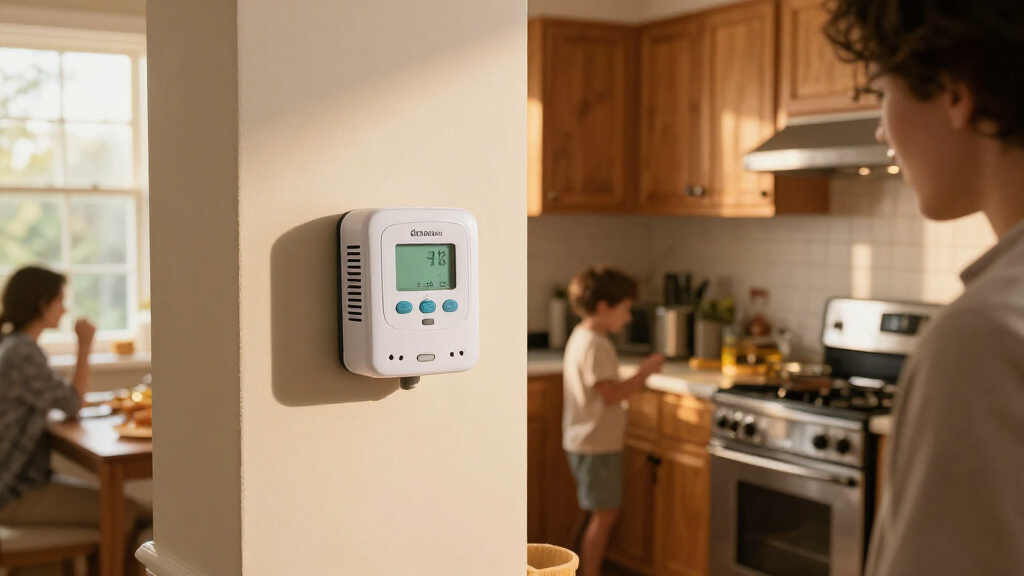
I evaluated these fourteen devices based on three core pillars: safety certification, sensor accuracy, and usability. For devices marketed as CO alarms, I prioritized those with UL 2034 certification, which is the industry standard for residential carbon monoxide detection. This immediately separates dedicated alarms from generic air quality monitors that may measure CO but are not certified to save lives in an emergency. I also assessed the clarity of the digital displays, as a readable ppm (parts per million) level is critical for understanding low-level exposure risks before they become dangerous.
Additionally, I compared the power options and connectivity features. Plug-in units with battery backup were ranked higher than battery-only units for ease of maintenance, while battery-only units were favored for flexibility in placement. For smart monitors, I looked at the depth of data provided—whether they just show a number or offer trends and alerts for CO2, VOCs, and humidity. The final ranking reflects a hierarchy where life-safety certification outweighs smart features, and dedicated CO sensing outweighs general air quality metrics.
Factors to Consider When Choosing Carbon Monoxide Air Monitor For Home
Choosing the right monitor requires understanding the difference between a safety alarm and a health tracker. Here are the key factors to weigh before making your purchase.Certification vs. Consumer Sensors
The most important distinction in this category is between devices certified as life-safety alarms (like those meeting UL 2034 standards) and consumer-grade air quality monitors. Certified alarms are rigorously tested to alert you when CO levels reach dangerous thresholds that could cause unconsciousness or death. In contrast, many air quality monitors measure CO as part of a broader dataset but may not have the same strict calibration for emergency alerting. If your primary goal is preventing poisoning, you must choose a certified alarm. If you are interested in general ventilation and comfort, a consumer monitor adds value but should never be your only line of defense against carbon monoxide.
Power Source and Placement Flexibility
Where you place a CO detector is just as important as the device itself. Plug-in models are convenient because they draw power from the wall and often include a small battery backup for outages, but they must be placed at appropriate heights and away from outlets that might be obstructed by furniture. Battery-operated units offer superior placement flexibility, allowing you to mount them high on walls or ceilings where CO tends to accumulate, especially in rooms with vaulted ceilings. Consider your home’s layout; if you lack accessible outlets at the correct height, a battery-powered model is the only practical choice for optimal safety.
Digital Display and Data Granularity
A digital display is more than a gimmick; it provides real-time ppm readings. This allows you to see low-level leaks before they trigger an alarm, giving you time to investigate and ventilate. Basic alarms only sound a siren, which gives you no context about the severity of the leak. However, high-end displays with Wi-Fi connectivity, like those from GoveeLife or SwitchBot, add complexity. You must decide if you want to manage app connections and firmware updates, or if a simple, standalone digital readout on a Kidde unit is sufficient for your needs.
Multi-Sensor Value vs. Single-Purpose Reliability
Many modern devices combine CO detection with temperature, humidity, and VOC sensors. While this seems like a better value, it can introduce cross-sensitivity issues where other gases interfere with CO readings, or simply dilute the focus of the device. A dedicated CO alarm is engineered for one task and performs it with high reliability. Multi-sensor air quality monitors are excellent for tracking general health and comfort, such as detecting off-gassing from new furniture (VOCs) or poor ventilation (CO2). The best strategy for many homeowners is actually a hybrid approach: use a certified dedicated CO alarm for safety and a separate air quality monitor for comfort.
Frequently Asked Questions
Can a smart air quality monitor replace a dedicated carbon monoxide alarm?
No, you should not rely on a general smart air quality monitor as your only carbon monoxide alarm. Most consumer air quality monitors are not certified under safety standards like UL 2034, which dictates specific sensitivity and alarm thresholds for life-safety situations. While they can detect the presence of CO, their primary design is for tracking trends in indoor air quality rather than preventing poisoning. You should always use a dedicated, certified CO alarm for safety and consider an air quality monitor as a supplementary tool for ventilation and health insights.
Do I need a carbon monoxide monitor in every room of my house?
You do not need one in every single room, but you should follow specific placement guidelines to ensure coverage. The general recommendation is to install a CO alarm on every level of your home, including the basement, and outside each sleeping area. This ensures that if CO is generated by a furnace or water heater, it is detected before it spreads to bedrooms. Kitchens and garages are common sources of CO, so placing a monitor near these areas is wise, but avoid placing them directly next to fuel-burning appliances to prevent false alarms from normal startup emissions.
Why do some carbon monoxide monitors have battery backups and others do not?
Battery backups are a critical feature for plug-in models because carbon monoxide leaks often occur during winter storms or power outages when heating systems are running hard. If the power goes out, a plug-in unit without a battery backup will stop working, leaving you unprotected. Battery-operated units do not need this feature because they are independent of the grid, but they require regular battery changes. For maximum reliability, I recommend choosing a plug-in model with a sealed lithium battery backup or a replaceable AA/9V battery backup to guarantee continuous operation.
What is the difference between ppm readings and an alarm sounding?
A ppm (parts per million) reading tells you the current concentration of carbon monoxide in the air, while an alarm sounding indicates that the concentration has reached a dangerous level defined by safety standards. Low levels, such as 10-35 ppm, might indicate a minor leak or poor ventilation but are generally not immediately life-threatening. High levels, above 70 ppm, can cause symptoms and become deadly over time. A digital display helps you identify these lower levels so you can investigate the source before it escalates to the threshold that triggers the audible siren.
Are smart Wi-Fi carbon monoxide detectors worth the extra cost?
Smart Wi-Fi detectors are worth the investment if you travel frequently, have elderly relatives living alone, or want to integrate safety alerts into your broader home automation system. They send notifications to your phone, allowing you to check your home’s status remotely. However, they depend on your home’s Wi-Fi network and cloud services, which can occasionally fail or experience lag. If you want simple, local alerts without needing to manage an app or worry about network connectivity, a standard digital display model is more reliable and often more affordable.
Conclusion
Choosing the right carbon monoxide air monitor for home depends largely on whether you prioritize strict life-safety compliance or broader environmental awareness. For most households, the Kidde Smart Carbon Monoxide Detector stands out as the best overall choice, offering certified safety alongside modern smart features. If you are on a tight budget or need a simple, no-nonsense device for a rental property, the Kidde COP Plug-In is the best value pick. For those deeply invested in health tracking and ventilation optimization, the GoveeLife Smart Air Quality Monitor provides the rich data needed to manage indoor air quality proactively. Ultimately, never compromise on certified CO detection; let the extra features come second.