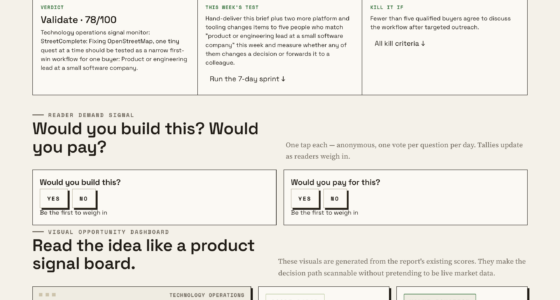
📊 Full opportunity report: Find Your Next Secondhand Item With Cross-Site Search on IdeaNavigator AI — validation score, market gap, and execution plan.

Get the latest gadgets delivered free with Prime
- Fast, free delivery on millions of items
- Prime Video, Amazon Music and more included
- Member-only deals all year
TL;DR

IdeaNavigator AI has outlined a proposed search tool that would let shoppers find secondhand listings across multiple marketplaces using a photo or keywords. The concept is at the idea and validation stage: no launched product, marketplace integrations, or test results are provided.
IdeaNavigator AI has outlined a proposed tool that would let shoppers search for a secondhand item by photo or keyword across several resale marketplaces in one place. The concept targets people hunting for a specific used product, but it is a product proposal, not a reported launch; no live service or completed trial is described.
The proposed service would offer a single search box where a shopper could upload an image or enter text and receive matching used listings from two or three major marketplaces. Results would be gathered into one view and ranked by price, reducing the need to repeat searches on separate platforms. The proposal names eBay, Facebook Marketplace, Mercari and Poshmark as examples of marketplaces where shoppers may currently search independently.
IdeaNavigator AI identifies the central problem as fragmented resale inventory: marketplaces do not share a unified listing database, so shoppers may have to reuse the same image or query on several services. The proposed tool would depend on visual-search technology to identify similar products in listing photos, alongside keyword search. The proposal does not specify how the tool would access listings or keep results current.
The suggested business model is affiliate commissions when users complete purchases through marketplace links. For an initial test, the proposal recommends manually handling image-match requests for 20 shoppers across three marketplaces, then measuring whether shoppers click through and prefer the aggregated results. No findings from that test are reported.
A Faster Route to Used Listings
If built and effective, a cross-site search tool could save shoppers time and make it easier to compare prices across resale platforms. A single search could also surface listings that users might miss when checking only one marketplace, particularly when an item is described differently or photographed from another angle. These are potential benefits of the proposed approach, not outcomes demonstrated by a working product.
The idea also addresses a practical discovery problem in secondhand shopping: inventory is spread across services, and shoppers may not know which marketplace has the item they want. But usefulness would depend on the coverage and accuracy of matching, as well as the quality and freshness of listing data. A search that returns irrelevant items or misses available stock could add another step rather than remove one.
The proposed commission model would tie revenue to purchases completed on marketplaces. Whether that could support the service is unknown. The proposal provides no commission rates, expected traffic, operating costs, or evidence that shoppers would use an intermediary rather than search directly.
used electronics cross-site search tool
As an affiliate, we earn on qualifying purchases.
As an affiliate, we earn on qualifying purchases.
How the Search Proposal Would Work
The concept is framed as a narrow first-use case: a deal-seeking shopper already knows what item they want and needs to locate a used example. It is not described as a general resale marketplace, and the proposed initial version would cover only two or three platforms rather than every secondhand site.
Image-based product matching and keyword search would be combined in one interface. The proposal says visual-search models are now cheap and accurate enough to support photo matching, but supplies no benchmark, cost estimate, or independent evaluation for this specific use. The claim is a rationale for testing the idea, not evidence that the proposed service already performs reliably.
The suggested validation step is deliberately manual: fulfill image-match requests for 20 shoppers using listings from three marketplaces, then observe click-through behavior and ask whether users prefer the combined results. That would offer an early signal about interest, but the small test would not by itself establish broad demand, matching accuracy at scale, or commercial viability.
secondhand marketplace product search
As an affiliate, we earn on qualifying purchases.
As an affiliate, we earn on qualifying purchases.
Product Status and Coverage Remain Open
The proposal does not identify a developer, launch date, working prototype, or participating marketplaces. It is not clear whether any marketplace has agreed to provide listing access, or how the tool would gather listings while complying with each service’s terms and technical requirements.
Important product details also remain unspecified: how often results would refresh, how image matches would be scored, whether shoppers could filter by condition or location, and how duplicates or unavailable listings would be handled. There are no reported test results to show whether the approach can produce useful matches or whether users would click through.
The proposal’s statements about the affordability and accuracy of visual-search models are not accompanied by measurements. Its commercial prospects are also undetermined: the commission rate, expected purchase conversion, and costs of operating search across multiple marketplaces are not given.
As an affiliate, we earn on qualifying purchases.
Manual Shopper Test Comes First
The next step set out in the proposal is a manual trial with 20 shoppers, searching across three marketplaces and tracking click-throughs and user preference for aggregated results. That test could help determine whether shoppers see value in a combined search before a larger product is built.
No schedule or recruitment plan is provided, and it is unclear whether the trial has started. Further reporting would need to establish whether a prototype is being developed, which marketplaces it can search, and what the test finds about match quality and shopper behavior. Until then, the cross-site search remains a concept awaiting validation.
Source: IdeaNavigator AI
As an affiliate, we earn on qualifying purchases.
Key Questions
Is the cross-site secondhand search tool available now?
No launch is reported. The concept is presented as a proposed product and a possible test, not as a service shoppers can currently use.
Which marketplaces would it search?
The proposal gives eBay, Facebook Marketplace, Mercari and Poshmark as examples. It recommends beginning with two or three marketplaces but does not say which would be included in an initial product.
How would shoppers search for an item?
The proposed interface would accept either an uploaded photo or keywords, then show matching used listings gathered from multiple marketplaces and ranked by price.
How would the service make money?
The suggested model is affiliate commission on purchases completed through marketplace links. No commission rates or revenue estimates are provided.
Has the idea been tested with shoppers?
No results are reported. The proposed first test would manually fulfill image searches for 20 shoppers across three marketplaces and measure click-throughs and user preference.
Source: IdeaNavigator AI
Fall Picks
fall essentials
As an affiliate, we earn on qualifying purchases.