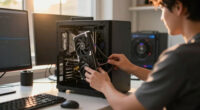
📊 Full opportunity report: How to Reduce Heat and Noise in a High-Power AI Workstation on ThorstenMeyerAI.com — validation score, market gap, and execution plan.
Prime for Young Adults — start your free trial
Fast free delivery, streaming and member deals for eligible 18–24 year olds.
Try it freeAs an affiliate, we earn on qualifying purchases.
TL;DR
High-power AI workstations generate significant heat and noise due to sustained GPU loads. Effective cooling strategies include undervolting, optimizing airflow, and component choices. These measures improve performance and reduce operational noise.
High-power AI workstations produce excessive heat and noise during sustained workloads, affecting performance and workspace comfort. Experts confirm that targeted cooling strategies, such as undervolting GPUs and optimizing airflow, can significantly mitigate these issues, making AI inference more efficient and less disruptive.
AI workstations operating under continuous load generate more heat and noise than gaming PCs, primarily due to the sustained GPU activity which keeps fans running at high speeds. The main heat source is the GPU, often responsible for over 70% of thermal output, with CPU and power supply components also contributing. To address this, experts recommend undervolting GPUs to reduce power consumption and heat without sacrificing performance, especially for memory-bound inference tasks. Improving case airflow by optimizing fan placement and case design helps dissipate heat more effectively, lowering fan speeds and noise. Additionally, selecting high-quality power supplies and managing VRMs can prevent excess heat from these components. Each of these measures can be implemented incrementally to balance cooling efficiency, noise reduction, and cost, tailored to specific workload demands.
An AI workstation isn’t a gaming PC —
and that’s why it runs hot.
Local inference is a sustained load: the GPU sits near full power for hours with no loading screens, so the heat never dissipates and the fans never get a break. Here’s where the heat comes from — and the five levers that reduce it.
Impact of Effective Cooling on AI Workstation Performance
Implementing these cooling strategies enhances the reliability and longevity of high-power AI hardware, reduces operational noise, and creates a more comfortable working environment. For professionals running continuous inference workloads, these improvements translate into more stable performance and lower energy costs, making AI deployment more practical and scalable in office settings.
As an affiliate, we earn on qualifying purchases.
Background on Heat and Noise Challenges in AI Hardware
Unlike gaming PCs, AI workstations operate under sustained load, often running GPUs at or near maximum capacity for hours. This continuous operation leads to higher thermal output and noise levels, requiring specialized cooling approaches. Common issues include throttling due to overheating, increased fan noise, and component stress. Recent discussions among hardware users highlight undervolting and airflow optimization as effective solutions, with industry guides emphasizing that cooling is not just about cooling the GPU but managing overall system heat sources.
“Undervolting your GPU can drastically cut heat and noise without impacting inference speed, especially for memory-bound workloads.”
— Thorsten Meyer, AI hardware expert
As an affiliate, we earn on qualifying purchases.
Uncertainties and Ongoing Developments in Cooling Techniques
While undervolting and airflow improvements are proven to help, the optimal configurations vary by hardware model and workload. It is not yet clear how future GPU architectures will impact cooling requirements, or how emerging liquid cooling solutions will compare in cost and effectiveness for AI workloads. More empirical data is needed to establish standardized best practices for different setups.
As an affiliate, we earn on qualifying purchases.
Next Steps for AI Workstation Cooling Optimization
Users and researchers will continue testing undervolting techniques, advanced cooling hardware, and case designs. Manufacturers may release more energy-efficient GPUs with built-in thermal management features. Future guides and community feedback will refine best practices, aiming for quieter, cooler, and more reliable AI inference environments.
As an affiliate, we earn on qualifying purchases.
Key Questions
Can undervolting affect AI inference performance?
In most memory-bound inference workloads, undervolting reduces heat and noise without impacting performance significantly. However, for compute-bound tasks, careful testing is recommended to avoid performance drops.
What case features help improve airflow for AI workstations?
High-quality airflow cases with multiple intake and exhaust fans, good cable management, and strategic component placement improve heat dissipation and reduce noise.
Are liquid coolers worth the investment for AI workstations?
Liquid cooling can provide better thermal management and quieter operation, especially for overclocked or high-load GPUs, but costs and maintenance should be considered.
How do power supplies influence heat and noise in AI systems?
Undersized or low-quality PSUs generate more heat and noise. Using high-quality, appropriately rated PSUs can reduce these issues and improve overall system stability.
Source: ThorstenMeyerAI.com
Fall yard work Picks
leaf blowers
As an affiliate, we earn on qualifying purchases.