For a large property, I’d start with the Driveway Alarm with 1/2 Mile Range, 1 Receiver, and 4 Sensors as the best overall pick because its four sensors offer broader coverage than the similar two-sensor package. The Wuloo Solar Wireless Driveway Alarm stands out for a multi-point setup with four motion sensors, while the HOZOL 6-Pack 12-Gauge Perimeter Trip Alarm suits buyers who need a different, tripwire-based approach. The main tradeoff is between wireless convenience and sensor placement, range, power, and the type of alert you need. A long advertised range alone does not guarantee reliable coverage across trees, buildings, slopes, or other obstacles. Read on for how the options differ and which system best matches your property layout.

Get the latest gadgets delivered free with Prime
- Fast, free delivery on millions of items
- Prime Video, Amazon Music and more included
- Member-only deals all year
Complete the kit



Key Takeaways
- Sensor count matters: The four-sensor half-mile driveway alarm package covers more potential approach points out of the box than its two-sensor counterpart.
- Solar power can simplify upkeep: Wuloo, HTZSAFE, and Chtoocy offer solar-powered sensor options, though the best fit depends on sunlight and placement rather than the power source alone.
- Not every perimeter alarm works the same way: Driveway motion sensors alert when movement is detected, while the HOZOL trip-alarm kit relies on a physical trip mechanism.
- Portable kits trade permanent coverage for flexibility: The portable trip alarm and two LETWESAF radar options are better suited to temporary or changing setups than a fixed property-wide layout.
- Range claims need context: The listed 1/2-mile and 300-foot figures describe different products and should not be treated as guaranteed coverage through buildings, dense vegetation, or uneven terrain.
| Driveway Alarm with 1/2 Mile Range, 1 Receiver, 2 Sensors |  | Best for Flexible, Expandable Coverage | Wireless transmission range: Up to 1/2 mile | Detection range: 35–50 feet | Sensitivity: Low: 35 feet; high: 50 feet | VIEW ON AMAZON | See Our Full Breakdown |
| Wuloo Solar Wireless Driveway Alarm with 1 Receiver and 4 Motion Sensors |  | Best Solar Starter Kit | Wireless range: Up to 1,760 feet (536 m) | Detection range: Up to 30 feet | Included components: 1 receiver and 4 sensors | VIEW ON AMAZON | See Our Full Breakdown |
| Portable Perimeter Trip Alarm with 1 Receiver and 4 Motion Sensors |  | Best for Temporary or Off-Grid Coverage | Included components: 1 receiver and 4 motion sensors | Wireless range: Up to 1/4 mile | Motion detection range: Up to 35 feet | VIEW ON AMAZON | See Our Full Breakdown |
| HTZSAFE Solar Wireless Driveway Alarm System with 300-Foot Sensor Range |  | Best for Defined Long-Driveway Beams | Sensor detection span: Up to 300 feet between sensors | Wireless transmission range: Up to 0.5 miles | Sensor technology: Active infrared beams | VIEW ON AMAZON | See Our Full Breakdown |
| Wireless Driveway Alarm System with Motion Sensors and Plug-In Receiver |  | Best for Indoor Receiver Convenience | Wireless transmission range: Up to 1/2 mile; varies by terrain | Motion detection range: 35–50 feet | Sensitivity settings: 2 | VIEW ON AMAZON | See Our Full Breakdown |
| HOZOL 6-Pack 12-Gauge Perimeter Trip Alarm |  | Best for Close-In, Physical Perimeters | Pack size: 6 | Trigger: Spring-triggered concealed trip wire | Alarm type: Audible | VIEW ON AMAZON | See Our Full Breakdown |
| Driveway Alarm with 1/2 Mile Range, 1 Receiver, and 4 Sensors |  | Best for Expandable, Multi-Zone Coverage | Included components: 1 receiver and 4 sensors | Wireless transmission range: Up to 1/2 mile | Detection range: 35–50 ft | VIEW ON AMAZON | See Our Full Breakdown |
| LETWESAF Radar Perimeter Security Alarm, Portable Camping Perimeter Alarm |  | Best for Portable, Offline Outdoor Monitoring | Detection range: Up to 0.5 miles (800 m) | Detection zone: 17 × 20 ft to 50 × 20 ft | Battery capacity: 3000 mAh | VIEW ON AMAZON | See Our Full Breakdown |
| LETWESAF Radar Camping Perimeter Alarm Kit with Motion Detector |  | Best for Solar-Assisted Radar Flexibility | Detection technology: 24 GHz millimeter-wave radar | Wireless transmission range: Up to 0.5 mile (800 m) | Detection area: 17 × 20 ft, expandable to 50 × 20 ft | VIEW ON AMAZON | See Our Full Breakdown |
| Chtoocy Wireless Driveway Alarm with Solar-Powered Sensors |  | Best for Low-Maintenance Solar Sensor Coverage | Included components: 1 receiver and 4 sensors | Maximum transmission range: 2640 ft (1/2 mile) | Detection width: Up to 33 ft | VIEW ON AMAZON | See Our Full Breakdown |
| perimeter alarm system for large property | Included components | Wireless transmission range |
|---|---|---|
| Driveway Alarm with 1/2 Mile R | 1 receiver and 2 sensors | Up to 1/2 mile |
| Wuloo Solar Wireless Driveway | 1 receiver and 4 sensors | — |
| Portable Perimeter Trip Alarm | 1 receiver and 4 motion sensors | — |
| HTZSAFE Solar Wireless Drivewa | 1 pair of sensors and 1 receiver | Up to 0.5 miles |
| Wireless Driveway Alarm System | — | Up to 1/2 mile; varies by terrain |
| HOZOL 6-Pack 12-Gauge Perimete | — | — |
| Driveway Alarm with 1/2 Mile R | 1 receiver and 4 sensors | Up to 1/2 mile |
| LETWESAF Radar Perimeter Secur | — | — |
| LETWESAF Radar Camping Perimet | — | Up to 0.5 mile (800 m) |
| Chtoocy Wireless Driveway Alar | 1 receiver and 4 sensors | — |
More Details on Our Top Picks
Driveway Alarm with 1/2 Mile Range, 1 Receiver, 2 Sensors
For a large property with several separate approach points, I’d favor this kit’s half-mile wireless link and expansion capacity over a setup limited to its included sensors. It comes with two motion sensors and can grow to 32 sensors and unlimited receivers, so I can add coverage in stages rather than replace the system as needs change. Detection reaches 35–50 feet, with sensitivity settings to help tune each sensor to its location. Compared with the Wuloo Solar Wireless Driveway Alarm, this model offers more room to expand, while Wuloo includes four sensors and solar charging from the start. The tradeoff is that these sensors need AA batteries, which aren’t included, and wireless range can fall with terrain or obstructions. It suits buyers willing to plan sensor placement and maintain battery power.
Pros:- Wireless transmission range is listed at up to 1/2 mile.
- Expandable to as many as 32 sensors and unlimited receivers.
- Two detection sensitivity settings cover a 35–50-foot detection range.
- Multiple melodies and four volume levels help distinguish alerts.
Cons:- Requires three AA batteries, which are not included.
- Actual wireless range can vary with terrain and obstructions.
- Setup and sensor placement take some planning.
Best for: Owners of long driveways or multiple property entrances who want to add sensors and receivers over time.
Not ideal for: Buyers seeking a ready-to-install multi-sensor kit with solar-powered sensors or minimal battery upkeep.
- Wireless transmission range:Up to 1/2 mile
- Detection range:35–50 feet
- Sensitivity:Low: 35 feet; high: 50 feet
- Included components:1 receiver and 2 sensors
- Power:3 AA batteries required; not included
- Weather resistance:Weather-resistant
- Expandability:Up to 32 sensors and unlimited receivers
- Alert choices:35 melodies and 4 volume levels
Our verdict“Choose this kit if you want a long-range system that can grow across several property approaches and don’t mind supplying batteries.”
Wuloo Solar Wireless Driveway Alarm with 1 Receiver and 4 Motion Sensors
I’d pick the Wuloo when a property owner wants four detection points right away and would rather not replace sensor batteries on a frequent schedule. Its solar-powered sensors use rechargeable batteries, and the stated wireless range reaches 1,760 feet, making it a practical fit for a large home lot where the receiver can be placed within that link. Compared with the B08NYH9JL4 alarm, Wuloo includes twice as many sensors and solar charging, but it detects movement only up to 30 feet away and supports just eight additional sensors. That makes it less adaptable for a property that may need many more zones. Adjustable sensitivity and receiver chimes help tailor alerts, though setup requires following the instructions, and real wireless performance depends on site conditions. I see it as a simpler, lower-maintenance starting point rather than a highly scalable perimeter network.
Pros:- Includes four sensors and one receiver.
- Solar charging supports rechargeable sensor batteries.
- Weatherproof sensors are intended for outdoor use.
- Adjustable sensitivity and receiver chimes, sounds, and volume allow alert customization.
Cons:- Motion detection is limited to up to 30 feet.
- Expansion is limited to eight additional sensors.
- Setup requires following the included instructions.
Best for: Property owners who need four outdoor alert points from the outset and prefer solar-recharged sensors over replaceable batteries.
Not ideal for: Owners with long sensor-to-target distances or plans to expand beyond 12 sensors.
- Wireless range:Up to 1,760 feet (536 m)
- Detection range:Up to 30 feet
- Included components:1 receiver and 4 sensors
- Power source:Solar and rechargeable battery
- Battery life:Up to 24 months on a full charge
- Weather resistance:Weatherproof
- Expandability:Up to 8 additional sensors
- Mounting type:Wall mount
Our verdict“Choose Wuloo for a solar-powered four-sensor starter setup, but choose the B08NYH9JL4 if broader expansion matters more.”
Portable Perimeter Trip Alarm with 1 Receiver and 4 Motion Sensors
Unlike the fixed driveway alarms in this lineup, this HTZSAFE kit is built around portable, rechargeable equipment. Four IP65-rated motion sensors pair with a receiver offering sound, light, or vibration alerts, which can suit a campsite, temporary work area, or property without a convenient indoor outlet. The wireless link reaches up to 1/4 mile, shorter than the half-mile claims for the B08NYH9JL4 and B0BPGKPH32, so I’d choose it when portability and varied alert modes matter more than maximum reach. Detection extends up to 35 feet, and the listed sensor battery life is up to 14 days per charge; the receiver lasts up to 48 hours. That means recharging is part of the routine, unlike the solar sensors on Wuloo’s system. Detection is also optimized for larger moving objects, so small animals may not trigger it.
Pros:- Four weather-resistant sensors are included, with an IP65 rating.
- Receiver supports light, sound, and vibration alert modes.
- Built-in rechargeable batteries avoid disposable sensor batteries.
- Portable kit includes a storage bag.
Cons:- Wireless range is up to 1/4 mile and can vary with terrain.
- Sensor battery life is listed at up to 14 days per charge, requiring regular recharging.
- Small animals may not trigger the motion sensors.
Best for: Campers, land managers, and property owners who need movable alert zones or a receiver with vibration and light alerts.
Not ideal for: Buyers seeking permanent, low-maintenance coverage across a very large property or reliable detection of small animals.
- Included components:1 receiver and 4 motion sensors
- Wireless range:Up to 1/4 mile
- Motion detection range:Up to 35 feet
- Receiver alert modes:Light, sound, and vibration
- Receiver battery life:Up to 48 hours per charge
- Motion sensor battery life:Up to 14 days per charge
- Operating temperature:-30 to 150 °F
Our verdict“Choose this portable kit for temporary or off-grid zones where flexible alerts matter more than the longer reach of fixed driveway systems.”
HTZSAFE Solar Wireless Driveway Alarm System with 300-Foot Sensor Range
This HTZSAFE system differs from the motion-sensor kits by using active infrared beams between a pair of solar-powered sensors. With a sensor span of up to 300 feet, it can mark a long driveway or a specific access lane rather than watch a broad, open area. That beam-based approach is designed to reduce alerts from small objects and weather, a useful distinction from motion-based options such as the B0BPGKPH32. Its wireless signal reaches up to 1/2 mile, and it can expand to 32 sensors with unlimited receivers. The tradeoff is coverage geometry: the beam must be positioned across the route you want to monitor, so it is less suitable for irregular areas than standalone motion sensors. Solar recharging also depends on natural light, and the listed wireless range varies with terrain.
Pros:- Active infrared sensors span up to 300 feet between the pair.
- Solar-recharged sensors require no wiring.
- Wireless transmission reaches up to 1/2 mile, depending on terrain.
- Supports up to 32 sensors and unlimited receivers.
Cons:- The beam must be aligned across a defined route, limiting placement flexibility.
- Sensor recharging depends on access to natural light.
- Wireless transmission range can vary with terrain.
Best for: Owners of long, clearly defined driveways or access lanes who want a solar-powered beam across a specific route.
Not ideal for: Buyers who need flexible detection across open or irregular terrain, or whose sensor locations receive little natural light.
- Sensor detection span:Up to 300 feet between sensors
- Wireless transmission range:Up to 0.5 miles
- Sensor technology:Active infrared beams
- Power source:Solar-powered rechargeable sensor batteries; receiver is AC/battery powered
- Included components:1 pair of sensors and 1 receiver
- Expandability:Up to 32 sensors and unlimited receivers
- Receiver settings:4 volume levels and 35 ringtones
- Connectivity:Wireless infrared
Our verdict“Choose this system when you can define a long driveway with a beam; choose motion sensors for more flexible coverage around scattered approaches.”
Wireless Driveway Alarm System with Motion Sensors and Plug-In Receiver
The plug-in receiver makes this system a good match for a large property where someone wants alerts in a regularly occupied indoor space without relying on receiver battery power. Sensors detect movement 35–50 feet away and send a signal from up to 1/2 mile, giving it the same broad-range profile as the B08NYH9JL4. Both systems can expand to 32 sensors and unlimited receivers, but this model’s outlet-powered receiver is the more convenient choice when a suitable indoor outlet is available. It also offers two sensitivity settings, four volume levels, and 35 melodies for separating alerts. The compromise is that sensor power still depends on three AA batteries, which are not included, and the long wireless range is terrain-dependent. The supplied description does not specify the sensor count, so I would verify the package contents before planning coverage across multiple entrances.
Pros:- Wireless transmission is listed at up to 1/2 mile.
- Motion detection range is 35–50 feet with two sensitivity settings.
- Plug-in receiver avoids dependence on receiver battery power.
- Expandable to 32 sensors and unlimited receivers.
Cons:- Sensors require three AA alkaline batteries, which are not included.
- Wireless range varies with terrain.
- Receiver needs access to an outlet, limiting placement.
Best for: Owners who want a plug-in indoor alert point and expandable motion coverage for a driveway or several access routes.
Not ideal for: Buyers who need a battery-powered receiver away from outlets or want solar-powered sensors with low battery upkeep.
- Wireless transmission range:Up to 1/2 mile; varies by terrain
- Motion detection range:35–50 feet
- Sensitivity settings:2
- Receiver power:Plugs into an outlet
- Sensor power:3 AA 1.5V alkaline batteries; not included
- Receiver volume levels:4
- Melodies:35
- Expandability:Up to 32 sensors and unlimited receivers
Our verdict“Choose this system if a plug-in receiver suits your indoor setup and you want long-range, expandable motion alerts without a solar-powered sensor requirement.”
HOZOL 6-Pack 12-Gauge Perimeter Trip Alarm
The HOZOL 6-pack takes a different approach from the driveway sensors in this roundup: a concealed, low-placed trip wire triggers an audible alarm when someone crosses it. Six units can mark several approaches or gates, and the reusable 6061 aluminum bodies suit repeated outdoor setup better than a single-use marker. Compared with the Chtoocy Wireless Driveway Alarm, this is a physical boundary alert rather than a solar-powered motion system sending a signal to a receiver, so it does not depend on a long wireless link. That tradeoff also makes it less convenient for monitoring a broad property from indoors. It uses 12-gauge blanks or flares, and compatible accessories are not included. Never use live ammunition, and keep the device away from flammable materials.
Pros:- Six units allow several physical trip points to be set
- Reusable, reloadable spring-triggered design
- Concealed low trip wire can mark a boundary without a visible sensor
- 6061 aluminum body is rust-resistant
Cons:- 12-gauge blanks or flares and compatible adapters or accessories are not included
- Live ammunition must not be used, adding a safety and handling burden
- Audible local alert does not provide the receiver-based remote monitoring offered by driveway alarm systems
Best for: Property owners who need several close-range, audible trip points at gates, campsites, or restricted approaches and can safely handle the specified blank or flare setup.
Not ideal for: Buyers seeking a receiver-based driveway alert, remote notification, or a system that avoids ammunition-related accessories and handling.
- Pack size:6
- Trigger:Spring-triggered concealed trip wire
- Alarm type:Audible
- Compatible ammunition:12-gauge blanks or flares
- Body material:6061 aluminum
- Dimensions:4 × 1 × 2 in
- Item weight:4.8 oz
Our verdict“Choose the HOZOL kit for multiple close-in physical trip points, not for broad wireless monitoring from a receiver.”
Driveway Alarm with 1/2 Mile Range, 1 Receiver, and 4 Sensors
For a large property where one alert point is not enough, this kit starts with four sensors and one receiver and can grow to as many as 32 sensors, with additional receivers supported. Its stated half-mile wireless transmission range is useful when the receiver needs to sit well away from the driveway or yard sensors, while adjustable detection sensitivity lets you choose a shorter 35-foot or longer 50-foot setting. Compared with the Chtoocy Wireless Driveway Alarm, it offers much more room to expand, but Chtoocy includes solar-powered sensors and lists a narrower maximum detection width. This system is a practical fit for mapping separate approaches; it is not a perimeter fence or continuous-motion boundary. The range can vary with terrain, and the four included sensors mean a larger site may need add-ons. Batteries are not included.
Pros:- Four sensors provide multiple alert zones from the start
- Expandable to 32 sensors and multiple receivers
- Adjustable detection distance offers 35-foot and 50-foot settings
- Weather-resistant design is specified for a broad temperature range
Cons:- Requires three AA batteries per sensor, which are not included
- Actual wireless transmission distance can be reduced by terrain or obstructions
- Four included sensors may not cover a large property without expansion
Best for: Owners of spread-out homes, farms, or driveways who want to monitor several entry points and add sensors over time.
Not ideal for: Buyers who want solar-powered sensor operation, a continuous perimeter boundary, or a complete setup with batteries included.
- Included components:1 receiver and 4 sensors
- Wireless transmission range:Up to 1/2 mile
- Detection range:35–50 ft
- Sensor power:3 AA batteries per sensor; batteries not included
- Expansion capacity:Up to 32 sensors and multiple receivers
- Volume levels:4 adjustable levels
- Temperature range:-30°F to 150°F
Our verdict“Pick this kit when expandable multi-zone coverage matters more than solar power or a fixed, complete perimeter layout.”
LETWESAF Radar Perimeter Security Alarm, Portable Camping Perimeter Alarm
The LETWESAF radar alarm suits remote outdoor locations where Wi-Fi is unavailable and a portable sensor is more useful than a fixed driveway chime. Its listed 0.5-mile detection range and weatherproof construction position it for campsites, farms, and temporary monitoring, while the detection zone can be set from 17 × 20 feet to 50 × 20 feet. Compared with the Driveway Alarm with 1/2 Mile Range and four sensors, this pick emphasizes portable radar detection rather than a large, expandable network of conventional driveway sensors. Its main limitation for a large property is coverage: the system supports up to six sensors, but additional sensors are needed to build out the perimeter. The rechargeable battery is rated for up to 48 hours, so extended unattended use may call for more frequent charging or a suitable power plan.
Pros:- Operates without Wi-Fi for use in remote locations
- IP66 weatherproof rating supports outdoor placement
- Adjustable detection zone covers different monitoring needs
- Supports expansion to as many as six sensors
Cons:- Battery life is listed at up to 48 hours, limiting long unattended deployments
- Additional sensors for wider coverage are sold separately
- Designed for outdoor use rather than indoor security
Best for: Campers, farm operators, and remote-property owners who need portable, Wi-Fi-free outdoor motion alerts for selected zones.
Not ideal for: Buyers who need continuous long-term operation without charging, indoor monitoring, or broad coverage from a large included sensor set.
- Detection range:Up to 0.5 miles (800 m)
- Detection zone:17 × 20 ft to 50 × 20 ft
- Battery capacity:3000 mAh
- Battery life:Up to 48 hours
- Expandable sensors:Up to 6
Our verdict“Choose this portable radar system for selected remote outdoor zones, provided you can manage its charging and sensor-expansion needs.”
LETWESAF Radar Camping Perimeter Alarm Kit with Motion Detector
This LETWESAF kit is the more clearly specified radar option for buyers who want flexible mounting and a path to extend battery operation. Its 24 GHz millimeter-wave radar detects movement across a selectable area up to 50 × 20 feet, while the receiver link reaches up to 0.5 mile without Wi-Fi. The solar-panel charging support gives it an advantage over the other LETWESAF radar alarm listed here, whose description specifies a rechargeable battery but not solar charging. It also supports wall, ball-mount, or rope setup, which helps when a fixed post is not available. The limitation remains runtime: the battery is rated for up to 48 hours, and solar charging depends on suitable conditions and equipment. Like the first LETWESAF, it supports up to six sensors, with extras sold separately, so it is better for selected zones than a fully equipped large perimeter out of the box.
Pros:- 24 GHz radar detection works without Wi-Fi
- Supports solar-panel charging as well as rechargeable-battery operation
- IP66-rated sensor is suited to outdoor conditions
- Wall, ball-mount, and rope setup options suit varied locations
Cons:- Battery runtime is listed at up to 48 hours
- Additional sensors are sold separately, with a limit of six sensors per receiver
- Solar charging depends on suitable conditions and a compatible panel
Best for: Remote-property owners and campers who want offline radar alerts, flexible mounting, and the option to use solar-panel charging.
Not ideal for: Buyers needing a large number of included sensors, guaranteed continuous operation in low sunlight, or a conventional indoor driveway receiver system.
- Detection technology:24 GHz millimeter-wave radar
- Wireless transmission range:Up to 0.5 mile (800 m)
- Detection area:17 × 20 ft, expandable to 50 × 20 ft
- Battery:3000 mAh; up to 48 hours
- Charging support:Battery powered; supports solar-panel charging
- Water and dust resistance:IP66
- Expandable sensors:Up to 6 sensors per receiver
- Mounting:Wall mount, ball mount, or rope setup
Our verdict“Pick this LETWESAF kit over the other radar model when solar-assisted charging and flexible mounting matter, while planning for limited sensor capacity.”
Chtoocy Wireless Driveway Alarm with Solar-Powered Sensors
The Chtoocy system is the strongest fit here for buyers who want a four-sensor starter setup without routine battery changes at each outdoor sensor. Its solar-powered, IP67-rated sensors are built for outdoor use, and the receiver can be placed up to a stated half-mile transmission distance away. Adjustable sensitivity, four volume settings, and 12 chimes help distinguish alerts across a home or property. Compared with the Driveway Alarm with four sensors and 32-sensor expansion, Chtoocy offers solar operation and a more modest expansion limit: it supports up to eight additional sensors rather than scaling to 32. Its listed detection width is up to 33 feet, so it monitors approaches rather than forming a continuous boundary. The receiver also requires lithium-ion batteries, and wireless distance may depend on the site layout.
Pros:- Four included sensors are solar-powered
- IP67 weather resistance supports outdoor sensor placement
- Three sensitivity levels and four volume settings allow alert tuning
- Supports up to eight additional sensors
Cons:- Detection width is limited to up to 33 feet, so separate approaches may need separate sensors
- Receiver requires lithium-ion batteries
- Expansion is more limited than the 32-sensor driveway alarm system
Best for: Homeowners or small-acreage property managers who want four solar-powered outdoor sensors for driveways, gates, and other defined approaches.
Not ideal for: Owners of very large properties who need to expand beyond 12 total sensors or monitor a broad area with fewer, wider detection zones.
- Included components:1 receiver and 4 sensors
- Maximum transmission range:2640 ft (1/2 mile)
- Detection width:Up to 33 ft
- Sensor power:Solar-powered sensors
- Weather resistance:IP67
- Expansion capacity:Up to 8 additional sensors
- Sensitivity levels:3
- Chimes and volume:12 chimes; 4 volume settings, including mute
Our verdict“Choose Chtoocy for a solar-powered four-zone setup, but choose the 32-sensor system if your property needs much larger expansion.”
How We Picked
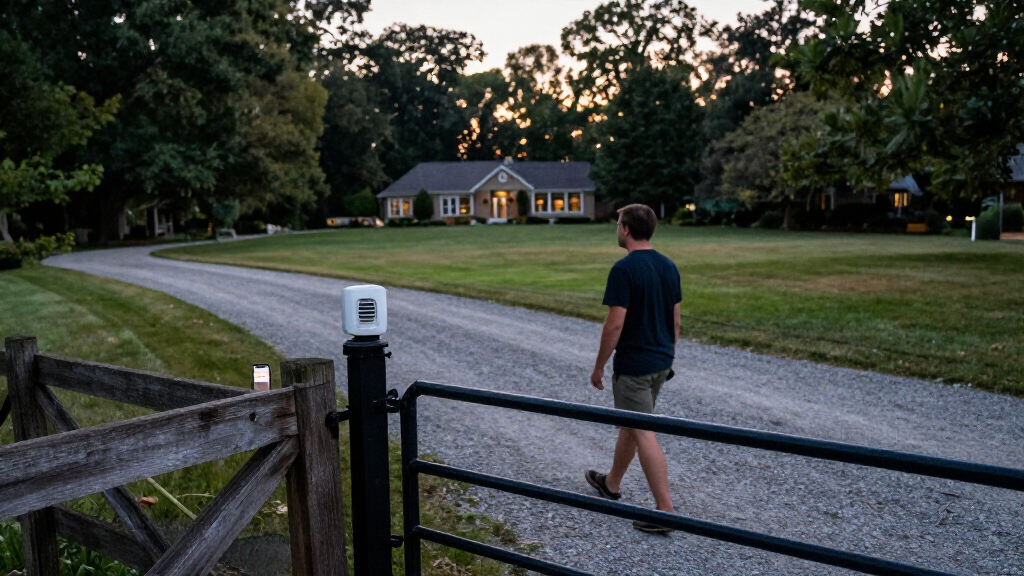
I ranked these options around the demands of a large property: reaching multiple approach points, fitting a practical sensor layout, offering a usable alert setup, and limiting maintenance where possible. I also separated fixed driveway-style systems from portable radar or trip-alarm kits, since they solve different problems and are not interchangeable just because each can provide a perimeter alert.
The four-sensor half-mile driveway package ranks ahead of the two-sensor version because it offers more coverage points while retaining the same stated range. Solar-powered systems earn attention for reducing routine battery work, but their placement needs suitable light. Portable and trip-based options rank lower for general property coverage because they require a more specific use case or setup. Product descriptions do not establish real-world range through obstacles, weather durability, alert customization, or compatibility, so I treat those as questions buyers should verify before choosing.
| perimeter alarm system for large property | Wireless transmission range |
|---|---|
| Driveway Alarm with 1/2 Mile R | Up to 1/2 mile |
| Wuloo Solar Wireless Driveway | — |
| Portable Perimeter Trip Alarm | — |
| HTZSAFE Solar Wireless Drivewa | Up to 0.5 miles |
| Wireless Driveway Alarm System | Up to 1/2 mile; varies by terrain |
| HOZOL 6-Pack 12-Gauge Perimete | — |
| Driveway Alarm with 1/2 Mile R | Up to 1/2 mile |
| LETWESAF Radar Perimeter Secur | — |
| LETWESAF Radar Camping Perimet | Up to 0.5 mile (800 m) |
| Chtoocy Wireless Driveway Alar | — |
Factors to Consider When Choosing Perimeter Alarm System For Large Property
Before choosing a system, I’d map how someone could approach the property and decide what an alert should tell me. The right setup depends on the layout and response plan, not just the biggest range figure or sensor count.
Map approach routes before counting sensors
Start with entrances, gates, driveways, outbuildings, and paths that bypass the main approach. A sensor aimed at an open driveway may miss a person crossing a side field, while several sensors clustered together can leave the same blind spot. For a broad property, plan coverage around likely routes rather than trying to place a device at every boundary point. Check whether the receiver can be positioned where someone will hear or notice it. If one receiver cannot serve the areas where alerts matter, you may need a different architecture or more than one alert location.
Treat wireless range as a starting point, not a promise
Advertised range figures usually describe favorable conditions, and a property adds obstacles that can weaken a wireless link. Buildings, metal structures, dense trees, terrain changes, and interference can all affect communication between sensor and receiver. A longer stated range may be useful across an open field, but it does not automatically outperform a shorter-range option in a complicated layout. Before committing to a permanent mounting plan, check the seller’s range conditions and return policy. Where possible, test the proposed sensor and receiver positions before fixing mounts or relying on alerts.
Match the detection method to the job
Driveway motion sensors are suited to monitoring movement through selected zones, while a trip alarm responds when its physical line or mechanism is triggered. Radar-style portable devices can suit temporary setups, but buyers should verify their sensing area and behavior rather than assuming they cover a whole boundary. Detection method affects nuisance alerts as well as coverage: animals, moving vegetation, or passing activity may trigger some placements. Decide whether you need warning of movement near a route or a direct alert when a specific boundary is crossed. That choice can matter more than adding another sensor of the wrong type.
Plan for power and seasonal conditions
Solar-powered sensors can reduce battery changes, but they still need a location with suitable light and an installation angle that works through the seasons. Shaded gates, north-facing walls, or winter conditions may limit how dependable solar charging is. Battery-powered options can be easier to place in shade, though they create a maintenance task across every sensor. On a large property, the cost of checking and replacing multiple batteries can add up in time even when the devices are inexpensive to run. Choose power based on actual mounting conditions, and confirm what power source the receiver uses as well.
Choose alert placement and sound deliberately
A system only helps if the alert reaches the person who needs to act. Consider whether the receiver will be indoors, in a workshop, or near another active area, and whether the product supports the number of receivers you require. A single receiver may be sufficient for a compact home base but less useful when staff or family members spend time in separate buildings. Also decide whether an audible alert is appropriate: a warning that is easy to hear may be undesirable in some settings, while a quiet or distant alert can go unnoticed. Verify alert options and receiver support from the product details before purchase.
Budget for coverage, not just the starter kit
A starter package may leave gaps if it includes too few sensors for the property’s approach routes. Compare the included sensor count with the number of locations you actually need to monitor, then check whether extra sensors are available and compatible. Do not assume products with similar names or ranges work together; confirm compatibility with the exact model. A larger kit can reduce piecemeal purchasing, but only if its sensors suit the site and the receiver can handle the setup. Paying more makes sense when it buys coverage or lower maintenance you will use, not merely a larger headline specification.
Frequently Asked Questions
Is a 1/2-mile driveway alarm range enough for a large property?
It may be enough across open ground, but the stated range does not confirm performance through buildings, trees, slopes, or other obstacles. Think about the distance from each sensor to the receiver, not just the distance along the driveway. The four-sensor package can cover more approach points than the two-sensor version, yet both still depend on a workable wireless path. Check the product’s range conditions and test placement before relying on it for a remote gate or outbuilding. If the layout has substantial obstructions, a system designed for that environment may be a better fit than choosing by range alone.
Should I choose solar sensors or battery-powered sensors for a remote gate?
Solar sensors are appealing when the gate receives reliable sunlight and you want to reduce routine battery checks. A shaded location or seasonal loss of light can make solar less suitable, so check the site at the sensor’s intended mounting point. Battery-powered sensors offer more flexibility in shade but require a plan for inspecting and replacing batteries. On a remote gate, either option can become inconvenient if you cannot reach it easily for maintenance. Base the choice on the gate’s light exposure and your willingness to service the sensor, rather than treating solar as maintenance-free.
Can one driveway alarm monitor my whole property boundary?
Usually, a driveway alarm is best understood as a set of detection zones, not a continuous boundary barrier. Its sensors need to be placed where they can detect movement along specific approach routes, leaving other parts of the perimeter outside their coverage. A four-sensor package offers more placement options than a two-sensor package, but it still may not cover a large or irregular site. Map entrances and likely paths first, then compare the required locations with the included sensors and receiver support. If continuous boundary detection is the goal, verify that the chosen system’s detection method matches that expectation.
When does a trip alarm make more sense than a wireless driveway sensor?
A trip alarm can fit a specific temporary or controlled location where a physical trip mechanism is appropriate. A wireless driveway sensor is generally more convenient for monitoring movement near a route without setting a trip line across it. The HOZOL kit’s six-pack format may suit buyers who want multiple trip-alarm units, while portable trip alarms are more focused on flexible setups. Neither approach should be treated as a universal substitute for the other: installation, placement, and the type of alert differ. Consider who may cross the area and whether a physical trip mechanism is suitable and safe for that site.
What should I check before buying extra sensors for a multi-point setup?
Confirm that the extra sensors are compatible with the exact receiver model, since similar product names do not prove that devices can pair together. Check the receiver’s supported sensor capacity and whether it can distinguish alerts by location or only signal that movement was detected. Also compare the sensor’s power source and range with the placement you have planned. A sensor that pairs successfully may still be unreliable at a distant or obstructed location. If the product information does not answer these questions, ask the seller before expanding the system.
Conclusion
For most buyers seeking a fixed system across several approaches, I’d choose the Driveway Alarm with 1/2 Mile Range, 1 Receiver, and 4 Sensors as the best overall option in this group; its four sensors give it a practical coverage advantage over the two-sensor package. For best value, compare the two-sensor half-mile model with your actual layout and choose it only if two monitored points are enough. The Wuloo Solar Wireless Driveway Alarm is my best fit for buyers who want four motion sensors with solar-powered sensors, while the HTZSAFE 300-Foot System is a more focused pick when its stated range suits a shorter route. Beginners should favor a straightforward driveway layout and a receiver they can place where alerts will be noticed; the plug-in receiver system may suit that need if its coverage matches the site. For temporary or specialized setups, consider the portable trip alarm or LETWESAF radar kits, and choose the HOZOL trip-alarm pack only when a physical trip-based alert fits the boundary. The best choice is the one that covers your real approach routes and can be maintained where you install it.