
A deep cycle battery power backup system can keep essential equipment running, but the right choice depends on whether you need a standalone battery or a complete backup unit. My best overall pick is the Dyness 12V 100Ah Bluetooth LiFePO4 battery, which pairs lithium chemistry with app monitoring for RV, solar, and off-grid use. The Weize 100Ah AGM is a simpler alternative for buyers who prefer lead-acid, while the 2500W sump pump backup system is purpose-built for flood protection rather than general battery projects. The main tradeoffs are usable capacity, charging needs, cold-weather performance, and whether the system includes the inverter or controls your equipment requires. Read on for the full comparison and guidance on matching a battery to your backup load.

Get the latest gadgets delivered free with Prime
- Fast, free delivery on millions of items
- Prime Video, Amazon Music and more included
- Member-only deals all year
Complete the kit



Key Takeaways
The Dyness 100Ah LiFePO4 is the most versatile battery pick in this group: Bluetooth monitoring and RV, solar, and off-grid compatibility make it easier to track a general-purpose setup than a basic AGM battery.
Battery-only products and complete backup systems are not interchangeable. The 2500W sump pump unit and GOLDENMATE UPS include backup-system functions, while most entries are batteries that need compatible charging and power-conversion equipment.
Capacity changes the job a battery can handle. The 300Ah self-heating LiFePO4 is the standout for higher energy needs and cold conditions, while 100Ah models suit more modest or modular setups.
AGM remains a simpler chemistry choice, not a like-for-like lithium substitute. The Weize and Renogy AGM options avoid lithium-specific setup considerations, but buyers should compare weight, usable energy, and maintenance expectations against LiFePO4.
Compactness and monitoring are separate advantages. Renogy’s mini-size LiFePO4 emphasizes a smaller footprint and remote monitoring; buyers with tight installation space may prefer it over a standard-size 100Ah battery.


| deep cycle battery power backup system | Voltage | Capacity | Dimensions |
|---|---|---|---|
| Dyness 12V 100Ah Bluetooth LiF | 12.8 volts | 100 amp-hours | 6.77 × 12.99 × 8.43 inches |
| Weize Deep Cycle AGM 12 Volt 1 | 12 volts | 100Ah | 12.99 × 6.73 × 8.43 inches |
| 2500W Sump Pump Battery Backup | — | — | — |
| 12.8V 300Ah Self-Heating LiFeP | 12.8V | 300Ah | — |
| GOLDENMATE 1500VA/1000W Lithiu | — | — | — |
| Renogy 12 Volt 100Ah Deep Cycl | 12V | 100Ah | — |
| 12V 100Ah LiFePO4 Battery | 12.8V | 100Ah | 12.9 x 6.69 x 8.5 inches |
| Renogy 12V 100Ah LiFePO4 Lithi | 12V | 100Ah | 9.02 x 5.43 x 8.39 inches |
More Details on Our Top Picks
Dyness 12V 100Ah Bluetooth LiFePO4 Lithium Battery for RV, Solar, Off-Grid
The Dyness 12V 100Ah LiFePO4 is a good fit for buyers replacing a lead-acid battery in an RV, solar setup, or off-grid system who want status information without opening a compartment. Its Bluetooth app monitoring makes battery checks more convenient, while the listed life of over 4,000 deep cycles points to a longer-use alternative to the Weize 100Ah AGM. Low-temperature protection and built-in BMS safeguards add useful protection for everyday system use, and its 25.3-pound weight is manageable for a 100Ah battery.
The tradeoff is that this is still a single 100Ah battery, not the high-capacity solution offered by the 300Ah self-heating model. Expansion can also take planning, and the product data calls for a specific charger for best performance without specifying a warranty duration. I’d choose it for app visibility and lithium cycle life, but not for buyers seeking a simple, fully documented plug-and-play setup.
Pros:- Bluetooth app provides real-time battery monitoring.
- Listed for over 4,000 deep cycles, exceeding the Weize AGM’s maintenance-focused value proposition.
- BMS protection and low-temperature protection support safer battery operation.
- Expandable configuration can serve as a starting point for a larger system.
Cons:- A specific charger is recommended for optimal performance.
- Planning series or parallel expansion may require technical knowledge.
- Warranty duration is not specified in the provided product data.
Best for: RV and off-grid owners replacing a 12V 100Ah lead-acid battery who want Bluetooth status checks and a lithium-based deep-cycle system.
Not ideal for: Buyers who need a stated long-term warranty, prefer AGM simplicity, or want 300Ah capacity in one battery.
- Voltage:12.8 volts
- Capacity:100 amp-hours
- Battery type:Lithium-ion LiFePO4
- Weight:25.3 pounds
- Dimensions:6.77 × 12.99 × 8.43 inches
- Terminals:M8
- Maximum energy storage:20.48 kWh
- Series/parallel configuration:4S4P
Our verdict“Choose the Dyness for a monitorable 100Ah lithium replacement, but pick another option if you need a larger single-battery reserve or clearly stated warranty coverage.”
Weize Deep Cycle AGM 12 Volt 100Ah Battery
The Weize 12V 100Ah AGM suits buyers who want a sealed, maintenance-free deep-cycle battery and do not need the app monitoring or lithium cycle-life claims of the Dyness 100Ah LiFePO4. Its 1–3% monthly self-discharge rate is useful for equipment that sits between trips, and the sealed design avoids routine electrolyte maintenance. Compatibility with RV, solar, marine, and off-grid use gives it a broad range of potential roles.
That simpler chemistry has a clear cost in system weight and temperature sensitivity: the listed battery is bulky for portable use, and its operating range begins at 14°F. The one-year warranty is also shorter than many buyers may want for a backup component expected to sit ready for outages. I’d favor Weize when familiar AGM behavior and low-maintenance storage matter more than reduced weight or longer lithium cycle life; buyers building a frequently cycled system should compare it closely with Dyness.
Pros:- Sealed, maintenance-free construction avoids routine electrolyte service.
- Low listed self-discharge helps when the battery is stored between uses.
- 100Ah capacity suits common 12V RV, solar, and marine setups.
- Broad application range covers several common deep-cycle roles.
Cons:- Heavier and bulkier for portable use than a lithium alternative such as Dyness.
- Listed operating temperature starts at 14°F, limiting cold-weather flexibility.
- One-year warranty offers limited coverage for a long-term backup component.
Best for: RV, marine, and backup-system owners who want a sealed 100Ah AGM battery for moderate cycling and periods of storage.
Not ideal for: Frequent off-grid users prioritizing low weight, cold-weather operation, long cycle life, or a warranty longer than one year.
- Voltage:12 volts
- Capacity:100Ah
- Dimensions:12.99 × 6.73 × 8.43 inches
- Maximum discharge current:1150A
- Self-discharge rate:1–3% per month
- Operating temperature:14°F to 122°F
- Best operating temperature:77°F (25°C)
- Warranty:1 year
Our verdict“Choose the Weize if you want a straightforward sealed AGM battery for occasional or moderate deep-cycle use and can accommodate its weight and temperature limits.”
2500W Sump Pump Battery Backup System
Unlike the standalone Dyness and Weize batteries, this 2500W sump pump backup system combines an inverter, charger, and automatic transfer function to keep a compatible sump pump running when utility power fails. Its pure sine wave output is suited to pump motors and other sensitive loads, while the 25A multi-stage charger handles battery charging as part of the system. The LCD remote also gives a clearer view of battery voltage and operating status than a basic inverter setup.
This is the most purpose-built backup choice in the group, but it is not a complete battery system: a compatible 12V deep-cycle battery must be purchased separately. It can accept LiFePO4, AGM, GEL, and flooded batteries, so buyers can pair it with options such as Dyness or Weize, though battery choice affects runtime and maintenance. Its hardwire output must not connect to utility or generator power, which makes installation planning important. I’d pick it for sump protection, not as a general replacement for a battery alone.
Pros:- Automatically switches to battery power when utility power fails.
- Pure sine wave output is designed for sump pumps and sensitive devices.
- 25A multi-stage charger includes several listed electrical protections.
- LCD remote reports battery voltage, load status, and operating mode.
Cons:- Deep-cycle battery is not included, so runtime depends on a separate purchase.
- Hardwire output must not be connected to utility or generator power.
- At 19.06 inches long overall, it needs a suitable installation location.
Best for: Homeowners who need automatic 120V backup for a compatible sump pump and are prepared to select and install a separate 12V deep-cycle battery.
Not ideal for: Buyers seeking an all-in-one battery backup, a portable battery, or a system without installation and wiring constraints.
- Input:12V DC
- Output:120V AC
- Continuous output power:2500W
- Peak output power:5000W
- Waveform:Pure sine wave
- Charger:25A, multi-stage
- Battery compatibility:LiFePO4, AGM, GEL, and flooded deep-cycle batteries
- AC outlets and ports:3 AC outlets; USB and Type-C
- Weight and overall dimensions:10.9 pounds; 19.06 × 9.53 × 4.29 inches
Our verdict“Choose this unit for automatic sump-pump backup if you can supply a compatible battery and follow its wiring restrictions.”
12.8V 300Ah Self-Heating LiFePO4 Lithium Battery with APP Monitoring
For a deep-cycle backup system that needs substantial reserve in one battery, this 12.8V 300Ah LiFePO4 offers three times the listed capacity of the Dyness 100Ah battery. That larger reserve can reduce the need to combine multiple batteries for a 12V installation, while the self-heating function is a useful differentiator for cold-weather use. Its app monitoring and stated life of over 5,000 cycles also make it more feature-rich than the Weize AGM for buyers building a frequently used storage system.
The capacity and cold-weather features do not make it a universal battery. Product data says it cannot be used as a starter or golf cart battery, and monitoring depends on app setup. The provided details also omit dimensions, weight, voltage limits, and warranty information, which makes fit and system planning harder than with the more fully specified Dyness. I’d shortlist it for high-capacity stationary or RV storage in cold conditions, but not for buyers who need a compact, well-documented drop-in replacement.
Pros:- 300Ah capacity provides substantially more reserve than the Dyness 100Ah battery.
- Self-heating feature supports use in low temperatures.
- Listed cycle life exceeds 5,000 cycles.
- App-enabled monitoring provides remote access to battery information.
Cons:- Not suitable for starter or golf cart battery applications.
- App setup is needed to use its monitoring feature.
- Provided product data does not state dimensions, weight, or warranty duration.
Best for: RV and off-grid users who need a large 12V energy reserve, app monitoring, and battery heating for cold-weather operation.
Not ideal for: Starter-battery or golf-cart buyers, as well as shoppers who need published dimensions, weight, or warranty details before planning installation.
- Voltage:12.8V
- Capacity:300Ah
- Battery type:LiFePO4
- Cycle life:Over 5,000 cycles
- Self-heating:Yes
- Monitoring:App-enabled
- BMS protection:Advanced BMS protection
- Excluded applications:Starter battery and golf cart battery use
Our verdict“Choose this battery when high 12V capacity and cold-weather self-heating matter more than compact size or complete published installation details.”
GOLDENMATE 1500VA/1000W Lithium UPS Battery Backup & Surge Protector, White
The GOLDENMATE 1500VA/1000W Lithium UPS is a different kind of backup choice from the standalone deep-cycle batteries in this roundup: it is a ready-to-connect AC UPS for computers and network equipment, not a 12V battery for an RV or off-grid inverter. Its LiFePO4 battery, pure sine wave output, eight outlets, USB charging, and LCD status display make it suited to keeping several desk or network devices powered through an interruption. The listed 3,000-plus charge cycles and over-10-year battery life also set it apart from a conventional sealed lead-acid UPS.
Compared with the 2500W sump pump system, GOLDENMATE is easier to use with standard AC equipment but offers less listed output power and is not designed around a separate deep-cycle battery bank. Its 120V AC input range may limit use with some generators or in other regions, and the cooling fan can be noisy under heavy load. I’d choose it for electronics backup, not for high-capacity household or off-grid storage.
Pros:- LiFePO4 battery is listed for over 3,000 charge cycles and more than 10 years of use.
- Pure sine wave output suits computers and network equipment.
- Eight outlets and USB charging support multiple connected devices.
- LCD display provides real-time operating information.
Cons:- 1000W output is below the 2500W sump pump inverter’s listed continuous output.
- Designed for standard utility AC input and may not support generator-supplied power.
- Listed 90–140V AC input range can limit use in some regions.
- Cooling fan may be noisy under heavy use.
Best for: Home-office and network users who want a self-contained LiFePO4 UPS for computers, routers, and other standard AC equipment.
Not ideal for: RV, solar, or sump-pump buyers who need a 12V deep-cycle battery system, higher output than 1000W, or generator flexibility.
- Battery chemistry:LiFePO4
- Input voltage:120 volts
- Output voltage:120 volts
- Output waveform:Pure sine wave
- Number of outlets:8
- Power plug and connector:Type B, 3-pin; NEMA
- Battery life and cycle claim:Over 10 years; 3,000+ charge cycles
Our verdict“Choose GOLDENMATE for convenient computer and network backup, but select a 12V battery-and-inverter setup for deep-cycle RV, solar, or sump-pump power.”
Renogy 12 Volt 100Ah Deep Cycle AGM Battery
I’d choose this 100Ah AGM battery when a power backup system needs a straightforward, maintenance-free lead-acid option that can handle varied temperatures. Its stated 1100A discharge current suits applications with substantial short bursts of demand, while a 3% self-discharge rate at 77°F helps it retain charge during storage. Compared with the 12V 100Ah LiFePO4 options in this roundup, it avoids lithium-specific system compatibility questions, but it is heavier and lacks their long cycle-life claims. That makes it a more grounded fit for an RV, marine setup, or backup bank where AGM is already supported—not the best choice for frequent cycling or portability. The tradeoff is clear: stable AGM chemistry and storage convenience over lighter weight and lithium longevity.
Pros:- Maintenance-free AGM design avoids routine electrolyte checks.
- Stated 1100A discharge current supports high short-duration demand.
- Low 3% self-discharge rate at 77°F helps during storage.
- Designed for performance across a wide range of temperatures.
Cons:- Heavier and bulkier for portable or space-limited installations.
- AGM chemistry generally offers less cycle-life potential than the listed LiFePO4 batteries.
- A 12V, 100Ah capacity may not cover extended backup loads without additional batteries.
Best for: RV and marine owners with AGM-compatible charging equipment who want a maintenance-free 100Ah battery for occasional backup use across changing temperatures.
Not ideal for: Buyers building a frequently cycled off-grid system or needing a battery they can move easily; this AGM model is heavy and does not offer the cycle-life advantages claimed for the LiFePO4 options.
- Voltage:12V
- Capacity:100Ah
- Discharge current:1100A
- Self-discharge rate:3% at 77°F (25°C)
- Chemistry:AGM
- Maintenance:Maintenance-free
Our verdict“Choose this Renogy AGM for a temperature-flexible, low-maintenance backup battery when your system already suits AGM and portability is not a priority.”
12V 100Ah LiFePO4 Battery, 1280Wh Lithium Battery with Smart BMS, 10-Year Lifespan, Suitable for RVs, Marine, Off-Grid Solar, Trolling Motors
This battery is the strongest fit here for buyers who expect a backup system to cycle often rather than sit charged for emergencies. Its stated 15,000+ deep cycles and 1280Wh capacity make it more suited to repeated RV, marine, or solar use than the Renogy AGM, while its 24-pound weight is easier to manage than a typical AGM battery. The smart BMS adds battery protection, and series/parallel expansion supports a larger bank, up to the stated 20.48kWh. Those benefits come with system limits: it is a 12V battery, delivers a maximum 100A discharge current, and needs compatible charging and inverter equipment. Compared with the compact Renogy Mini, this model provides more disclosed capacity and expansion detail, but its listed dimensions are larger. I’d favor it for a scalable, frequently cycled 12V setup, not a higher-voltage system.
Pros:- Stated 15,000+ deep-cycle life supports frequent use.
- Provides 1280Wh of stated energy at 100Ah capacity.
- At 24 pounds, it is easier to handle than a bulky AGM battery.
- Series/parallel connections support expansion up to the stated 20.48kWh.
Cons:- Maximum discharge current is 100A, which may restrict high-demand loads.
- Requires compatible solar, charging, and inverter equipment.
- 12V design does not suit higher-voltage systems.
Best for: RV, marine, and off-grid solar owners who regularly cycle a 12V battery and want a lightweight, expandable bank with a smart BMS.
Not ideal for: Buyers with higher-voltage equipment, incompatible chargers, or a tight upfront budget; this battery is limited to 12V systems and needs compatible power electronics.
- Voltage:12.8V
- Capacity:100Ah
- Energy:1280Wh
- Cycle life:15,000+ deep cycles
- Temperature range:-4°F to 140°F (-20°C to 60°C)
- Dimensions:12.9 x 6.69 x 8.5 inches
- Weight:24 lb
- Maximum discharge current:100A
- Expandable capacity:Up to 20.48kWh with series/parallel connections
Our verdict“Pick this LiFePO4 model for a frequently cycled, expandable 12V backup bank, provided your charging gear supports lithium batteries.”
Renogy 12V 100Ah LiFePO4 Lithium Battery Mini Size with 100A BMS and Remote Monitoring
For installations where every inch matters, this compact Renogy LiFePO4 has a distinct advantage over the larger 12V 100Ah LiFePO4 battery listed here: its footprint is just 9.02 x 5.43 inches. That can make fitting a 100Ah battery into a crowded boat or RV compartment easier, while the 100A BMS and IP65-rated casing add protection for demanding installation environments. Remote monitoring is available, but it requires additional accessories, so it is not a complete out-of-the-box monitoring setup. Unlike the other lithium model, the supplied specifications do not state energy, cycle life, weight, or expansion capacity; buyers comparing long-term value or planning a larger bank have less information to work with. Its five-year warranty is also shorter than the 10-year lifespan claim on the other LiFePO4 option. I’d prioritize its small size over expansive performance documentation.
Pros:- Compact 9.02 x 5.43-inch footprint suits tight battery compartments.
- 100A BMS provides battery protection.
- IP65-rated casing is suited to dusty or wet installation environments.
- Remote monitoring capability is available with additional accessories.
Cons:- Remote monitoring requires separately obtained accessories.
- Supplied specifications do not state cycle life, energy, weight, or expansion limits.
- Five-year warranty is shorter than the 10-year lifespan claim for the other LiFePO4 battery.
Best for: RV and boat owners fitting a 12V, 100Ah lithium battery into a narrow compartment who value a protected casing and optional remote status checks.
Not ideal for: Buyers choosing primarily by stated cycle life, energy capacity, or battery-bank expansion; those details are not provided here, and remote monitoring needs extra accessories.
- Voltage:12V
- Capacity:100Ah
- Chemistry:LiFePO4
- BMS:100A
- Dimensions:9.02 x 5.43 x 8.39 inches
- Water and dust resistance:IP65
- Warranty:5 years
- Remote monitoring:Available; additional accessories required
Our verdict“Choose this Renogy Mini when compartment space is the main constraint, but compare other options if cycle-life data or built-in monitoring matters more.”
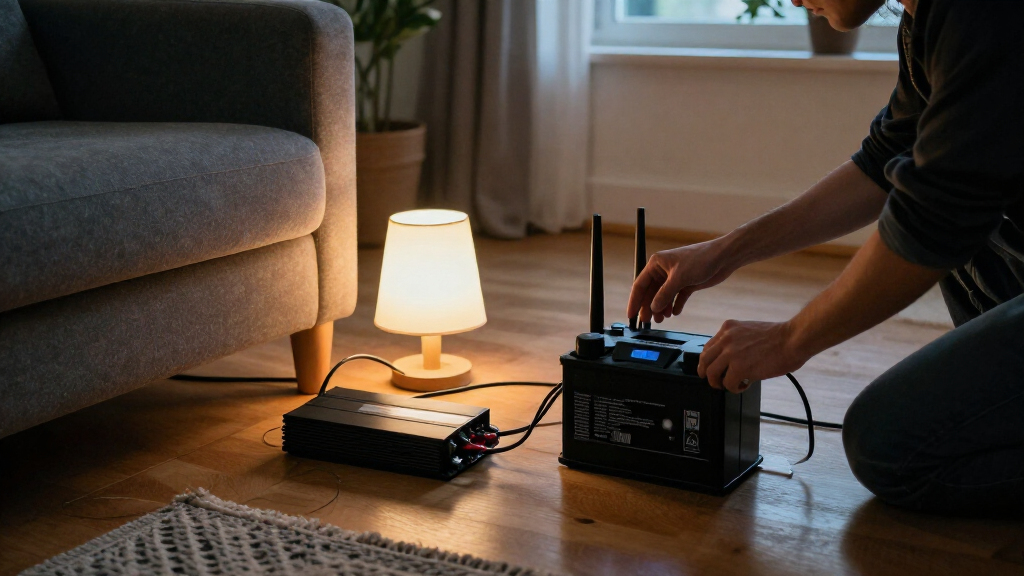
How We Picked
I ranked these products by how well they serve a real backup-power job, not by treating every battery as a complete system. I looked at chemistry, stated capacity, monitoring, cold-weather features, form factor, and the intended application, then weighed how much additional equipment a buyer may need. A battery-only product can be a strong fit for an RV or solar setup, but it is not ready to power household devices without compatible charging, an inverter, wiring, and protection.
The order favors versatility and practical fit for the broadest range of backup buyers, followed by options with a clear advantage for a specific need. The Dyness leads as a monitored, general-purpose lithium battery; the sump pump system and GOLDENMATE UPS stand apart for ready-made, dedicated backup roles. The 300Ah self-heating model earns attention for capacity and cold-weather use, while the AGM and compact lithium choices are ranked by their distinct tradeoffs rather than assumed to be interchangeable.
Factors to Consider When Choosing Deep Cycle Battery Power Backup System
Before choosing a battery, define what must stay powered and what equipment will connect it to the load. These checks help avoid a common mismatch: buying a capable battery when the actual need is a complete, automatic backup system—or selecting a backup unit that cannot run the required load for long enough.
Start With the Load and Required Runtime
List the devices you want to power, their running watts, and any brief startup surge from motors or compressors. Add the loads you expect to run at the same time, then estimate runtime from their energy use rather than relying on the battery’s amp-hour label alone. A sump pump, refrigerator, and small electronics place very different demands on a backup system. Leave a margin for conversion losses and for battery capacity that may not be usable in your chosen setup. If the load has a large startup surge, check the inverter’s surge rating as well as its continuous output.
Decide Whether You Need a Battery or a Complete System
A standalone deep-cycle battery stores energy; it does not automatically supply the outlets or switching behavior a home backup may require. A complete system may add an inverter, charger, transfer function, alarms, or dedicated pump connections, but those features vary by product. Before ordering a battery-only model, map out the compatible charger, inverter, cables, fuses, and enclosure. For equipment that must switch on during an outage without manual intervention, confirm the system supports automatic backup operation. The convenience of a ready-made unit can outweigh the flexibility of assembling separate components.
Choose Chemistry for the Way You Use It
AGM batteries appeal to buyers seeking a familiar lead-acid format, while LiFePO4 models are often selected for lighter mobile setups, monitoring features, or repeated cycling. Compare usable capacity and cycle-life information from the manufacturer, not just nominal amp-hours, because these figures describe different things. Lithium batteries also require a compatible charging profile and battery management system. AGM still has its own charging and ventilation requirements, so it is not a maintenance-free fit for every location. The best chemistry depends on the whole system, including charger compatibility, use frequency, and installation conditions.
Plan for Cold Weather and Installation Conditions
Temperature can affect both battery performance and safe charging, particularly in an unheated garage, shed, or vehicle. A self-heating battery can reduce cold-weather charging friction, but buyers should verify its operating limits and how the heating function draws power. Do not assume that a battery labeled for outdoor or mobile use can be exposed directly to rain, freezing temperatures, or poor ventilation. Check the manufacturer’s placement, enclosure, and terminal-protection guidance before installation. In a climate-controlled indoor setup, paying extra for cold-weather features may bring little benefit.
Match Capacity, Size, and Expansion Plans
A larger-capacity battery can support longer runtime, but it also takes more space and may add weight or require more substantial wiring and charging equipment. Measure the intended installation area, including room for cable bends, ventilation, and service access, rather than checking only the battery’s outer dimensions. Compact models can solve fit problems, while a larger 300Ah option may reduce the need to combine multiple batteries. If you plan to expand later, confirm that the manufacturer permits the intended series or parallel configuration and specifies matching requirements. Avoid mixing batteries with different chemistries, ages, or capacities unless the system documentation explicitly allows it.
Check Monitoring, Maintenance, and Backup Behavior
Bluetooth apps and remote monitoring can make it easier to track charge state, but they do not replace proper sizing or a low-battery plan. Ask whether monitoring works locally, requires a nearby phone, or depends on a separate connection. For a UPS or sump pump setup, check alarms, self-tests, recharge behavior, and what happens when utility power returns. For a battery bank, follow the manufacturer’s inspection and charging instructions and plan how you will confirm the system is ready before an outage. Prioritize features that address a real task in your setup instead of paying for monitoring you are unlikely to use.
Frequently Asked Questions
Can I use a deep-cycle battery by itself as a home power backup?
Usually, a battery alone cannot power household AC devices directly. You will generally need a compatible inverter, a charger or charging source, suitable wiring, fusing, and a safe installation plan. If you want automatic changeover when utility power fails, the system also needs a compatible transfer or UPS function. A purpose-built unit such as a UPS or sump pump backup may include some of these parts, but its output and intended loads still need to match your equipment. Check the product documentation before connecting household circuits.
How do I tell whether 100Ah is enough for my backup needs?
Start with the wattage of each device and how many hours you need it to run. Convert the expected use into energy, then account for inverter losses and the usable portion of the battery’s stated capacity. Motor loads can add a separate challenge because their startup demand may exceed their normal running draw. A 100Ah label alone does not tell you the runtime for a particular appliance, especially when comparing different battery chemistries or system voltages. If the calculation is close, size up or reduce the load rather than relying on ideal conditions.
Should I choose AGM or LiFePO4 for an RV or off-grid backup setup?
Choose based on the complete setup, not chemistry in isolation. LiFePO4 may suit frequent cycling and mobile use, but it needs compatible charging and a battery management system; cold-weather charging limits also matter. AGM can fit buyers who prefer a familiar lead-acid option, though its weight and usable capacity may change how much battery space the installation needs. Compare manufacturer specifications for capacity, charging, cycle life, and operating temperature. If the existing charger is not compatible with your preferred chemistry, include a charger change in the plan.
When is a dedicated sump pump backup better than buying a larger battery?
A dedicated sump pump system makes more sense when the main job is keeping that pump operating during an outage and you want purpose-built connections or backup behavior. A larger standalone battery can offer flexibility for other loads, but it may still need an inverter, controls, and a safe way to connect the pump. Check the pump’s running and startup demands against the system’s output ratings, then compare expected runtime with the likely outage length. If you also need to power electronics or other appliances, a dedicated pump unit may not cover those needs. If flood protection is the priority, avoid assuming that a general battery bank will perform the same role without compatible components.
What should I verify before connecting two deep-cycle batteries together?
First check that the batteries are approved for the intended series or parallel arrangement and that the system voltage matches the inverter and charger. Follow the manufacturer’s rules for matching chemistry, capacity, age, and state of charge; mismatched batteries can charge and discharge unevenly. Use correctly sized cables, overcurrent protection, and the specified wiring layout, and have a qualified installer review a high-current system if you are uncertain. Confirm that the charger supports the combined bank and that its settings match the battery chemistry. Never treat a second battery as a simple capacity add-on without checking the full system design.
Conclusion
For the broadest mix of RV, solar, and off-grid backup uses, my best overall pick is the Dyness 12V 100Ah LiFePO4, thanks to its Bluetooth monitoring and general-purpose fit. The best value for a straightforward AGM setup is the Weize 100Ah, while the best premium-capacity choice is the 300Ah self-heating LiFePO4 for buyers who need more stored energy and cold-weather support. Beginners who want a dedicated device rather than a battery-building project should look closely at the GOLDENMATE UPS for electronics or the sump pump backup for flood protection, depending on the load. Choose the Renogy mini LiFePO4 when installation space and remote monitoring lead your priorities, and compare the Renogy AGM with the Weize if you want a conventional lead-acid battery. The final decision should follow your load, runtime target, and whether you need a battery alone or a complete backup system.