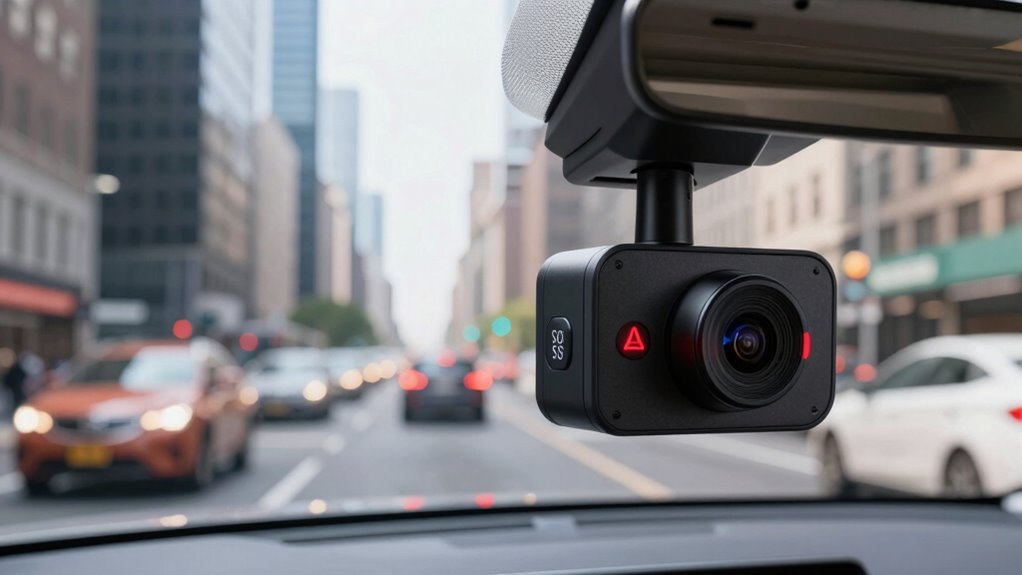

A dash cam with an emergency SOS button can mean different things: some cameras offer incident alerts or remote connectivity, while others mainly save footage after a collision. My best overall pick is the 70mai A810 Lite, because its listed 4G LTE remote access, GPS, and emergency lock features give it a stronger connected-safety profile than a basic recording camera. The Nextbase Piqo is a simpler choice for drivers who want a compact 1080p camera, while the LNCOON 4G stands out for front-and-cabin coverage and cellular connectivity. The main tradeoffs are cellular service and setup versus simpler operation, and wider coverage versus the sharper detail of a front-facing 4K camera. Read on for the full comparison and guidance on what an SOS feature can—and cannot—do.

Get the latest gadgets delivered free with Prime
- Fast, free delivery on millions of items
- Prime Video, Amazon Music and more included
- Member-only deals all year
Complete the kit


Key Takeaways
- The 70mai A810 Lite is the strongest fit for buyers prioritizing connected features: its listing specifies 4G LTE remote access, GPS, and emergency lock, though remote functions may depend on service and setup.
- The REDTIGER, ROVE, and Coolcrazy models emphasize 4K dual-camera recording and included memory; their listed features do not establish a dedicated emergency SOS calling service.
- The LNCOON combines 4G connectivity with front-and-interior coverage, making it a distinct choice for rideshare or cabin-monitoring needs rather than the broadest rear-road coverage.
- The Nextbase Piqo is the most approachable listed option for a buyer seeking a basic 1080p smart camera, but its feature set is less extensive than the connected 4K systems.
- Across the lineup, emergency lock, incident reports, remote access, and SOS calling are different functions; buyers should verify exactly what triggers an alert and whether a subscription or phone connection is required.


| dash cam with emergency sos button | Video resolution | GPS | Connectivity | Field of view |
|---|---|---|---|---|
| REDTIGER 4K STARVIS 2 Dash Cam | 4K UHD front, 1080p FHD rear | Built-in | — | 170° front, 140° rear |
| 3 Channel 4K Full UHD Dash Cam | — | — | Wi-Fi with dedicated app | 170° front, 150° interior, 160° rear |
| Nextbase Piqo 1K Smart Dash Ca | 1080p | — | Wireless; smartphone app | 140° |
| 70mai A810 Lite 4K Dash Cam Fr | 4K front, 1080p rear | GPS, GLONASS, and BDS | 5GHz Wi-Fi 6; 4G LTE support | — |
| PERNIS 4K Dash Cam Front and R | Native 4K front, HDR 1080p rear | Built-in; logs coordinates, speed, and date | — | 140° front and rear |
| ROVE R2-4K Dual Dash Cam Front | Upscaled 4K front (2160P), 1080P rear | Built-in; records live speed and compass | — | 150° front and 140° rear |
| Coolcrazy 4K Dual Dash Cam wit | — | — | 5GHz WiFi | — |
| LNCOON 4G Dual Dashcam for Car | 1080P | Yes | WiFi and 4G LTE | — |
| Escort M2 Smart Dash Cam | 1080P Full HD | Built-in; records speed and location | Dual-band WiFi | — |
More Details on Our Top Picks
REDTIGER 4K STARVIS 2 Dash Cam with Front and Rear Cameras, WiFi, GPS, Voice Control, 128GB Included
The REDTIGER earns this role through its 4K front and 1080p rear recording, backed by a STARVIS 2 sensor and wide views that help capture context around an incident. Compared with the Nextbase Piqo 1K, it gives up the compact, explicitly advertised Emergency SOS feature in favor of a second camera and sharper front footage. That makes it a stronger fit for drivers prioritizing recorded evidence over an SOS service. Built-in GPS, voice control, and 5GHz Wi-Fi add useful ways to document and retrieve clips without handling the camera while driving. The tradeoff is that parking monitoring needs a separate hardwire kit, and the small touchscreen and more involved installation may frustrate first-time installers. The product details do not list an emergency SOS function, so buyers seeking one should choose the Piqo instead.
Pros:- 4K front and 1080p rear recording cover both ends of the vehicle.
- STARVIS 2 sensor and night vision support low-light recording.
- Built-in GPS logs location and speed.
- Voice control and 5GHz Wi-Fi make basic operation and clip sharing more convenient.
Cons:- Emergency SOS is not listed among its features.
- Parking monitoring requires a separately purchased hardwire kit.
- Small touchscreen and more involved installation may be challenging for some owners.
Best for: Drivers who want high-resolution front-and-rear evidence, GPS route data, and hands-free controls, and do not require an SOS service.
Not ideal for: Buyers who specifically need an emergency SOS button or automatic emergency contact support; no such feature is listed for this model.
- Video resolution:4K UHD front, 1080p FHD rear
- Sensor:STARVIS 2
- Field of view:170° front, 140° rear
- Wi-Fi:5GHz
- Included memory card:128GB
- Display:3.18-inch touchscreen
- GPS:Built-in
- Parking mode:Supported; requires hardwire kit
Our verdict“Choose the REDTIGER for detailed dual-camera footage and GPS, but pick the Nextbase Piqo if an advertised Emergency SOS service is your priority.”
3 Channel 4K Full UHD Dash Camera for Cars with Built-in 32GB Card and Night Vision
When coverage inside the cabin matters as much as the road ahead, this camera’s three-channel setup is the distinguishing feature: 4K front footage plus 1080p interior and rear views. That gives it a different job from the REDTIGER dual-channel camera, which offers a larger included card and GPS but does not list an interior camera. Infrared lighting supports cabin recording in low light, making this configuration relevant to rideshare drivers and families who want a record of what happens inside the car. Plug-and-play installation is a welcome contrast to more involved setups, though routing the rear-camera cable still takes care. Its 32GB card is modest beside the REDTIGER’s 128GB, and 24-hour parking monitoring needs optional hardwiring. No Emergency SOS function is listed, so this is a coverage-first choice rather than an SOS-focused one.
Pros:- Records front, cabin, and rear views at the same time.
- Infrared lights support interior recording in low light.
- Plug-and-play setup is described as easy to install.
- App supports live viewing and video downloads.
Cons:- Emergency SOS is not listed.
- Included 32GB card offers less storage than the REDTIGER’s 128GB card.
- 24-hour parking mode needs an optional hardwiring kit, and rear-camera wiring can take care.
Best for: Rideshare drivers and family-car owners who want simultaneous road, cabin, and rear recording and can manage rear-camera wiring.
Not ideal for: Drivers whose main requirement is an emergency SOS feature, or those who want generous included storage without upgrading the card.
- Camera resolution:4K front, 1080p interior, 1080p rear
- Field of view:170° front, 150° interior, 160° rear
- Night vision:Infrared with four IR lights
- Included memory card:32GB
- Connectivity:Wi-Fi with dedicated app
- Recording:Loop recording
- Impact detection:G-sensor
- Parking mode:Supported with optional hardwiring kit
Our verdict“Pick this three-channel model when cabin footage is a priority; choose the REDTIGER for a larger included card and listed GPS, or the Nextbase Piqo for Emergency SOS.”
Nextbase Piqo 1K Smart Dash Cam, 1080p
The Nextbase Piqo is the clearest match here for shoppers who mean an actual emergency feature when they search for a dash cam with emergency SOS: its listed service can share GPS location and critical details. That sets it apart from the REDTIGER and PERNIS, whose product details describe recording and emergency locking but do not list an SOS service. The compact windshield-mounted design and automatic collision-footage locking suit drivers who want a simpler camera rather than a multi-camera evidence system. The compromise is video coverage: this model records 1080p through a 140-degree view, while the REDTIGER and PERNIS offer 4K front recording and rear cameras. Also, Emergency SOS requires a Piqo Protect+ subscription; Smart Parking needs a separately sold cable. Check service and accessory requirements before choosing it.
Pros:- Emergency SOS can share GPS location and critical details.
- Compact design takes up less windshield space than multi-camera systems.
- Collision footage is automatically locked.
- Voice control and app connectivity support convenient operation.
Cons:- Emergency SOS requires a Piqo Protect+ subscription.
- Smart Parking requires a separately sold Quick Connect or Pro Install Cable.
- 1080p resolution and a single listed camera provide less coverage than the REDTIGER or PERNIS dual-camera systems.
Best for: Drivers who want a compact dash cam with a listed Emergency SOS service that can share GPS location and incident details, and are prepared for the subscription requirement.
Not ideal for: Drivers seeking 4K footage, rear-camera coverage, or SOS functionality without a subscription and separate parking-mode cable.
- Video resolution:1080p
- Field of view:140°
- Frame rate:30 FPS
- Emergency SOS:Shares GPS location and critical details; Piqo Protect+ subscription required
- Storage capacity:128GB
- Connectivity:Wireless; smartphone app
- Mounting:Windshield mount
- Dimensions:1.26 x 1.57 x 4.25 inches (D x W x H)
Our verdict“Choose the Piqo if Emergency SOS matters more than 4K or rear-camera recording, and confirm you are comfortable with its subscription and cable requirements.”
70mai A810 Lite 4K Dash Cam Front and Rear, 5GHz Wi-Fi 6 DashCam, Car Camera 4G LTE Remote Access, GPS Tracking, HDR Night Vision, 24H Parking Mode, Voice Control, Emergency Lock, Loop Recording
The 70mai A810 Lite stands apart through 4G LTE remote access: with the required UP05 4G hardwire kit, owners can check live footage, location, and alerts when away from the car. That is a different kind of reassurance from the Nextbase Piqo’s Emergency SOS, which is the listed option for sharing GPS location and critical details in an emergency. The 70mai instead focuses on remote vehicle monitoring, dual-camera evidence, and parking coverage. Its 4K front, 1080p rear, HDR night vision, and three-mode GPS make it a feature-rich choice for frequent drivers, while Wi-Fi 6 is intended to speed up phone transfers. The catch is that remote access and parking modes rely on separately purchased hardwire hardware; LTE support should not be mistaken for an SOS service, which is not listed.
Pros:- 4G LTE support enables remote live viewing, vehicle tracking, and alerts with the required kit.
- 4K front and 1080p rear recording combine with HDR night vision.
- GPS uses GPS, GLONASS, and BDS to record route and location data.
- Supercapacitor design is specified for stable operation in extreme temperatures.
Cons:- Emergency SOS is not listed; LTE remote monitoring is not the same feature.
- Remote access requires the UP05 4G hardwire kit.
- Parking modes also require a compatible hardwire kit, adding installation complexity.
Best for: Drivers who park away from home and want app-based remote viewing, location tracking, and alerts, with the budget and installation plan for the required LTE hardwire kit.
Not ideal for: Buyers seeking a clearly listed emergency SOS service, or those who want remote access and parking monitoring without separate hardware.
- Video resolution:4K front, 1080p rear
- Connectivity:5GHz Wi-Fi 6; 4G LTE support
- Remote access:Live view, vehicle tracking, and alerts with UP05 4G hardwire kit
- GPS:GPS, GLONASS, and BDS
- Night recording:HDR; F1.55 aperture
- Included memory card:64GB
- Parking mode:Impact detection and time-lapse; compatible hardwire kit required
- Power component:Supercapacitor
Our verdict“Choose the 70mai for connected parking and remote vehicle checks, but select the Nextbase Piqo if your priority is an advertised Emergency SOS service.”
PERNIS 4K Dash Cam Front and Rear, STARVIS Sensor, Free Card Included, 2.4GHz WiFi Dual Dash Camera for Cars, Built-in GPS, Night Vision, G-Sensor, Emergency Lock, 3.16” IPS, Parking Mode(DS315)
The PERNIS DS315 pairs native 4K front recording with HDR 1080p rear footage and lists an emergency lock function, which can help preserve an incident clip from loop-recording overwrite. That is useful evidence protection, but it is not the same as the Nextbase Piqo’s Emergency SOS: PERNIS does not list a service that contacts or shares details with emergency responders. Compared with the REDTIGER, it offers a 64GB card and 2.4GHz Wi-Fi rather than 128GB and 5GHz Wi-Fi, but adds quick-access physical controls for locking footage and muting audio. Built-in GPS and a STARVIS sensor support location logging and low-light recording. Parking monitoring needs a hardwire kit, and the G-sensor’s default setting is off, so owners need to check settings rather than assume impact locking is active.
Pros:- Native 4K front and HDR 1080p rear recording provide dual-camera coverage.
- STARVIS sensor and night-vision capability support low-light footage.
- Built-in GPS records coordinates, speed, and date.
- Quick-access buttons include a lock control and microphone mute.
Cons:- Emergency lock preserves footage but is not a listed Emergency SOS service.
- Parking monitoring requires a hardwire kit, and the G-sensor is off by default.
- Included 64GB card and 2.4GHz Wi-Fi are less generous or slower-spec’d than the REDTIGER’s 128GB card and 5GHz Wi-Fi.
Best for: Drivers who want dual-camera 4K recording, GPS, and a physical way to lock incident footage, without needing an SOS contact service.
Not ideal for: Anyone who needs emergency-response contact or location sharing, or who wants parking impact detection active without checking settings and adding a hardwire kit.
- Video resolution:Native 4K front, HDR 1080p rear
- Sensor:STARVIS
- Field of view:140° front and rear
- Wi-Fi:2.4GHz
- Included memory card:64GB; expandable to 256GB
- GPS:Built-in; logs coordinates, speed, and date
- Parking monitoring:Time-lapse and G-sensor; hardwire kit required
- Display:3.16-inch IPS
Our verdict“Pick the PERNIS for dual-camera evidence and quick clip locking, but choose the Nextbase Piqo when emergency location sharing is the deciding feature.”
ROVE R2-4K Dual Dash Cam Front and Rear, STARVIS 2 Sensor, Free 128GB Card
The ROVE R2-4K is a strong fit for drivers who want front-and-rear recording with an emphasis on night footage, rather than an SOS button. Its Sony STARVIS 2 sensor, HDR night vision, and built-in GPS give it a more evidence-focused setup than the Escort M2, which records at 1080P but offers an emergency Mayday alert to a contact. ROVE’s front video is described as upscaled 4K, so buyers should not assume the fine detail of native 4K; the rear camera records at 1080P. A 128GB card is included, and dual-band WiFi supports file access and sharing. The tradeoff for its two-camera coverage is that parking mode requires a separate hardwire kit. I’d choose it for video coverage, not for hands-free emergency notification.
Pros:- Sony STARVIS 2 sensor with HDR night vision supports clearer low-light footage
- Front and rear cameras provide broader incident coverage than a front-only setup
- Built-in GPS records speed and compass information
- Includes a 128GB microSD card and dual-band WiFi
Cons:- The front resolution is upscaled 4K, not native 4K
- Parking mode requires a hardwire kit that is not included
- No emergency SOS button or Mayday contact alert is listed
Best for: Drivers who prioritize night-time front-and-rear evidence, built-in GPS, and an included memory card over a dedicated emergency-contact alert
Not ideal for: Buyers who specifically want an SOS or automatic Mayday message, or who need parking mode without buying and installing a hardwire kit
- Video resolution:Upscaled 4K front (2160P), 1080P rear
- Sensor:Sony STARVIS 2 IMX675
- Night recording:Super night vision with HDR
- WiFi:Dual-band 5.8GHz and 2.4GHz
- GPS:Built-in; records live speed and compass
- Display:3-inch IPS
- Field of view:150° front and 140° rear
- Included storage:128GB microSD card; supports cards up to 1TB
Our verdict“Choose the ROVE for low-light two-camera coverage and GPS, but pick the Escort M2 if an emergency contact alert matters more than rear video.”
Coolcrazy 4K Dual Dash Cam with GPS, Night Vision, and 128GB Card Included
Coolcrazy’s main distinction is its claimed 4K front-and-rear recording, paired with wide viewing angles and a 60fps frame-rate spec. That makes it a more ambitious coverage option than the ROVE R2-4K, whose rear camera is 1080P and whose front 4K is upscaled. The included 128GB card, GPS, and 5GHz WiFi make the feature set appealing for drivers who want to capture and review trips from both ends of the car. It also lists 24-hour parking mode, though the supplied details do not explain its power requirements or installation. For this roundup’s SOS focus, the gap is important: no emergency button or automatic contact alert is specified. I’d treat it as a video-and-parking-feature pick, not an emergency notification device, and verify the recording and parking setup before buying.
Pros:- Description lists 4K UHD recording for both front and rear cameras
- 170° front and 150° rear angles cover a broad view
- Includes GPS, 5GHz WiFi, and a 128GB card
- 24-hour parking mode is listed for parked-vehicle monitoring
Cons:- No SOS button or automatic emergency-contact alert is specified
- Parking-mode power and installation requirements are not detailed
- 4K recording across both channels can consume storage quickly
Best for: Drivers seeking broad front-and-rear video coverage, GPS, and a listed parking mode, who do not need a dedicated SOS alert
Not ideal for: Drivers whose priority is a verified emergency-contact feature or who want clearer details about installation and parking-mode power requirements before choosing
- Resolution:4K UHD
- Front camera angle:170°
- Rear camera angle:150°
- Night recording:STARVIS sensor with WDR
- Frame rate:60fps
- Storage:128GB card included
- Connectivity:5GHz WiFi
- Parking mode:24-hour parking mode
Our verdict“Pick Coolcrazy for its stated dual-4K coverage and wide angles, but choose the Escort M2 if emergency contact notification is your deciding feature.”
LNCOON 4G Dual Dashcam for Car Front and Inside with WiFi, GPS, Night Vision, and ADAS
Among these four, the LNCOON is the closest match to a literal emergency SOS button: its listed features include an external SOS key, plus 4G LTE remote monitoring and event alerts. The front-and-interior view also suits fleet operators or drivers who need to document cabin activity, unlike the ROVE R2-4K and Coolcrazy models, which emphasize front-and-rear road coverage. Its 1080P recording is less detailed on paper than their 4K claims, and the remote functions depend on cellular service, app access, and cloud storage. The listing also mentions a relay fuel cutoff, so I’d check installation and compatibility carefully before using that function. This is the more specialized security choice, but it asks for more setup and connectivity than the Escort M2’s contact-alert approach.
Pros:- External SOS key is explicitly listed
- 4G LTE enables remote monitoring and live streaming
- Front-and-interior recording suits fleet and cabin-security needs
- Includes GPS, ADAS, night vision, and cloud-storage support
Cons:- 1080P resolution offers less stated detail than the 4K options in this roundup
- Remote features rely on 4G LTE, app connectivity, and cloud services
- Multiple functions, including the relay fuel cutoff, may require involved installation and setup
Best for: Fleet managers and vehicle owners who need cabin monitoring, remote access, and a physical SOS key with a working 4G connection
Not ideal for: Drivers who want high-resolution road footage, a simple plug-in setup, or emergency alerts that do not depend on cellular and app services
- Video resolution:1080P
- Camera views:Front and interior
- Connectivity:WiFi and 4G LTE
- GPS:Yes
- SOS control:External SOS key
- Safety features:ADAS
- Recording features:24H loop recording and G-sensor
- Storage:TF card and cloud storage support
Our verdict“Choose LNCOON when a physical SOS key and remote cabin monitoring matter most, but skip it if you want a simpler high-resolution road camera.”
Escort M2 Smart Dash Cam – 1080P Full HD Video Dash Cam, Incident Reports, Parking Mode, Drive Smarter App, Wi-Fi & GPS, 16GB Micro SD Card, Compatible with MAX 360c, MAX 360
The Escort M2 earns its place by addressing the central SOS question directly: its Mayday alert can text an emergency contact after a serious accident, and it protects emergency or manually saved clips from being overwritten. That is a different safety benefit from the LNCOON’s external SOS key, which offers a physical control but also brings 4G-dependent remote features and a more complex setup. Escort instead pairs 1080P video, GPS, WiFi, and the Drive Smarter app with a clear contact-alert function. The tradeoff is coverage: unlike the ROVE R2-4K and Coolcrazy, the supplied description does not list a rear camera, and 1080P is a step below their stated 4K options. Parking mode also needs a hardwire connection. I’d favor this model when automatic notification matters more than multi-camera detail.
Pros:- Mayday feature sends an emergency contact an automatic text after a serious accident
- Emergency and manually saved clips are protected from being overwritten
- Built-in GPS records speed and location
- WiFi and the Drive Smarter app support video management and sharing
Cons:- 1080P recording is lower resolution than the 4K options in this roundup
- No rear camera is specified in the supplied product details
- Parking mode requires a hardwire connection
Best for: Drivers who want an automatic text to an emergency contact after a serious accident, plus GPS-tagged video and app-based clip access
Not ideal for: Drivers who need front-and-rear coverage, higher-resolution footage, or parking mode without a hardwire connection
- Video resolution:1080P Full HD
- GPS:Built-in; records speed and location
- Connectivity:Dual-band WiFi
- Emergency alert:Mayday text to an emergency contact after a serious accident
- Parking mode:Available with hardwire connection
- Included storage:16GB microSD card
- App:Drive Smarter
- Compatibility:Compatible with select Escort radar detectors
Our verdict“Choose the Escort M2 if automatic emergency-contact texting is your priority, and choose ROVE or Coolcrazy instead if rear-camera coverage matters more.”

How We Picked
I ranked these models around the specific promise behind an emergency SOS dash cam: whether the listed features support getting help or preserving useful evidence after an incident, not just recording a drive. I compared stated connectivity, incident-saving tools, camera coverage, resolution, GPS, night-vision claims, included memory, and the apparent complexity of setup. A camera with 4G remote access or incident reporting earns more consideration for connected response, while a high-resolution dual-channel model can still make better sense for buyers who mainly want evidence.
The ranking also reflects the limits of the available product information. A feature called emergency lock does not by itself mean a camera can call emergency services, and GPS or Wi-Fi alone does not provide cellular communication. I favored models whose listed functions most closely support the SOS use case, then separated simpler or recording-focused options by coverage and ease of choice. I did not treat unlisted SOS capabilities, subscriptions, or compatibility details as confirmed.
| dash cam with emergency sos button | GPS |
|---|---|
| REDTIGER 4K STARVIS 2 Dash Cam | Built-in |
| 3 Channel 4K Full UHD Dash Cam | — |
| Nextbase Piqo 1K Smart Dash Ca | — |
| 70mai A810 Lite 4K Dash Cam Fr | GPS, GLONASS, and BDS |
| PERNIS 4K Dash Cam Front and R | Built-in; logs coordinates, speed, and date |
| ROVE R2-4K Dual Dash Cam Front | Built-in; records live speed and compass |
| Coolcrazy 4K Dual Dash Cam wit | — |
| LNCOON 4G Dual Dashcam for Car | Yes |
| Escort M2 Smart Dash Cam | Built-in; records speed and location |
Factors to Consider When Choosing Dash Cam With Emergency Sos Button
Before choosing, separate the camera’s recording job from its help-request job. A sharp video file can document an incident, but it does not automatically contact anyone; connectivity and a clearly defined alert function are separate requirements.
Confirm What “SOS” Actually Does
Product listings often group emergency lock, incident reporting, crash alerts, and SOS under safety language, but they do not do the same thing. Emergency lock usually protects a clip from being overwritten; it does not necessarily send a message or place a call. Before buying, check whether an event prompts a phone notification, shares a location with contacts, or contacts an emergency service. Look for the trigger conditions, such as a detected collision or a button press, and whether a phone must be nearby. If the listing does not clearly name the recipient and action, treat the feature as unverified rather than assuming it is a true SOS service.
Check Connectivity, Coverage, and Ongoing Requirements
Wi-Fi is commonly used to connect a camera to a phone nearby, while remote access generally calls for cellular connectivity and an active data path. A listed 4G feature can be useful when the car is out of sight, but buyers should verify whether a SIM, data plan, subscription, or compatible app is required. GPS can add location information to recordings without sending that location to anyone. Also check whether cellular coverage is available where the vehicle is driven and parked. If you want emergency communication, confirm the entire chain—camera, network, app, and recipient—before relying on it.
Choose Coverage for the Incidents You Need to Record
A front-and-rear setup captures more of the road environment than a front-only camera, while a front-and-interior model is better suited to documenting activity inside the cabin. These layouts are not interchangeable, so choose based on where evidence is most likely to matter for your driving. Rideshare drivers may value cabin footage, whereas commuters may prefer a rear-facing view of traffic behind the car. Check how the rear or interior camera connects and whether installation requires routing a cable through the vehicle. A three-channel system may cover more angles, but it also adds components and setup demands.
Balance Resolution With Useful Night Footage
Higher resolution can preserve finer details, but it is not a guarantee that a plate or road hazard will be readable in every condition. Sensor quality, exposure, lighting, windshield reflections, camera placement, and motion all affect footage. Night-vision and HDR labels are useful starting points, not substitutes for checking sample clips from the exact camera and channel you plan to use. Rear-camera footage may differ from front-camera footage, so assess both views. If your driving is mostly after dark, prioritize dependable low-light performance over resolution claims alone.
Plan for Parking Mode and Power
Parking mode can preserve evidence while a car is unattended, but it may require a hardwire kit or another power arrangement that is not included with every camera. Check how the system detects an event, how long it can remain active, and whether it has a low-voltage cutoff to protect the vehicle battery. A camera that records only while the engine is running will not provide the same parked-car coverage. Installation choices can affect warranty terms and battery behavior, so review the vehicle and camera instructions before wiring anything. Buyers who rarely park in exposed locations may prefer a simpler setup over round-the-clock monitoring.
Match Storage and App Workflows to Your Routine
Included memory gets a camera recording sooner, but capacity affects how much footage remains before loop recording overwrites older files. A protected incident clip may be retained separately, though buyers should confirm how the camera handles locked files when storage fills. Check the supported card type and capacity rather than assuming any card will work. App access also matters: consider how easily you can retrieve a clip, share it, or receive an alert without distracting yourself while driving. A feature-rich system can be a poor fit if its everyday workflow is cumbersome.
Frequently Asked Questions
Does any camera in this roundup definitely call emergency services?
The listed information does not confirm that any model automatically calls emergency services. The 70mai A810 Lite lists 4G LTE remote access and emergency lock, while the Escort M2 lists incident reports; neither description alone confirms an emergency call. A camera may instead save a clip or send an app alert. Before relying on SOS, verify the exact response, recipient, network requirements, and service terms with the manufacturer. If immediate help is the priority, keep a phone or dedicated emergency device available as a separate backup.
Is a 4G dash cam a better emergency choice than a Wi-Fi model?
It can be, if you need remote access when your phone is not near the car and the camera has a working cellular connection. Wi-Fi usually supports local phone-to-camera access, not communication from a parked vehicle over a distance. A 4G label still does not prove that the camera can contact emergency services, and data service or an app may be required. Check coverage, activation steps, and ongoing service costs before choosing cellular hardware. If you only retrieve clips while standing beside the vehicle, Wi-Fi may be enough.
Should I choose front-and-rear coverage or front-and-interior coverage?
Choose front-and-rear if your priority is documenting traffic approaching from behind, such as a rear impact. Front-and-interior coverage better suits rideshare or other driving where activity inside the cabin matters. The LNCOON listing describes front-and-inside recording, while several other models specify front and rear cameras, so their coverage targets differ. Neither configuration replaces the other, and channel count alone does not tell you which view is more useful. Decide which incident scenario matters most, then confirm the actual camera angles and installation requirements.
Do I need to hardwire a dash cam for emergency or parking alerts?
Not always for driving-related recording, but parking surveillance commonly needs a power source while the ignition is off. Some systems may require a hardwire kit, and the product listing should clarify whether that hardware is included or sold separately. Hardwiring can support longer parked coverage, but incorrect installation or weak battery protection can create problems. Check for a low-voltage cutoff and the vehicle maker’s guidance before connecting to the fuse box. If you do not need parked monitoring, a simpler power connection may be the better fit.
Is a higher-resolution camera more important than an SOS feature?
That depends on the job you need the camera to do. Higher-resolution recording can help preserve visual detail, while an SOS or remote-alert function is meant to support communication or response after an incident. These functions solve different problems, and the product descriptions in this lineup do not establish that one replaces the other. If evidence is your priority, compare footage quality across front and rear channels, including at night. If getting notified matters more, verify connectivity and alert behavior before placing resolution first.
Conclusion
For the broadest listed combination of connected safety and recording features, I’d start with the 70mai A810 Lite as best overall, while confirming its 4G service requirements and what emergency lock actually does. For best value in coverage and included storage, compare the REDTIGER, ROVE, and Coolcrazy dual-camera models by their exact camera layout and app needs; their listings emphasize recording rather than confirmed SOS calling. The best premium-style connected choice is also the 70mai if remote access is your priority, but the lineup does not establish a separate premium SOS service. For beginners, the Nextbase Piqo is the simpler listed 1080p option, though it is not the strongest match for cellular emergency response. For cabin monitoring, choose the LNCOON; for drivers who want an incident-reporting ecosystem, consider the Escort M2. Whichever model you select, verify whether it alerts a person, contacts emergency services, or only saves footage before treating it as an SOS device.