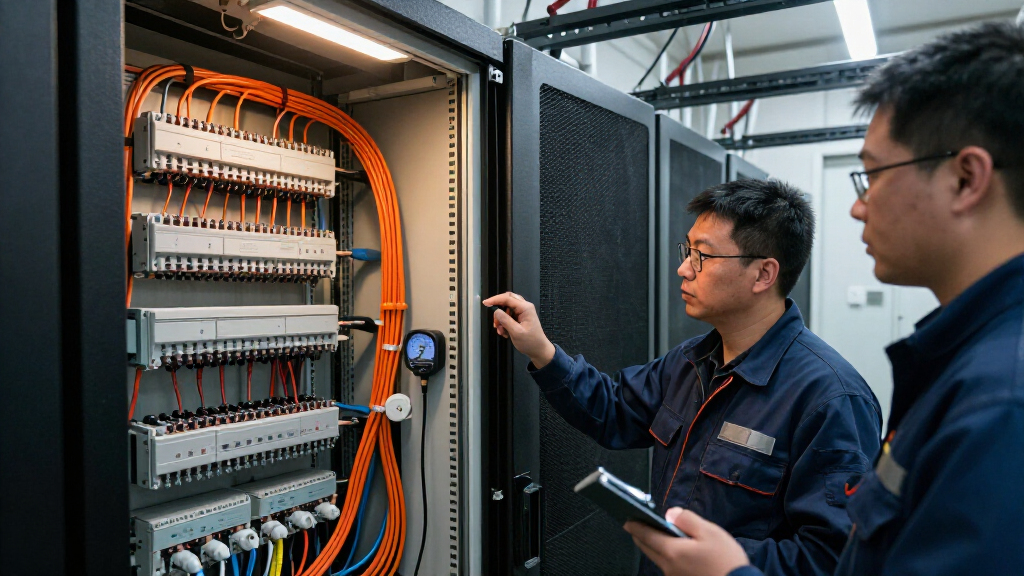
🔍 Read the full analysis: What Electricians Need To Know About AI Data Centers’ 800-Volt Shift on ThorstenMeyerAI.com

Get the latest gadgets delivered free with Prime
- Fast, free delivery on millions of items
- Prime Video, Amazon Music and more included
- Member-only deals all year
TL;DR
Vantage reserved more than 1 gigawatt of factory capacity for Heron Power solid-state transformers that can convert grid electricity to 800-volt DC, according to the source report. The move reflects a broader industry response to rising AI rack power demands, but efficiency and cost benefits cited by equipment makers remain vendor claims, and grid connections remain a major constraint.
Data center operator Vantage reserved more than 1 gigawatt of factory capacity for Heron Power solid-state transformers that convert grid electricity directly into 800-volt direct current, according to a report dated October 27. The reservation is a sign that operators are preparing for AI facilities with much higher power demands, a trend explored in the shift toward investment-heavy data centers, though it does not establish how many transformers will be installed or when they will enter service.
The report says the reservation was made on October 21. Heron’s transformer design combines power conversion with energy storage, placing batteries on the facility’s main power path to help manage rapid changes in electricity demand. Vantage’s reservation concerns factory capacity; the source does not specify a delivery schedule, project locations or a final deployment plan.
A separate development came on October 16, when Indiana utility NiSource signed a 20-year power agreement with Microsoft. The deal adds about 1,100 megawatts of generation and a 600-megawatt battery, the source report says. It does not describe the agreement as an 800-volt project, but it shows how new generation and storage are being arranged alongside large data center power needs.
The equipment shift is tied to the growing load of AI servers. The International Energy Agency says server power density rose 11-fold from 2020 to 2025 and is projected to quadruple again by 2027, increasing pressure on the power grid. NVIDIA’s reference design proposes converting 13.8-kilovolt grid power to 800-volt DC near a facility’s perimeter and distributing it to racks. NVIDIA says the design could use 45% less copper than 415-volt AC distribution and improve end-to-end efficiency by up to 5% compared with current 54-volt systems. Those figures are company estimates, not independently verified measurements; full-scale production is planned alongside Kyber systems in 2027.
Infographic 01 · From grid to rack
AI racks near a megawatt are outgrowing the AC power chain.
Why the industry is moving to 800-volt direct current: fewer conversions, less copper, batteries on the main path. The numbers are vendor figures with different baselines, so they cannot be added up.
Today: many conversions
Typical AC chain from the grid to the rack
- Medium-voltage AC from the grid
- Transformer steps it down to low-voltage AC
- UPS converts to DC for the batteries and back to AC
- Distribution units feed the racks
- Every server power supply converts AC to DC again
Each stage loses energy, and almost all of the loss becomes heat the cooling system must remove.
800 V DC: convert once, outside
NVIDIA reference design, full-scale production planned with Kyber racks in 2027
- 13.8 kV AC from the grid
- Converted once to 800 V DC at the edge of the site, batteries on the same DC bus
- 800 V DC busway to the racks
- Stepped down inside the rack, for 1 MW racks and beyond
Bridge for existing halls: a “sidecar” cabinet next to the rack converts AC to 800 V DC, while the old chain stays in place.
Power lost per MW delivered to the rack
kW, SMA white-paper model vendor model
What NVIDIA says 800 V DC changes
NVIDIA’s engineering claims claim
Sources: NVIDIA technical blog (20 May 2025, updated 31 Jul 2025); SMA America, sponsored content in Utility Dive (26 Oct 2026). Rack density: IEA, Key Questions on Energy and AI (Apr 2026) (AI server power density 11× from 2020 to 2025, a further 4× by 2027).
Powered by Thorsten Meyer AI
Power Design Moves Beyond the Server
For electricians and contractors, the shift could change the work involved in planning and building AI data centers. Moving conversion closer to the grid connection and distributing DC at higher voltage may affect transformer selection, switchgear, protection, cabling and battery integration. The exact design will depend on the facility and the equipment adopted; the source does not set out a single standard installation or a common code pathway.
Higher voltage can deliver more power through a given conductor size than lower-voltage distribution, but the practical results depend on system design and operating conditions. NVIDIA’s copper and efficiency figures should be treated as vendor claims, not guaranteed savings for every project. Operators may also use intermediate arrangements: an October 26 Utility Dive article, sponsored by inverter maker SMA America, describes a “sidecar” conversion cabinet that could connect 800-volt racks to existing AC halls while much of their current power infrastructure remains in place.
The larger constraint may be access to electricity rather than equipment alone. The IEA says transformers can take two to three years to arrive and grid connections can take five to 10 years in many places. Those timelines can affect project schedules and create pressure to coordinate electrical trades, utilities and equipment suppliers well before construction.
Products Worth Considering

Jackery HomePower 3600 Plus Portable Power Station, 3584Wh, 3600W

Anker SOLIX C200 DC Portable Power Station, 192Wh, 200W

Logitech MX Master 4 for Mac, Ergonomic Bluetooth Mouse with Haptic Feedback, Ultra-Fast Scrolling, USB-C Charging, for MacOS, iPadOS, Windo
As an affiliate, we earn on qualifying purchases.
Why AI Racks Need New Power
Traditional data centers receive alternating current, step it down through transformers and other equipment, and convert it to low-voltage DC near the servers. Every conversion loses some energy, much of which becomes heat that cooling systems must remove. That arrangement served facilities with racks drawing tens of kilowatts, but the source report says AI systems are pushing designs toward loads approaching one megawatt per rack.
NVIDIA’s technical material says a one-megawatt rack supplied at 54 volts could require up to 200 kilograms of copper busbar and take up substantial rack space with power shelves. Its proposed 800-volt architecture is intended to reduce those demands. The company says the system can move 85% more power through the same conductor size than its stated comparison and lower maintenance costs by up to 70%; these are also NVIDIA’s projections, not independent field results.
Electricity demand is growing alongside rack density. The IEA projects global data center use rising from 485 terawatt-hours in 2025 to 950 TWh in 2030. Separately, Berkeley Lab estimated that US data centers used 4.4% of national electricity in 2023 and could account for 6.7% to 12% by 2028. These estimates have different geographic and time scopes and should not be read as measurements of the Vantage or Microsoft projects.
“Leaving no room for compute”
— NVIDIA, in its 800 VDC technical material
Costs and Deployment Remain Open
The reported Vantage reservation does not disclose the number of transformers, delivery dates, project sites or final installed capacity. It is also unclear how much of the reserved factory capacity will become equipment operating at data centers. The NiSource-Microsoft agreement is a separate power arrangement, and the source gives no detail on how its generation or battery capacity will be allocated or dispatched.
Independent operating data for the proposed 800-volt systems is not provided. Claimed reductions in copper, energy losses and maintenance come from equipment makers or sponsored industry material; they do not establish actual savings across different facilities. The source also does not detail the electrical code, training or workforce requirements that may apply to specific installations.
Grid delays and who ultimately pays for new generation, storage and network upgrades remain unresolved across projects. The source says cost allocation is being settled contract by contract, but offers no terms for the NiSource-Microsoft agreement. Its effects on local electricity bills cannot be determined from the reported figures alone.
Watch for Deliveries and Project Plans
The next milestones to watch are disclosures about Heron transformer deliveries and Vantage deployment plans, along with details on the facilities where the equipment may be used. NVIDIA has said full-scale production of its 800-volt reference design is planned with Kyber systems in 2027; that is a stated product plan, not evidence that the design is already operating at scale.
For electricians and project teams, further information on system specifications, protection and control arrangements, installation requirements and commissioning will show how the designs translate into site work. More operating data will be needed to test vendor claims about efficiency, copper use and maintenance. Utilities’ project filings and power agreements may also clarify how new data center demand is being matched with generation, batteries and grid upgrades.
Key Questions
What is the 800-volt shift?
It is a proposed move to distribute 800-volt direct current through AI data centers, rather than relying on a series of AC and low-voltage conversion steps near each rack. NVIDIA’s reference design converts grid power near the facility perimeter.
What did Vantage reserve?
According to the source report, Vantage reserved more than 1 gigawatt of factory capacity for Heron Power solid-state transformers. The report does not specify how many units will be delivered or where they will be installed.
Are the stated efficiency and copper savings confirmed?
No independent measurements are provided in the source. The figures, including NVIDIA’s claim of 45% less copper and up to 5% better end-to-end efficiency against its stated comparison, are vendor claims or projections.
Why are batteries part of the data center power plans?
AI workloads can cause rapid changes in site electricity demand. Batteries may help buffer those swings or respond to grid disturbances, but their benefits and role in supporting the grid depend on system design and, as the IEA says, suitable incentives.
What could electricians need to track?
Project-specific plans for transformers, DC distribution, protection, switchgear, cabling and storage will show what work changes at a given site. The source does not specify universal installation standards or training requirements.
Source: ThorstenMeyerAI.com