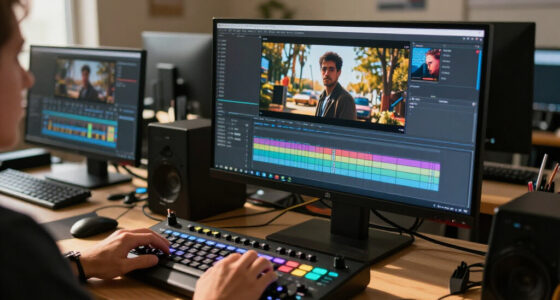

🔍 Read the full analysis: SenseTime Experts Predict Rapid Progress In Multimodal AI Development on ThorstenMeyerAI.com

Get the latest gadgets delivered free with Prime
- Fast, free delivery on millions of items
- Prime Video, Amazon Music and more included
- Member-only deals all year
TL;DR
A senior researcher at SenseTime predicts a breakthrough in multimodal AI within two years, indicating faster-than-expected progress in understanding and integrating text, images, and audio. The claim highlights the company’s strategic focus and industry-wide race, though specifics remain unconfirmed.
A senior researcher at SenseTime, one of China’s leading AI firms, has predicted that a significant breakthrough in multimodal AI could occur within the next two years, according to a report by KrASIA. This forecast suggests rapid advancements in AI systems capable of understanding and reasoning across multiple data types, such as text, images, and audio, as detailed in the original analysis. The prediction signals a potential acceleration in the development of more human-like AI, with broad implications for robotics, autonomous vehicles, and human-computer interaction. For more context, see recent industry reports on multimodal AI progress.
The prediction was made by an unnamed SenseTime scientist, with no specific technical milestones or research results provided. The forecast emphasizes that the current state of multimodal AI involves systems that can process multiple inputs—such as image uploads or video generation from text—but these are generally seen as collections of separate modules rather than fully integrated models with genuine cross-modal understanding.
The forecast indicates that within two years, AI models might achieve a true cross-modal reasoning capability, enabling machines to interpret sight, sound, and language with human-like fluency, as discussed in the original analysis. This would mark a significant shift from existing patchwork systems to unified architectures that can reason seamlessly across sensory modalities. SenseTime’s strategic focus on multimodal models stems from its origins in computer vision and recent investments in foundation models like SenseNova, aiming to differentiate itself in a competitive global landscape.
The prediction’s timing—before the end of 2027—places it within a context of intense industry competition, with major players like OpenAI, Google, Alibaba, and Baidu racing to develop similar capabilities. The claim underscores the importance of this race for both commercial and strategic reasons, as more capable multimodal systems could revolutionize applications across numerous sectors.
Implications of a Rapid AI Development Timeline
If accurate, this forecast indicates that multimodal AI systems capable of human-like understanding could be available within a very short timeframe, potentially transforming industries such as robotics, healthcare, and autonomous vehicles. Such systems would enable more natural interactions between humans and machines, improving interfaces and automation processes. For policymakers and industry stakeholders, the timeline underscores the urgency of establishing appropriate regulatory frameworks and safety standards in anticipation of these advancements. The forecast also elevates SenseTime’s position as a key player in the race for general AI capabilities, highlighting the strategic importance of multimodal development in the broader AI landscape.
As an affiliate, we earn on qualifying purchases.
Industry Trends and SenseTime’s Strategic Shift
SenseTime has historically specialized in computer vision, providing facial recognition and image analysis solutions. Since 2019, the company has faced US sanctions that limited access to American technology, prompting a pivot toward domestic AI development. In recent years, SenseTime has launched its SenseNova foundation model series, emphasizing multimodal capabilities as a key differentiator. This shift aligns with a broader industry movement, where firms like OpenAI, Google, Alibaba, and Baidu are releasing models that accept diverse inputs—images, audio, video—and aim for integrated understanding. The race for a true multimodal AI system has become a central focus, driven by both technological potential and commercial opportunity.
“A SenseTime scientist predicts a major breakthrough in multimodal AI within two years.”
— KrASIA report
AI image and audio processing software
As an affiliate, we earn on qualifying purchases.
As an affiliate, we earn on qualifying purchases.
Unconfirmed Details and Potential Variability
Several key details remain unclear. The identity and specific role of the SenseTime scientist were not disclosed, nor was the context of the prediction—whether it was made during a conference, interview, or internal discussion. The precise meaning of ‘breakthrough’—whether it refers to a new architectural approach, a measurable capability jump, or commercial deployment—is also unspecified. Additionally, the timeline might reflect internal research milestones or a broader industry forecast, but this distinction is not confirmed. As with many predictions in AI, the accuracy and reliability of this forecast remain uncertain.
As an affiliate, we earn on qualifying purchases.
Monitoring Developments and Industry Benchmarks
Over the coming two years, the industry will closely watch SenseTime’s release of new SenseNova models and their performance on multimodal benchmarks. Progress from competitors such as OpenAI, Google, Alibaba, and Baidu will also be critical indicators. Researchers will look for published research on unified architectures that move beyond stitching together separate vision and language modules. If SenseTime or other firms formally announce breakthroughs—via research papers, product launches, or earnings calls—it will significantly influence industry expectations and strategic planning.
AI cross-modal reasoning platforms
As an affiliate, we earn on qualifying purchases.
As an affiliate, we earn on qualifying purchases.
Key Questions
What exactly is a multimodal AI system?
A multimodal AI system can interpret and reason across multiple types of data, such as text, images, audio, and video, enabling more human-like understanding and interaction.
How likely is it that a breakthrough will occur within two years?
The prediction is based on expert opinion within SenseTime, but such forecasts are inherently uncertain. Technological progress may accelerate or face unforeseen challenges.
What are the potential applications of advanced multimodal AI?
Potential applications include autonomous vehicles, advanced robotics, medical imaging, virtual assistants, and interactive interfaces that understand and respond to multiple data types naturally.
How does this forecast compare to industry trends?
The forecast aligns with a broader industry push toward multimodal models, with major firms investing heavily in this area. However, the timeline for genuine breakthroughs remains uncertain across the sector.
Will this impact regulation and policy?
Yes, if such systems become feasible within two years, regulators and policymakers will need to prepare frameworks addressing safety, ethics, and deployment standards for advanced multimodal AI.
Source: ThorstenMeyerAI.com
Columbus Day / Indigenous Peoples' Day Picks
long weekend sales
As an affiliate, we earn on qualifying purchases.