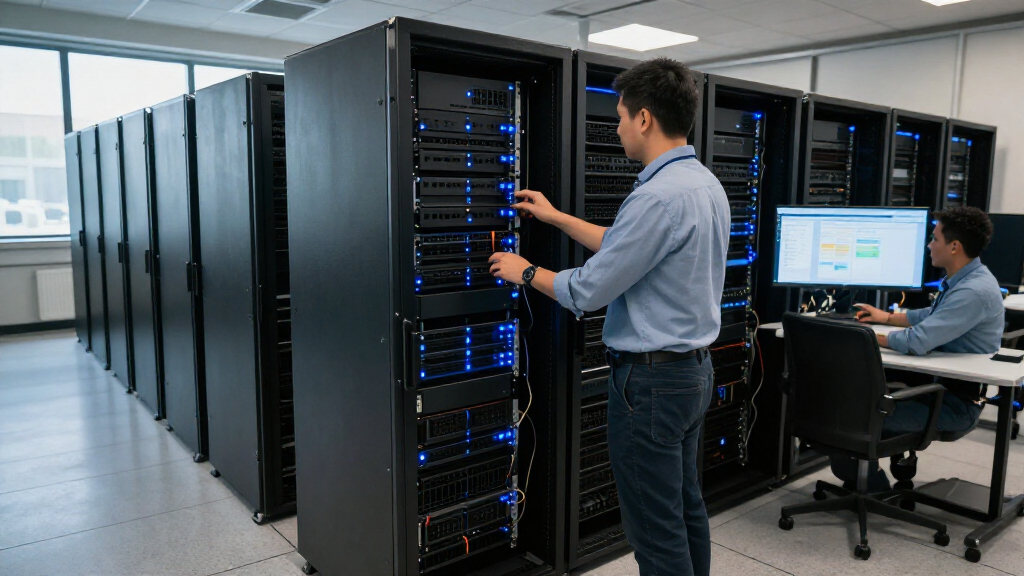
🔍 Read the full analysis: How Renting AI Hardware Creates A Neocloud Revenue Stream on ThorstenMeyerAI.com

Get the latest gadgets delivered free with Prime
- Fast, free delivery on millions of items
- Prime Video, Amazon Music and more included
- Member-only deals all year
TL;DR
Neoclouds earn revenue by renting AI computing capacity, often under long-term customer contracts that help support heavy spending on GPUs and data centers. CoreWeave reported $3.661 billion in revenue for the quarter ended Sept. 30, 2026; the source’s calculations put depreciation and amortization at about $52 per $100 of revenue and net interest at about $23. The model’s returns depend on demand, equipment life, financing costs and whether customers use the capacity they book.
Neoclouds earn money by renting out computing capacity built around AI chips, but their revenue must cover costly equipment and financing. A Nov. 29 explainer from ThorstenMeyerAI.com uses CoreWeave’s quarter ended Sept. 30, 2026, to illustrate the trade-offs: its calculations say depreciation and amortization accounted for about $52 of every $100 in revenue, while net interest accounted for about $23.
CoreWeave reported $3.661 billion in revenue for the three months ended Sept. 30, 2026, according to its results release dated Nov. 10. The source’s breakdown divides selected costs by revenue: depreciation and amortization of $1.889 billion equaled 51.6%, while net interest of $846 million equaled about 23%. The figures are rounded, and the source notes the rows may not add up exactly.
Those expenses reflect the capital-intensive structure of the business. Providers buy servers and GPUs, operate data centers, and finance their investments. Depreciation spreads the recorded cost of equipment over its expected useful life; CoreWeave uses a six-year period for technology equipment, after changing from five years in 2023, according to the explainer’s account of its annual filing.
Customer contracts help support the investment. The explainer describes long-term, take-or-pay agreements, under which a customer pays for reserved capacity whether or not it uses all of it. Such commitments can give a provider predictable revenue and help support borrowing, but they also mean customers take on the risk of paying for unused capacity.
The Costs Behind GPU Rental Revenue
The figures show why rising sales alone do not establish whether a neocloud is profitable. A provider has to keep expensive chips working and earn enough over their useful economic life to cover depreciation, interest and operating costs. An idle GPU hour cannot be stored and sold later, so utilization—the share of capacity in use—affects how much revenue the installed equipment can generate.
The model also matters to customers. The source cites an April 2026 rental index that put a widely used Nvidia chip at neoclouds at about one-third of the big-cloud on-demand price. That is an index comparison, not a guarantee of what any particular buyer will pay: negotiated terms, availability and current prices can differ. Lower prices may widen access to AI computing, while long minimum commitments can leave customers paying for capacity they do not need.
For workers and users of AI services, infrastructure costs can feed through to the price of running AI features. That connection is not automatic: what users pay also depends on providers’ other costs, pricing decisions and demand. The source presents it as a possible effect of cheaper or more constrained computing, not a confirmed price change.
Products Worth Considering

Apple MacBook Air 15-inch with M5 chip, 32GB memory, 512GB SSD, Midnight

DJI Osmo Mobile 7P 3-Axis Smartphone Gimbal with Mic Mini Transmitter, Infinity Black

LG UltraGear 32-inch 4K UHD OLED Gaming Monitor, 165Hz
As an affiliate, we earn on qualifying purchases.
Specialist Clouds, Long-Term Commitments
Unlike hyperscalers such as Amazon, Microsoft, Google and Oracle, which offer a broad range of cloud services, a neocloud specializes mainly in GPU computing for AI workloads. The source identifies CoreWeave as a prominent publicly listed example and says its 2025 annual report names those hyperscalers as competitors, while also noting that some are current customers.
The explainer compares GPU rental to a hotel: data-center space is the building, chips are the rooms, and billed GPU hours are the nights sold. The analogy highlights the importance of utilization, but has a limit. A hotel room can remain useful for decades; a leading AI chip may lose commercial appeal after only a few years as technology advances.
Accounting useful life and market usefulness are not the same thing. CoreWeave’s six-year depreciation schedule is an estimate of how it allocates equipment costs in its accounts. It does not establish how long each chip will remain competitive or generate strong rental demand. The source also notes that Amazon shortened the estimated life for some servers and networking equipment from six years to five starting in January 2025, citing the pace of technology development.
“a number of which are also our current customers”
— CoreWeave, in its 2025 annual report, as quoted by ThorstenMeyerAI.com
Demand, Chip Lifetimes and Returns
The figures cited here do not settle whether CoreWeave or neoclouds generally are profitable on a sustained basis. The source provides a selected quarterly cost breakdown, not a full analysis of cash flow, capital spending, contract margins or future results. It also does not quantify how much of CoreWeave’s capacity was idle during the quarter or how rental rates may change.
Actual equipment lifetimes and future demand remain uncertain. Chips can continue operating after newer models arrive, but their ability to attract customers at profitable rates may change. The April 2026 price index is a dated reference, and the source warns that index rates are on-demand prices; contract prices and current offers may differ. The terms of individual customer commitments and the protections available if a provider faces financial or operational problems also vary.
Check Contracts and Current Rates
For buyers, the immediate step is to compare current provider offers rather than rely on a historical index. Before signing, customers should check the reservation period, take-or-pay terms, service commitments and what happens to workloads if the provider cannot deliver. They should also consider how quickly they could move workloads elsewhere, since a lower headline price may come with a costly commitment.
For the business model, subsequent company filings and results will show whether revenue growth is accompanied by sufficient utilization and whether financing and equipment costs remain manageable. The cited quarter offers a snapshot, not a forecast. The economics will continue to depend on customer demand, rental prices, capital costs and how quickly computing hardware loses value in the market.
Key Questions
What is a neocloud?
A neocloud is a specialist cloud provider focused mainly on renting GPU computing capacity for AI workloads, rather than offering the broad range of services provided by hyperscalers.
How do neoclouds make money?
They charge customers for access to computing capacity, often through contracts that reserve capacity for a set period. Revenue depends in part on keeping costly equipment in use and collecting payments that cover equipment, financing and operating costs.
What do CoreWeave’s quarterly figures show?
For the quarter ended Sept. 30, 2026, CoreWeave reported $3.661 billion in revenue. The source calculates depreciation and amortization at about $52 per $100 of revenue and net interest at about $23; these figures are a selected cost breakdown, not a complete measure of profitability.
What does take-or-pay mean for a customer?
It means a customer may have to pay for capacity it reserved even if it does not use all of it. Buyers should review contract length, payment obligations and options for shifting workloads before committing.
Are neocloud GPU rentals always cheaper than big-cloud prices?
No. The source cites an April 2026 index that put a widely used Nvidia chip at neoclouds at about one-third of big-cloud on-demand prices, but actual rates depend on timing, provider and contract. The index is not a quote for an individual customer.
Source: ThorstenMeyerAI.com