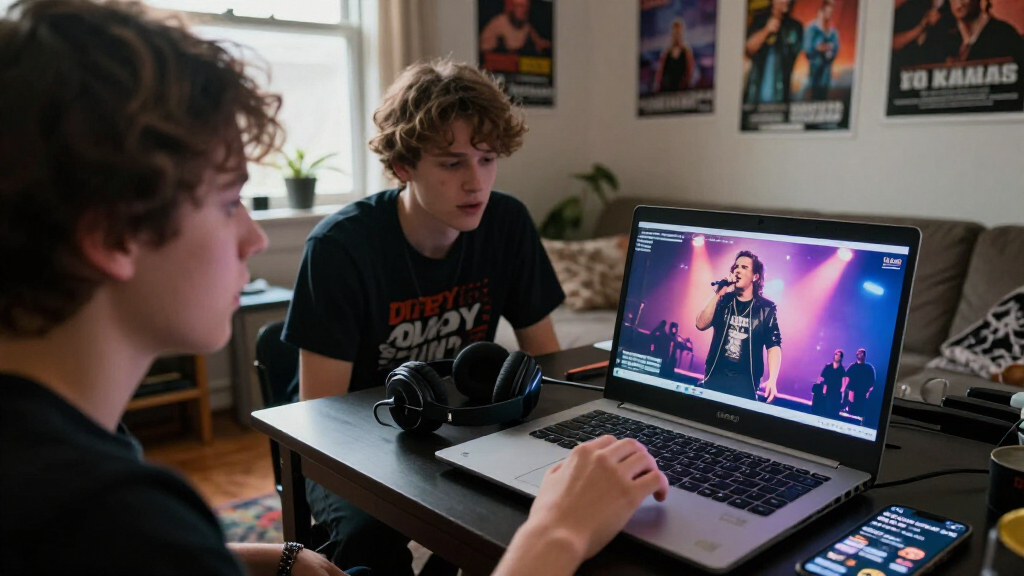

🔍 Read the full analysis: AI And The Fan Response: Lessons From The Digital Ozzy Debate on ThorstenMeyerAI.com

Get the latest gadgets delivered free with Prime
- Fast, free delivery on millions of items
- Prime Video, Amazon Music and more included
- Member-only deals all year
TL;DR
A late-October 2026 roundup of entertainment disputes shows different sources of audience concern about AI: craft, commercial use, credit and trust. Jack Osbourne said the backlash to plans for a Digital Ozzy avatar was his own fault, while an allegation about AI use in an A$AP Rocky video remained unanswered in the cited reporting.
Several entertainment disputes and announcements between Oct. 19 and Oct. 26, 2026, have highlighted how audiences respond to AI use: Jack Osbourne said he mishandled the presentation of a planned Digital Ozzy avatar, while a visual-effects artist accused the team behind an A$AP Rocky video of reusing his footage with AI. The cases are not equivalent, and the allegation about Rocky’s video was not resolved in the source reporting; together with reactions to an AI-made “Odyssey” clip and a warning from Jay-Z, they show that disclosure alone does not settle questions of consent, credit, commercial use and creative quality.
On Oct. 21, Jack Osbourne said on the Great Company podcast that backlash to plans for an interactive Ozzy Osbourne avatar was “my own fault.” He said he had not been prepared to explain the project and acknowledged that fans had interpreted the idea as the late singer being used to sell products. The family had announced the project with Hyperreal and Proto Hologram in May, describing it as a digital recreation using Ozzy’s voice, image and movement. A planned summer debut in Proto Luma units in the United States and United Kingdom had not happened as of the source report.
On Oct. 23, xAI’s Grok Imagine account posted a roughly seven-minute clip identified as “Episode 1 of our Odyssey series,” a project Elon Musk had said in July would become a full-length, historically accurate adaptation before the end of the year. The clip was openly attributed to Grok Imagine and described as a collaboration with Wonder Studios and director Dev Walker. TechCrunch’s Anthony Ha noted moments that looked like live-action footage but judged the clip “completely airless.” The source report gave no confirmation that a full-length version was completed.
A separate dispute concerns A$AP Rocky’s “Shroom Clouds” video, released Oct. 19 with AI artists listed in its credits. VFX artist Cache Bunny alleged that a shot used his 2019 footage processed with AI and altered to include Rocky. The allegation had not received a public response from Rocky’s side in the cited report. On Oct. 24, Jay-Z told an audience at SoFi Stadium to “question everything in this world of AI,” a statement the source framed as a warning about trust rather than a rejection of a particular tool.
Consent, Credit and Audience Trust
The cases point to distinct tests for AI-assisted entertainment, not one shared verdict on the technology. In the Odyssey clip, the use of AI was disclosed, yet the criticism cited by the source focused on the work’s perceived quality and its contrast with Musk’s promise of historical accuracy. In the Ozzy case, the family’s stated involvement did not prevent fans from objecting to language that suggested commercial licensing. In the Rocky dispute, the central issue is an unresolved claim about whether a creator’s earlier footage was reused without credit or permission.
These distinctions matter to artists, rights holders, platforms and audiences. A label identifying AI may tell viewers how something was made, but it does not answer whether the people whose likenesses or work appear agreed to that use, whether contributors are credited, or whether the result meets its own creative claims. For companies developing digital replicas, the Ozzy reaction also shows that family authorization and audience acceptance are separate questions. The public response can affect whether a project launches as planned and how its owners explain its intended uses.
The examples also caution against treating online reaction as a single anti-AI movement. The source cites the Beatles’ “Now and Then,” which used machine learning to clean a John Lennon demo and won a Grammy, and a Randy Travis comeback song made with AI assistance and involvement from Travis and his family. Those examples do not establish a universal rule for audience approval, but they illustrate why consent, attribution and the purpose of a project need to be assessed case by case.
Products Worth Considering

Amazon Kindle Paperwhite (12th Generation, 2024), 16 GB, 7-inch Display, Jade

Apple iPad Air (4th Generation, 10.9-inch, Wi-Fi, 256GB) – Space Gray

Amazon Kindle Scribe Colorsoft 64GB (1st Generation)
As an affiliate, we earn on qualifying purchases.
A Week of AI Entertainment Disputes
The reporting groups developments across one week. The “Shroom Clouds” video appeared Oct. 19; Jack Osbourne discussed the Digital Ozzy backlash on Oct. 21; Grok Imagine posted its Odyssey episode on Oct. 23; and Jay-Z made his remarks at SoFi Stadium on Oct. 24. The VFX artist’s accusation about the video was reported between Oct. 24 and 26. These events differ in evidence and status: a public post and a podcast statement can be confirmed as events, while the reuse allegation remains an allegation.
The Odyssey clip followed a public dispute over Christopher Nolan’s film. The source says Musk criticized the casting of Lupita Nyong’o as Helen of Troy and later promised an AI-made, historically accurate full-length version. Nolan had called the casting criticism “irrelevant,” according to Deadline. The source also reports that Nolan praised audiences’ skepticism toward AI video in an earlier interview. Its cited figures put Nolan’s film above $1.78 billion worldwide and the Grok clip at four million views at press time; the figures refer to different measures and do not establish comparable audience responses.
Rules and prior projects provide limited context. The source says the EU AI Act’s disclosure requirements for deployers of deepfakes took effect on Aug. 2, 2026, with a less intrusive duty for evidently artistic work. It also describes the Ozzy project as an effort by the family and partner companies to control a digital likeness. The legal and business questions raised by these examples are broader than any one reaction, but the cited material does not establish how a court or regulator would resolve the Rocky allegation or any specific licensing dispute.
““The backlash, it was my own fault.””
— Jack Osbourne, speaking on the Great Company podcast
The Unanswered Rights Questions
The source report does not establish whether Cache Bunny’s footage was used in the “Shroom Clouds” video as he alleged, whether permission was obtained, or whether the video’s creators or Rocky’s representatives would respond. The claim should not be treated as a finding. It is also unclear when the Digital Ozzy avatar will launch: the planned late-summer appearance had not taken place by the report’s publication, and no revised date is supplied.
For the Odyssey project, the cited material confirms a seven-minute episode, not completion of Musk’s promised full-length film. It does not specify whether or when further episodes will be posted. More broadly, the examples do not prove that consent, credit or disclosure alone determine audience reaction. They describe a small set of cases, with different creators, formats and kinds of evidence.
Launches, Responses and Further Episodes
The next concrete developments to watch are any response from A$AP Rocky’s representatives or the video’s creators to Cache Bunny’s allegation, and whether the artist supplies further evidence or pursues a formal complaint. The status and timing of the Digital Ozzy rollout also remain open; the source gives no new launch date. Any later announcement would clarify whether the family’s revised explanation changes the project’s plans or public reception.
For Grok Imagine, further episodes or a full-length release would show whether Musk’s July promise advances beyond the Oct. 23 clip. Until then, the available reporting supports a narrower conclusion: the clip was posted and reviewed, but the promised feature-length work was not confirmed. Jay-Z’s comment adds no specific policy proposal, and the source reports no follow-up action from him. The practical story will develop through project releases, public responses and any documented resolution of the rights claims.
Key Questions
What happened with the Digital Ozzy project?
Ozzy Osbourne’s family announced an interactive digital avatar project with Hyperreal and Proto Hologram in May 2026. Jack Osbourne said on Oct. 21 that backlash to how it was presented was “my own fault.” The planned summer appearance had not happened by the source report, and no new date was given.
Was the A$AP Rocky video proven to use stolen footage?
No. VFX artist Cache Bunny alleged that a shot in “Shroom Clouds” used his 2019 footage processed with AI. The source report said the allegation had not received a public response from Rocky’s side; it did not establish whether the claim was true.
Did Grok Imagine release a full-length Odyssey film?
The reported release was a roughly seven-minute clip posted as “Episode 1 of our Odyssey series” on Oct. 23, 2026. The source did not confirm that a full-length film had been completed.
Why did the AI Odyssey clip draw criticism?
The clip was identified as AI-made. The review quoted in the source criticized its creative quality, calling it “completely airless,” rather than treating the AI use as undisclosed.
What did Jay-Z say about AI?
At SoFi Stadium on Oct. 24, Jay-Z told the audience to “question everything in this world of AI.” The source characterized the remark as a warning about trust, not as a rejection of a specific AI tool.
Source: ThorstenMeyerAI.com