🔍 Read the full analysis: The Five-Dollar Day: A New Chapter For Assembly Line Workers on ThorstenMeyerAI.com

Get the latest gadgets delivered free with Prime
- Fast, free delivery on millions of items
- Prime Video, Amazon Music and more included
- Member-only deals all year
TL;DR
Ford introduced its five-dollar day on Jan. 5, 1914, raising minimum daily pay while reducing the workday from nine hours to eight. The move followed exceptionally high turnover as the moving assembly line accelerated production; the source says turnover fell to 54% in 1914. The account draws on Ford’s memoir and later historical research, and the precise terms and effects of the pay plan need to be read in that context.
Ford Motor Co. raised minimum daily pay to $5 and cut the workday from nine hours to eight on Jan. 5, 1914, responding to severe worker turnover as its moving assembly line changed factory work. A Nov. 6, 2026, account from ThorstenMeyerAI.com says the company’s turnover rate fell to 54% in 1914, presenting the pay increase as a response to the cost and disruption of constantly replacing workers—not simply as a way to help them buy Ford cars.
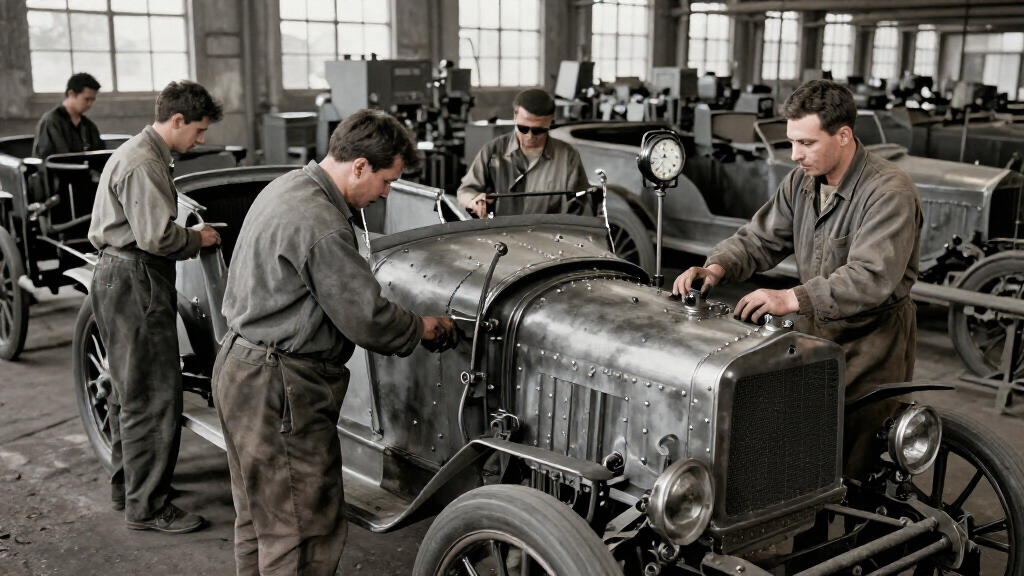
The change followed a rapid reorganization of production at Ford’s Highland Park plant in Detroit. The source reports that Ford’s own figures put labor time for assembling a Model T chassis at 12 hours and 28 minutes when the vehicle remained stationary, compared with 1 hour and 33 minutes on the moving line by early 1914. The figures imply a substantial reduction in labor time per chassis, although they come from the company’s account and should be understood as Ford-reported numbers.
Ford’s line experiments began with the flywheel magneto, a small generator used for ignition. In his 1922 book My Life and Work, written with Samuel Crowther, Henry Ford said workers divided the task into 29 operations and moved the part past them. The source says the time to assemble one magneto declined from about 20 minutes to 13 minutes and 10 seconds, then fell further after changes to the line. Ford also credited, in general terms, the overhead trolley used by Chicago meatpackers as an influence on the moving production system.
The efficiency gains came with a workforce problem. According to figures cited by the source from economists Daniel Raff and Lawrence Summers’ 1987 study, Ford hired 50,448 people in 1913 to maintain an average workforce of 13,623. That is the reported number of hires, not a direct measure of how many individual workers left, since some employees could have been hired more than once. The five-dollar day, paid under a conditional profit-sharing plan, raised the minimum daily rate while shortening the workday; the source reports turnover dropped to 54% the following year.
Pay and the Cost of Turnover
The decision matters because it connects a defining change in factory production with an employer’s response to the human costs of that change. The moving line reduced the time needed for particular assembly tasks, but repetitive, tightly divided work was difficult for Ford to staff. The account describes frequent absences and workers who stopped showing up, creating a continuing need to recruit and train replacements.
Higher pay was not only a benefit to employees; it was also a management measure intended to make the workforce more stable. Henry Ford later called the five-dollar day “one of the finest cost-cutting moves we ever made,” according to the source. That retrospective statement signals Ford’s view of the policy, but does not by itself establish the full financial effect or show that every worker received the same amount without conditions.
The story also challenges a familiar explanation that Ford raised wages mainly so his workers could afford his cars. The source argues that the immediate business problem was retaining enough workers to keep production running, rather than a shortage of customers. The distinction matters when discussing how industrial wages changed: the policy was an employer response to labor demand and turnover, as well as a major change in compensation.
Products Worth Considering

LG UltraGear 32GX850A-B 32-inch 4K UHD Glossy OLED Gaming Monitor

Bose QuietComfort True Wireless Earbuds with Active Noise Cancellation, Black

Apple MacBook Air 13-inch Laptop with M5 Chip, 16GB Memory, 512GB SSD, 12MP Center Stage Camera, Touch ID, Wi-Fi 7, Midnight
As an affiliate, we earn on qualifying purchases.
How Ford’s Moving Line Developed
Before Ford’s assembly-line experiments, workers built a car around a stationary chassis, bringing parts to the vehicle. The source says the company first tested a moving approach on the magneto in April 1913, then applied the idea to chassis assembly. An early setup used a rope and windlass to pull the chassis down a 250-foot line; workers moved alongside it and collected parts. Later changes raised the line and divided tasks further.
Ford’s published production figures are drawn in large part from My Life and Work, which appeared in 1922. The account explicitly treats the book as the company’s perspective. For turnover, it cites Raff and Summers’ 1987 study, which drew on earlier labor research and company surveys. The source also notes that the Henry Ford museum gives a turnover figure of about 380%, compared with 370% in the figures it highlights. The differing figures are a reminder that historical summaries may use different data or definitions.
The five-dollar day was not a simple unconditional wage increase for every worker. The source describes it as “profit sharing” subject to strict conditions, alongside the reduction in daily hours. It places the policy in an era when production was expanding: it says U.S. factory employment rose by about a third between 1910 and 1920. That broader figure is context, not evidence that Ford’s policy alone caused the national employment change.
What the Historical Figures Establish
The source does not provide a detailed breakdown of who qualified for the full five-dollar payment, how the conditions were applied, or how much workers received on average. It reports a minimum daily rate and a conditional profit-sharing arrangement, but readers should not take that to mean every employee automatically received $5 each day.
The turnover figures also require care. The source gives 370% for 1913, while the Henry Ford museum is said to give about 380%; the account does not resolve the difference in definitions or calculation. Nor does it provide enough information to establish how much of the subsequent decline to 54% resulted from the pay plan itself, as opposed to other changes in staffing, production, or working conditions.
The source’s descriptions of workers’ experiences and the production data rely on historical records, including Ford’s own memoir and company surveys. Those materials offer evidence about the period, but the supplied account does not include the underlying documents in full. The exact terms of the pay conditions, the experiences of workers excluded from them, and the complete costs and benefits of the policy remain unclear here.
How Historians Read the Policy
This is a historical report rather than a newly announced labor policy, so there is no upcoming implementation date or company decision to track. The next step for readers seeking a fuller account is to compare Ford’s memoir with the labor surveys and scholarship cited in the source, including the 1987 study by Raff and Summers. Those sources can help clarify how researchers define turnover and how they assess the relationship between higher wages, retention, and production costs.
The broader question raised by the episode remains relevant to debates about factory work: when production systems change, how do employers balance speed and output against pay, working hours, and workers’ ability to remain in the job? The source points to modern factories where robots perform more tasks, but it does not provide evidence to measure current automation’s effects against Ford’s experience. Any comparison between the eras would need current data on jobs, wages, and working conditions.
Key Questions
What did Ford change in January 1914?
Ford cut the workday from nine hours to eight and raised the minimum daily pay to $5, under a profit-sharing plan with conditions, according to the source.
Why did Ford introduce the five-dollar day?
The source presents it as a response to extremely high turnover as the moving assembly line changed factory work. Ford needed to recruit many people to maintain its workforce, and the pay change was intended to help retain workers.
How much did the assembly line reduce chassis labor time?
Ford’s reported figures, as presented in the source, put chassis assembly at 12 hours and 28 minutes of labor when stationary and 1 hour and 33 minutes on the moving line by early 1914. These are historical company figures, not independently verified measurements in the supplied account.
Did every Ford worker automatically receive $5 a day?
The source says the increased minimum was paid as “profit sharing” under strict conditions. It does not detail eligibility or show that every worker received the full amount each day.
Did the five-dollar day cause turnover to fall?
The source reports that turnover fell from 370% in 1913 to 54% in 1914, but the information provided does not isolate the pay plan’s effect from other possible changes. Another historical account cited in the source gives a slightly different 1913 turnover figure, about 380%.
Source: ThorstenMeyerAI.com