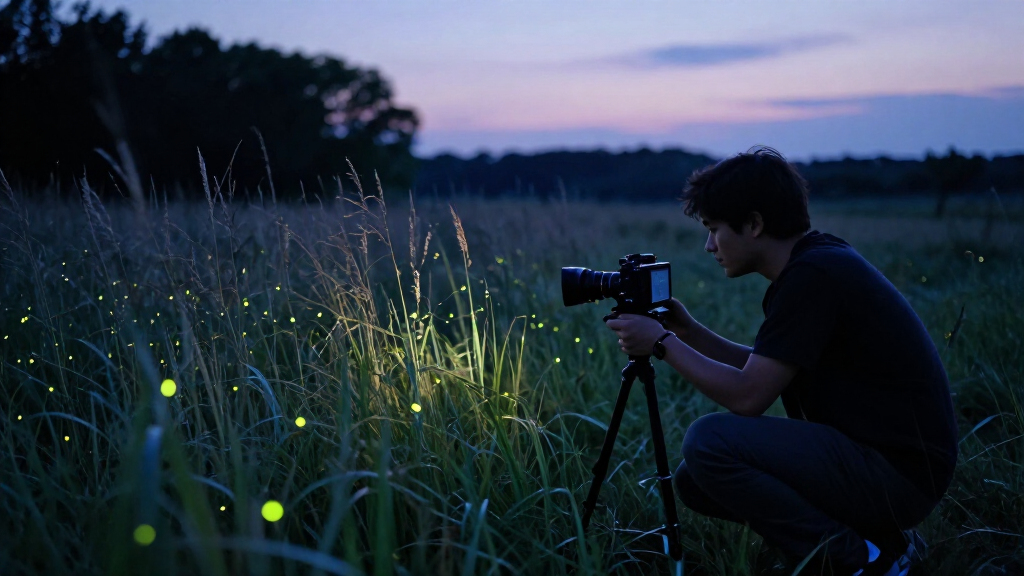

🔍 Read the full analysis: Making A Film About Fireflies: The “Luciole” Story on ThorstenMeyerAI.com

Get the latest gadgets delivered free with Prime
- Fast, free delivery on millions of items
- Prime Video, Amazon Music and more included
- Member-only deals all year
TL;DR
“Luciole — The Synchronous Fireflies of Vallon Creux” is Room 155 in an AI-built exhibition of 175 rooms. Its browser-based simulation lets visitors watch 96 fictional fireflies move from separate rhythms toward synchronization, then disrupt the pattern and observe its recovery.
“Luciole — The Synchronous Fireflies of Vallon Creux”, an AI-built interactive website in the FABLE/175 exhibition, invites visitors to watch simulated fireflies fall into a shared rhythm and then disturb the pattern. The room is an artwork and demonstration, not a record of a real species, location, company or field study: Vallon Creux and Luciole are fictional.
The exhibit presents itself as an interactive field notebook. Its central display follows 96 simulated fireflies, whose flashes begin out of sync and gradually converge into a collective pulse. Visitors can alter the field and see whether the simulated group finds coherence again. The project frames that change as a process to observe, rather than a preset animation.
Behind the display, each simulated insect is an oscillator with its own phase and tempo, connected to nearby neighbors. The simulation updates those phases over time: each retains its natural rhythm while nearby signals influence it. A coupling control changes the strength of that influence. A live coherence measure, a trace of the change and return, and a phase diagram are drawn from the simulation’s behavior.
The page’s visuals are made with HTML, CSS, SVG and canvas, rather than downloaded image assets or prerecorded firefly footage, according to the project description. It uses a dark green background, chartreuse signals and muted mauve notes to separate the simulated field from the observer’s annotations. The source also describes pausing the simulation when relevant views are offscreen or the page is hidden, and providing a calmer presentation for visitors who prefer reduced motion.
FABLE / 175 · Room 155 · Interactive exhibition
Making a Film About Fireflies: The “Luciole” Story
“Luciole — The Synchronous Fireflies of Vallon Creux” is an AI-built browser artwork where 96 fictional fireflies move from separate rhythms toward a shared pulse. Visitors can disturb the pattern and watch the simulation respond.
The idea in one line
“Its signature move is to make patience visible.”
The exhibit turns synchronization into something to watch unfold: a changing pattern shaped by many local interactions.
01 / What visitors see
A model you can disturb
Rather than show only a finished pattern, Luciole invites visitors to watch separate rhythms converge, change the strength of local influence, and interrupt the field to see whether coherence returns.
Separate rhythms
The 96 simulated fireflies begin out of sync. Each is represented as an oscillator with its own phase and tempo.
Nearby signals
Oscillators are described as influencing nearby neighbors. A coupling control changes the strength of that influence.
Pattern and recovery
Visitors can disturb the field and follow the live coherence measure, trace, and phase diagram as the simulation evolves.
02 / The sequence
From scattered flashes to shared pulse
The exhibit frames synchronization as a process to observe, not a preset animation.
Start apart
Each oscillator follows its own rhythm and phase.
Build influence
Neighboring signals nudge the group toward alignment.
Break the sync
A visitor changes the coupling or disrupts the field.
Watch it heal
Observe whether coherence returns under the chosen settings.
03 / Reading the display
What the signals communicate
These visual indicators are described as outputs of the live simulation. The supplied material provides no independent numerical findings.
“Breaking the sync and watching it heal.”
From the room’s art-direction brief, reproduced in the exhibit04 / Artwork & model
What Luciole is—and what it is not
The field-notebook style is part of the artwork. Its fictional setting and simulated behavior should not be mistaken for documentary evidence.
| Question | What the exhibit presents | What it does not establish |
|---|---|---|
| Where? | Vallon Creux, a fictional setting | A real place or study site |
| Which fireflies? | 96 simulated oscillators | Tracked or filmed insects |
| What is the model for? | Illustrating synchronization through interaction | New biological measurements |
| How was it built? | HTML, CSS, SVG, and canvas are described | Independent code or performance review |
05 / Limits & context
A simulation, not a field report
Luciole offers an interactive explanation and visual experience. The source material draws a clear boundary around what the room can support as a claim.
Luciole and Vallon Creux are fictional, created for the exhibit—not a real company, place, or field study.
The simulation can illustrate a possible path to shared rhythm; it does not verify how a real population behaves.
The supplied description does not include source-code review, independent testing, or performance measurements.
The project describes reduced-motion support, offscreen pausing, mobile adjustments, focus indicators, and announced state changes.
06 / Visitor guide
Questions visitors may ask
Open the live room to explore its controls and follow the simulated field in motion.
Is Vallon Creux real?
No. The exhibit describes it as a fictional setting, not a field-study location.
Are the fireflies real?
No real insects are filmed or tracked. The display represents 96 simulated oscillators.
What can visitors change?
Visitors can adjust coupling strength and disturb the field, then observe how coherence changes.
Does Luciole report new findings?
No. The supplied description presents an AI-built artwork and simulation, not new biological research.
A Model Visitors Can Disturb
The room’s core contribution is to make a process visible and interactive. Rather than just showing a finished pattern, it lets visitors change the strength of local influence, interrupt the order and watch what follows. That makes the exhibit a compact way to encounter synchronization as a dynamic result of many individual interactions.
Its status as an AI-built web artwork is also part of the subject. The source describes the site as a product of an AI coding process and says the exhibit exposes its original art-direction brief through a “Prompt” link in the footer. The piece therefore presents both the simulated phenomenon and a trace of how the digital room was commissioned and constructed. It does not, however, establish that AI independently conducted research or verified biological claims.
For visitors, the distinction between model and nature matters. The simulation can offer an intuitive illustration of how a shared rhythm might emerge, but it is not evidence that a particular real-world firefly population behaves in precisely the same way. The exhibit’s value lies in its interactive explanation and visual design, not in reporting new field observations.
Products Worth Considering

Bose QuietComfort Ultra Earbuds (2nd Gen) – Wireless Noise‑Cancelling Earbuds with Mic, Immersive Audio, USB‑C Charging, Up to 6 Hours Batte

Samsung Galaxy Tab A11 8.7-Inch Wi-Fi Tablet, 64GB, 4GB RAM, Silver

Jackery HomePower 3600 Plus Portable Power Station, 3584Wh, 3600W
As an affiliate, we earn on qualifying purchases.
Inside the FABLE/175 Rooms
Luciole is identified as Room 155 of 175 in the FABLE/175 project, a sequence of AI-built exhibition pieces. The room’s title refers to synchronous fireflies and a fictional place, Vallon Creux. The provided source explicitly distinguishes those invented elements from real locations and research, preventing the field-notebook style from being mistaken for documentary reporting.
The exhibit’s accompanying build brief calls for a single-page website with a canvas-based firefly display, invented species and field notes, and an interaction that breaks synchronization so visitors can watch it recover. It specifies a Kuramoto model as the mathematical basis for the synchronization effect. The source describes the implemented experience as using oscillators coupled to nearby neighbors, but it does not provide code or a technical evaluation that would independently verify every implementation detail.
The visual language supports the notebook premise: a literary serif carries the main text, while handwritten-style notes suggest an observer’s marginalia. The source also describes mobile adjustments, focus indicators and announced state changes. These details position Luciole as a designed browser experience, rather than a conventional article or a scientific instrument.
““Luciole and Vallon Creux are fictional, created for the exhibit—not a real company, place, or field study.””
— FABLE/175 exhibit description
What the Simulation Does Not Establish
The source does not identify a real-world firefly population studied for the project, and it explicitly says the setting and Luciole are fictional. The on-screen behavior should therefore be read as a simulation, not as a measured account of firefly activity in Vallon Creux or any other named habitat.
The supplied material does not include independent technical testing, source-code review, performance measurements or an evaluation of the model’s scientific fidelity. It describes a live coherence measure and phase diagram, but offers no numerical findings about their results beyond the simulated display. The exact behavior may also depend on visitor interaction and the simulation’s settings.
The source provides a live-site address and describes accessibility and performance features, but does not supply independent checks across devices or details about how the exhibit is maintained. Those aspects remain unverified from the material provided.
The Exhibit Remains Interactive
The next step for visitors is to open the live Luciole room and explore its controls: watch the simulated fireflies settle into rhythm, change the coupling strength, and disturb the field. The site’s footer “Prompt” link offers a route to the art-direction brief behind the room, according to the source.
No further release, update schedule or additional reporting milestone is specified. The project is presented as Room 155 of 175; the source does not say when or how the remaining rooms will be completed or whether Luciole will receive later changes.
Key Questions
Is Vallon Creux a real place?
No. The exhibit description says Vallon Creux is fictional, created for Luciole, and is not a real field-study location.
Are the fireflies real?
No real insects are being filmed or tracked. The room shows 96 simulated fireflies, represented by oscillators whose rhythms are influenced by nearby signals.
What can visitors change?
Visitors can adjust the coupling strength and disturb the simulated field. The display then shows how the group’s level of coherence changes and whether it returns toward a shared pulse.
Does Luciole report new scientific findings?
No. The supplied description presents it as an AI-built exhibition and simulation, not a field study or a report of new biological measurements.
Source: ThorstenMeyerAI.com