
📊 Full opportunity report: Rogue One: The Andor Cut — On Fan Editing as Tonal Reverse-Engineering on ThorstenMeyerAI.com — validation score, market gap, and execution plan.
TL;DR
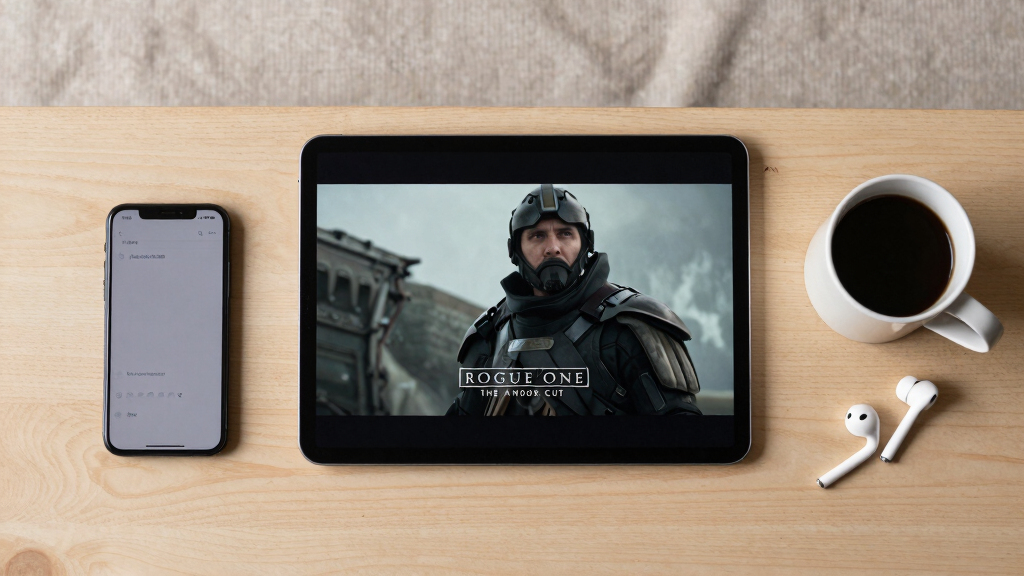
Fan editor Kaylor has released Rogue One: The Andor Cut, a re-edited version of the 2016 film that aligns its tone more closely with the series Andor. The project uses existing footage, score modifications, and deepfake replacements to create a new viewing experience. Its impact raises questions about fan reimaginings and tonal continuity in Star Wars.
On May 25, 2026, fan editor Kaylor released Rogue One: The Andor Cut, a re-edited version of the 2016 film that reimagines its tone to match the series Andor, using existing footage, score modifications, and visual enhancements. The project is distributed through clandestine channels typical of fan edits, aiming to explore how the film might feel if made after the series with its more political and contemplative tone.
The edit retains the original footage, actors, and plot beats but adjusts the tone to resemble Andor’s slower, more political aesthetic. Key changes include replacing Giacchino’s score with Nicholas Britell’s themes, removing minor continuity errors, and inserting flashbacks to deepen Cassian Andor’s backstory. Notably, deepfake technology has been used to replace CGI characters like Grand Moff Tarkin and Princess Leia with more realistic fan renders, surpassing the original 2016 CGI work.
While the scope of modifications is modest, the project aims to create a dialogue between the two works, emphasizing tonal and emotional continuity rather than altering the core story. The release has sparked conversations about the potential of fan edits to challenge or complement official narratives, especially in a franchise as expansive as Star Wars.
A Tonal Map of Two Star Warses
On the disjunction between Andor and Rogue One — and what the upcoming fan edit can and cannot resolve.
Andor and Rogue One occupy a peculiar place in the Star Wars catalogue. The film was released in 2016; the show concluded in 2025. The film is a prequel to A New Hope in narrative terms; the show is a prequel to the film. But Andor was made after Rogue One, and arrived at a distinctly different aesthetic — slower, more political, theatrically dialogued, scored against rather than within the John Williams tradition. When Cassian Andor finally walks into the Rogue One scenario in the show’s final moments, the two works sit together in visible tonal disagreement. This is a map of where they disagree.
The same galaxy. Two languages.
A reading of how the show and the film differ on the dimensions that the upcoming Andor Cut will most attempt to reconcile.
i · Pacing
Twenty-four episodes accumulating across two seasons. Whole hours given to a funeral, a heist, a prison escape, a senate vote. Accretion as structural principle.
133 minutes carrying setup, mission, and battle. Three-act structure in classical proportion. Forward motion as structural principle.
ii · Score
Strings, percussion, dissonance. The Williams orchestral grammar deliberately set aside. Music as political mood rather than emotional cue.
Brass, motifs, quotation. Williams’s grammar honored, occasionally evoked. Composed in four weeks after the original Desplat score was abandoned.
iii · Mood
The texture of authoritarianism rendered through dread. Surveillance as ambient atmosphere. Dialogue scenes that shimmer with unspoken threat.
The texture of war rendered through adventure. Action as ambient atmosphere. Set pieces that sustain emotional weight by accumulation.
iv · Politics
Fascism through paperwork. Resistance through years of small choices. Luthen’s network. The ISB as bureaucratic machine. Politics rendered procedurally.
The Empire through visible force. Resistance through one decisive act. Mon Mothma’s chamber. Saw’s cell. Politics rendered ceremonially.
v · Force & Mysticism
No Jedi. No Force. No destiny. The galaxy operates on human stakes and human costs. Materialism as theological commitment.
Chirrut Îmwe’s faith. The Whills. The Kyber crystal mythos kept at the periphery but present. Mysticism as available but lightly held.
vi · Violence
Bix’s torture. Narkina 5’s prison labor. Ghorman’s massacre. Surveillance, interrogation, summary execution rendered with their administrative machinery on screen.
Scarif beach assault. Vader’s hallway. Action-movie casualties at scale. Violence rendered as tactical event rather than systemic condition.
vii · Dialogue
Luthen’s “I burn my decency” speech. Maarva’s funeral oration. Karis Nemik’s manifesto. Words as substance. Cassian’s lines often the least interesting in the room.
Lines as gear-changes between action sequences. “Rebellions are built on hope.” “I am one with the Force.” Words as cue. Function preferred to figure.
viii · Cost of Resistance
Bix. Maarva. Brasso. Cinta. Nemik. Costs measured over years, paid in pieces. The cost is the texture of the show itself.
Every member of the team dies for one objective. Costs measured in the final act, paid in a single sequence. The cost is the climax.
Kaylor’s Andor Cut can re-tone what is already on screen. It cannot change pacing without footage that does not exist. What it can foreground is the version of Rogue One that was always reaching toward Andor — and was never quite allowed to arrive.
I burn my decency for someone else’s future. Like sunlight through dust.
The Andor Cut releases May 25, 2026. Available in 4K with 5.1 surround through fan edit channels.
The film is still the film. The question is whether, with Britell’s themes underneath and the show’s accumulated weight beneath every Cassian close-up, it finally sounds like the show that grew out of it.
Implications for Fan Creativity and Canonical Perception
This fan edit exemplifies how dedicated fans can reinterpret and reframe existing material, blurring lines between official canon and fan-driven reinterpretation. It raises questions about the role of tonal consistency in franchise storytelling and highlights technological advances like deepfake as tools for fan creativity. While not an official release, it demonstrates the potential for fan edits to influence perceptions of a film’s tone and narrative coherence, especially in a franchise with a complex production history like Star Wars. The project also underscores ongoing debates about the boundaries of fan work and the future of digital re-editing in popular media.Star Wars fan edit Rogue One Andor style
As an affiliate, we earn on qualifying purchases.
As an affiliate, we earn on qualifying purchases.
Star Wars Prequels, Sequels, and Tonal Divergence
Rogue One, released in 2016, was directed by Gareth Edwards with reshoots overseen by Tony Gilroy, resulting in a film more action-oriented and less morally ambiguous than Edwards’s original cut. The film’s tone contrasts sharply with the more political and contemplative style of the subsequent series Andor, which debuted in 2022. Andor, created by Gilroy, emphasizes bureaucracy, moral complexity, and a slower pace, diverging from the traditional Star Wars action and mysticism. This tonal dissonance has been a point of discussion among fans and critics, especially given the chronological relationship between the two works.
The release of Kaylor’s edit attempts to reconcile these differences by reworking Rogue One’s tone to align with Andor’s aesthetic, effectively creating a dialogue between the two narratives and exploring how the same footage could evoke different emotional responses based on editing choices.
“Kaylor’s edit is an intriguing experiment in tonal re-engineering, asking what Rogue One might look like if it were crafted after Andor, not before.”
— Thorsten Meyer
As an affiliate, we earn on qualifying purchases.
Limitations of Fan Re-Editing and Technological Constraints
While the edit incorporates advanced deepfake replacements and score modifications, it remains a fan project with inherent limitations. It cannot recreate the original Edwards cut or fully emulate the tonal nuance of a film that was never officially reworked in this manner. The impact of these edits on audience perception and the potential for official adoption or influence remain uncertain. Additionally, the long-term reception of such fan projects and their influence on franchise storytelling are still developing topics.
Star Wars score remix Nicholas Britell
As an affiliate, we earn on qualifying purchases.
As an affiliate, we earn on qualifying purchases.
Potential Influence on Official and Fan-Driven Star Wars Projects
As the fan edit circulates within dedicated communities, discussions about the role of tonal re-interpretations in franchise media are likely to intensify. It may inspire further fan projects exploring other films or series, and could influence how creators think about tone and narrative coherence. However, there is no indication of official endorsement or integration into the franchise’s canon. Future developments depend on community reception, technological advances, and ongoing debates about fan contributions to media reimagining.
Star Wars Blu-ray with political tone
As an affiliate, we earn on qualifying purchases.
As an affiliate, we earn on qualifying purchases.
Key Questions
Is Rogue One: The Andor Cut an official release?
No, it is a fan-made project distributed through unofficial channels, not an authorized or official version by Lucasfilm or Disney.
What are the main changes in this fan edit?
The edit replaces the score with Britell’s themes, inserts flashbacks to deepen Cassian’s backstory, removes minor continuity errors, and uses deepfake technology to improve CGI characters like Tarkin and Leia.
Does this change the story of Rogue One?
No, the core plot and footage remain the same; the changes are primarily tonal, visual, and auditory, aiming to align it more with the style of Andor.
Could this influence future official Star Wars films?
While unlikely in the short term, such fan projects highlight ongoing interest in tonal and narrative experimentation, which could inform future creative decisions or fan-driven initiatives.
How does this reflect broader trends in fan editing and AI technology?
This project exemplifies how fans leverage advanced tools like deepfake and editing software to reinterpret existing media, pushing the boundaries of fan creativity and digital reimagining.
Source: ThorstenMeyerAI.com