📊 Full opportunity report: Mac vs GPU Tower for Local LLMs: The Heat-and-Noise Tradeoff on ThorstenMeyerAI.com — validation score, market gap, and execution plan.

Get the latest gadgets delivered free with Prime
- Fast, free delivery on millions of items
- Prime Video, Amazon Music and more included
- Member-only deals all year
TL;DR
This article compares Mac Studio with Apple Silicon and GPU towers for running local large language models. The key differences are in heat, noise, capacity, and performance, influencing which system suits different workflows.
Apple Silicon-based Mac Studio offers a near-silent, low-power alternative to GPU towers for local large language model inference, but with significant tradeoffs in model capacity and throughput, according to recent hardware analyses.
GPU towers equipped with NVIDIA RTX 5090 or multiple GPUs deliver high memory bandwidth (around 1,792 GB/s), enabling faster inference on models that fit within their VRAM (24–32GB per card). However, these systems consume large amounts of power (575W to over 800W) and generate substantial heat, requiring complex thermal management and noise mitigation efforts. In contrast, Apple Silicon Macs, such as the Mac Studio with M3 Ultra, rely on unified memory architecture, offering up to 512GB of shared memory, which allows running models larger than 70 billion parameters that cannot fit into GPU VRAM. These Macs operate with minimal power consumption and are nearly silent, making them ideal for continuous, low-noise operation, but they are generally slower in token throughput due to lower memory bandwidth (~819 GB/s).
While GPU towers excel in maximum throughput, especially for models within VRAM limits, they demand ongoing thermal management and are less upgradeable, often requiring manual adjustments to cooling and fans. Conversely, Macs provide a plug-and-play experience with minimal heat and noise, but they require accepting slower inference speeds and are limited in upgradeability, as their memory capacity is fixed at purchase.
Mac vs GPU tower
for local LLMs.
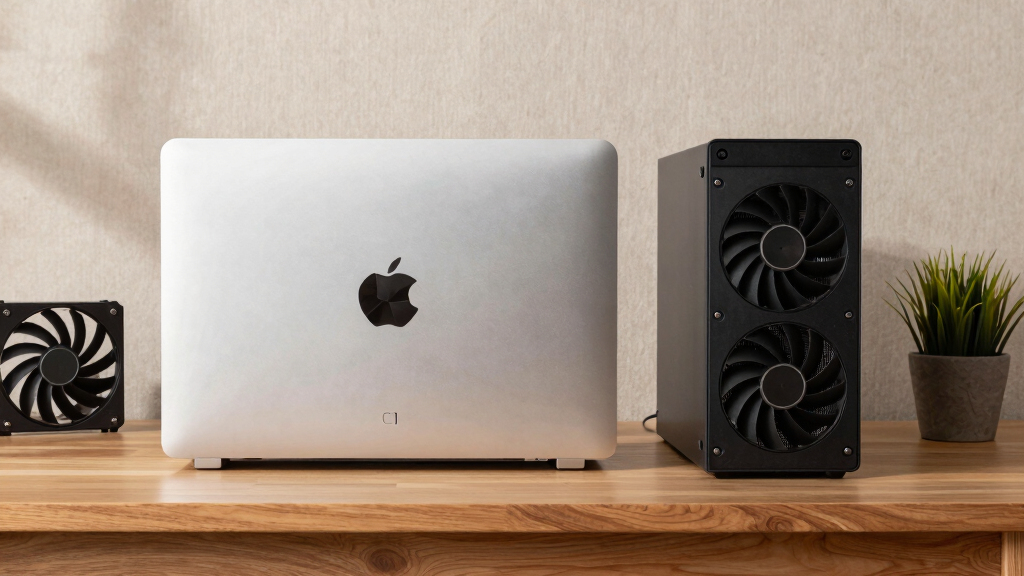
What if you sidestep the heat entirely with a different kind of machine? A tower is a high-bandwidth furnace you spend five levers quieting. Apple Silicon is near-silent by design — but asks for different tradeoffs. Match your priority in Part 2.
Put the loud, hot machine where its noise doesn’t matter, and the quiet one where you do. SSH into the tower when you need raw power; let the Mac handle everything else, silently.
Implications for Local AI Hardware Choices
This comparison highlights a fundamental choice for AI practitioners: prioritize raw throughput and upgrade flexibility with GPU towers, or opt for near-silent, power-efficient operation with Apple Silicon Macs. For workloads involving models that fit within VRAM, towers offer superior performance. For larger models exceeding GPU VRAM, Macs provide a feasible, quieter alternative, especially for continuous, low-power deployment. The decision impacts hardware investment, operational costs, and workflow complexity, making it a critical consideration for anyone deploying local large language models.
Products Worth Considering

Logitech MX Master 4 for Mac, Ergonomic Bluetooth Mouse with Haptic Feedback, Ultra-Fast Scrolling, USB-C Charging, for MacOS, iPadOS, Windo

Apple iPad Air (4th Generation, 10.9-inch, Wi-Fi, 256GB) - Space Gray

Apple iPad Air 13-inch (M4), 128GB, Wi-Fi 7, Space Gray
As an affiliate, we earn on qualifying purchases.
Hardware Capabilities and Tradeoffs in AI Inference
The core architectural difference lies in bandwidth versus capacity: GPU towers optimize for high memory bandwidth, enabling faster token generation on smaller models, while Apple Silicon chips maximize shared memory capacity, allowing larger models to run at the expense of speed. Historically, GPU systems with CUDA ecosystems dominate model training and fine-tuning, but Apple Silicon is increasingly capable for inference tasks. The heat and noise generated by GPU towers have long been a challenge, prompting ongoing efforts to reduce thermal footprint and manage acoustic output, whereas Apple Silicon's integrated design inherently minimizes these issues, making it a compelling choice for quiet, continuous operation.
Recent hardware developments have expanded the possibilities for both approaches, but the fundamental tradeoff remains: throughput versus capacity, and noise versus thermal management.
"For large models that don’t fit into VRAM, the Mac’s unified memory architecture is a game-changer, especially for continuous deployment where silence and power efficiency matter."
— Hardware engineer at a leading AI startup
Remaining Questions on Performance and Scalability
It is not yet clear how future hardware updates will shift these tradeoffs, particularly whether Apple Silicon will improve inference speeds significantly or if GPU architectures will become more power-efficient and quieter. Additionally, the ecosystem support for training and fine-tuning on Macs remains limited compared to NVIDIA’s CUDA platform, raising questions about scalability and broader applicability.
Upcoming Hardware and Software Developments
Future releases from Apple and NVIDIA are expected to refine these tradeoffs further. Apple may enhance inference performance with new chips or software optimizations, while GPU vendors continue to improve power efficiency and thermal management. Meanwhile, software ecosystems are likely to evolve, potentially enabling more seamless workflows across both hardware types. Observers should watch for new hardware launches, software updates, and benchmarks to better understand how these platforms will compete and complement each other in local AI deployment.
Key Questions
Can a Mac Studio run large language models as effectively as a GPU tower?
Mac Studios can run large models larger than 70 billion parameters thanks to unified memory, but their inference speed is generally slower than GPU towers optimized for throughput. The choice depends on whether capacity or speed is more critical for your workload.
Is the heat and noise from GPU towers manageable for continuous operation?
Managing heat and noise in GPU towers requires significant effort, including cooling solutions and fan tuning. While it’s possible to reduce noise, it remains a substantial operational consideration compared to the near-silent operation of Apple Silicon Macs.
Will future hardware updates change these tradeoffs?
Likely yes. Apple may improve inference performance with new chips, and NVIDIA may enhance power efficiency. Ecosystem support and software optimization will also influence how these platforms evolve for local AI workloads.
What are the main limitations of using a Mac for local AI inference?
The primary limitations are slower inference speeds compared to GPU towers and restricted upgradeability. Large models exceeding VRAM capacity can be run, but at reduced performance.
Which system is better for training models?
GPU towers currently dominate training and fine-tuning workflows due to their high bandwidth, CUDA ecosystem, and upgrade options. Macs are mainly suited for inference tasks, especially for large models that fit in shared memory.
Source: ThorstenMeyerAI.com