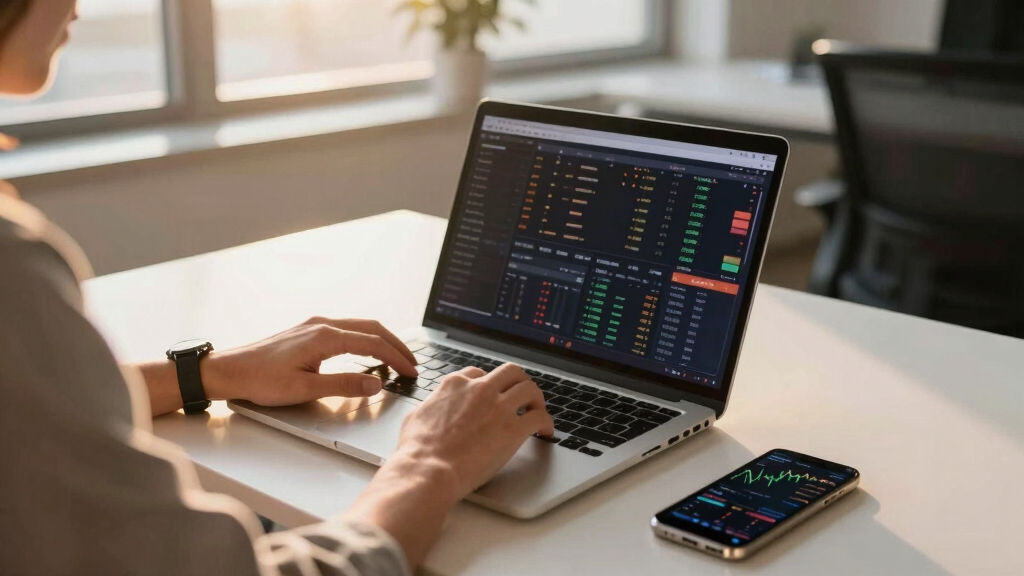

📊 Full opportunity report: Introducing Forezai · TradingAgents — a committee of LLMs decides paper-trades on ThorstenMeyerAI.com — validation score, market gap, and execution plan.

Get the latest gadgets delivered free with Prime
- Fast, free delivery on millions of items
- Prime Video, Amazon Music and more included
- Member-only deals all year
TL;DR
Forezai·TradingAgents is a new project where a committee of specialized large language models (LLMs) makes paper-trading decisions. It extends previous research on parametric strategies by testing AI collaboration in simulated markets, aiming to evaluate AI’s decision quality.
Forezai·TradingAgents is developed privately and is not publicly available. It is designed to let a committee of large language models (LLMs) autonomously perform paper-trades based on structured analysis. This development aims to explore whether AI collaboration can produce trading decisions at least as reliable as random chance, marking a significant step in AI-driven market research.
The project builds on prior research that tested parametric trading strategies against prediction markets, which mostly failed despite high win rates, revealing the pitfalls of mechanical edges. In contrast, Forezai·TradingAgents employs a multi-agent system where different LLMs, each with specialized roles—such as market analysis, social sentiment, fundamental review, and risk assessment—argue and synthesize their insights to generate trading signals.
The system does not aim to predict markets directly but to articulate and debate reasoning, with a final portfolio decision made by a dedicated agent. The fork adds operational features including an autonomous trading loop, paper trading interfaces with multiple broker modes, and a web dashboard for monitoring performance. It runs locally, with no real money involved unless deliberately overridden, emphasizing research rather than live trading.
While the framework is designed for simulation and research, it exemplifies a structured approach to AI decision-making in finance, combining multi-agent reasoning with rigorous logging and safety measures.
Introducing Forezai · TradingAgents.
A committee of LLMs
decides paper-trades.
Analysts · Debate · Risk · Decision
combined with -33% bankroll
services, HTTP routes (starting baseline)
(falls back to public API per token)
The bet is on a different mechanism, not a different parameter setting. The point is not to find a money-printing AI. The point is to put honest measurements of these systems into the public record — so the next person looking at the space starts a step further along than the last.Thorsten Meyer AI · Introducing Forezai · TradingAgents · § 03
Implications for AI-Driven Market Research
Forezai·TradingAgents demonstrates a novel approach to AI decision-making by leveraging a committee of specialized LLMs, rather than relying on single-model predictions. This approach can improve transparency and explicit reasoning, addressing common concerns about AI ‘black box’ outputs in trading contexts. Although it is not designed for real trading, the framework advances understanding of how AI can collaboratively analyze complex data and articulate reasoning, potentially informing future developments in automated trading and financial research.
Furthermore, by focusing on paper-trading and simulation, the project provides a safe environment to test AI capabilities, identify limitations, and refine multi-agent architectures. The project is developed privately and is not publicly available. It could still inform broader AI research in finance, especially around explainability, robustness, and multi-model collaboration.
As an affiliate, we earn on qualifying purchases.
Background on AI in Trading and Multi-Agent Frameworks
Previous efforts in AI trading have often centered on parametric strategies, which rely on explicit rules and parameters. Recent research, including reports from ThorstenMeyerAI.com, shows that such strategies often fail in live markets despite promising backtests, due to overfitting and mechanical artifacts. This has led to skepticism about AI’s ability to outperform simple random strategies after transaction costs.
The concept of multi-agent systems, where multiple AI models or algorithms collaborate or compete, has gained traction in fields like game theory and autonomous systems. In finance, some experimental frameworks have attempted to simulate market environments with multiple AI agents, but practical implementations remain limited. Forezai·TradingAgents builds on this trajectory by integrating specialized LLMs into a structured decision-making process, emphasizing explicit reasoning and debate rather than prediction alone.
“This project demonstrates how structured multi-LLM collaboration can serve as a research tool for understanding AI’s decision-making in markets, without promising predictive accuracy.”
— Thorsten Meyer, ThorstenMeyerAI.com
As an affiliate, we earn on qualifying purchases.
Unclear Effectiveness of Multi-LLM Committee in Live Markets
It remains unconfirmed whether the multi-LLM committee approach can produce consistently reliable trading signals in live or highly volatile markets, as the current implementation is limited to paper-trading simulations. The actual performance, robustness, and potential for real-world application are still under evaluation, and no live trading results have been publicly reported.
As an affiliate, we earn on qualifying purchases.
Next Steps for Testing and Development
Researchers plan to extend testing by running longer-term simulations, refining agent roles, and exploring variations in the decision architecture. They may also experiment with integrating real-time data feeds and more sophisticated risk-management features. Ultimately, the goal is to evaluate whether this multi-agent reasoning approach can be scaled or adapted for practical trading environments, while maintaining transparency and safety.
As an affiliate, we earn on qualifying purchases.
Key Questions
Can Forezai·TradingAgents be used for live trading?
No, the current system is designed for paper-trading and research purposes only. It explicitly avoids risking real money unless operators override safety features.
How does the multi-LLM system improve decision-making?
By involving specialized agents that analyze different aspects of market data and argue their perspectives, the system aims to produce more transparent and balanced decisions than single-model predictions.
What are the main limitations of this approach?
The system’s effectiveness in real markets remains unproven, and current implementations are limited to simulated environments. Its reliance on LLM reasoning also introduces challenges related to consistency and computational cost.
Will this framework replace traditional trading algorithms?
Not currently. It is primarily a research tool to explore AI reasoning and collaboration, which may inform future algorithm development but is not intended as a direct replacement for existing trading systems.
Is the code for Forezai·TradingAgents open-source?
No, the project is developed privately and is not publicly available.
Source: ThorstenMeyerAI.com
Columbus Day / Indigenous Peoples' Day Picks
long weekend sales
As an affiliate, we earn on qualifying purchases.