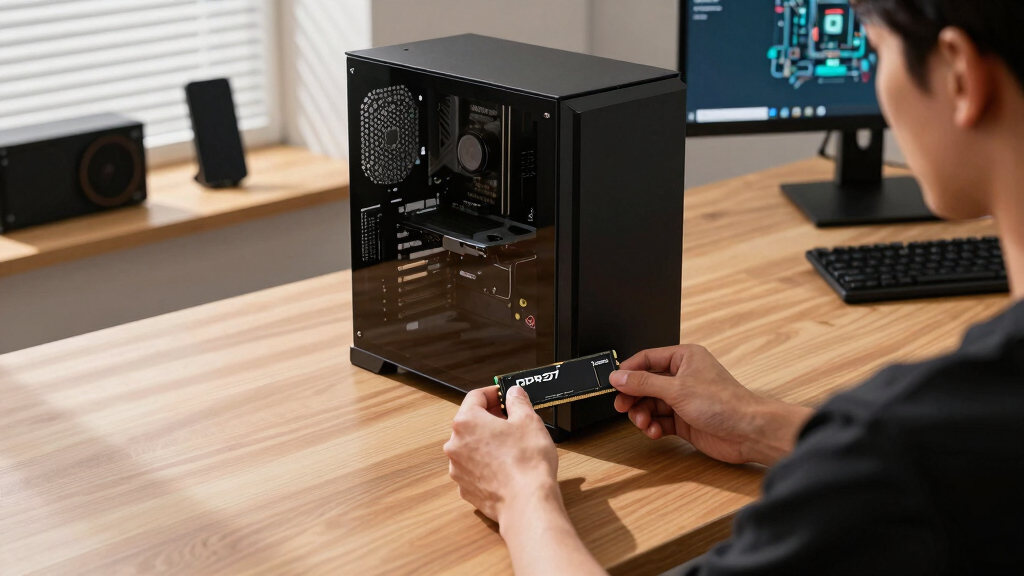

📊 Full opportunity report: DDR5 Now, DDR6 Soon: A Buyer’s Field Guide on ThorstenMeyerAI.com — validation score, market gap, and execution plan.
TL;DR
With memory prices high and DDR6 still years away from mainstream adoption, experts advise buying DDR5 now for current needs. DDR6 offers significant improvements but won’t be cost-effective until late 2020s.
Memory prices remain elevated in 2026, and DDR6 is not yet available for mainstream PCs. Experts recommend purchasing DDR5 now for current builds, as waiting for DDR6 will delay performance gains and increase costs.
Despite ongoing market shortages, the consensus among industry analysts is clear: **buy DDR5 now** for most users, as prices for DDR5-6000 CL30 kits remain the sweet spot for both AMD and Intel platforms. Higher-speed kits like DDR5-8000 are generally a waste of money for gaming and typical workloads, given diminishing returns.
Capacity planning should focus on actual needs—32GB for gaming and general use, 64GB for content creation—rather than overbuying to future-proof, which risks locking in high prices for unused modules. Platform considerations include newer boards supporting CUDIMMs for stability at higher speeds and the trend toward registered memory on high-core workstations.
Buying into DDR4 in 2026 is discouraged; DDR4 is effectively at end-of-life, with no future for new builds on DDR4 sockets, and the cost per gigabyte now rivals DDR5. Building on DDR4 now equates to paying premium for obsolete technology.
Regarding DDR6, it is a significant architectural leap, with quadruple sub-channels and much higher speeds (up to 17,600 MT/s). However, DDR6 is not backward compatible and requires new CPUs, chipsets, and modules, with rollout staged from 2026 through 2030. Early adoption is limited to specific high-bandwidth workloads and long-term workstations, not mainstream consumer PCs.
Most users should wait until DDR6 standards are finalized, and compatible hardware is available—likely around 2027—rather than rushing into early adoption, which involves higher costs and immature technology.
DDR5 now, DDR6 soon
A buyer’s field guide. The 20-year instinct — wait for prices to drop, or wait for the next generation — is broken this cycle. Buy the DDR5 you actually need now; don’t wait for DDR6. Here’s the reasoning.
Driven to end-of-life, production slashed. Same money, dead-end socket. Leave a working DDR4 box alone — but never start a new build on DDR4 to “save.”
A framework, not a gamble. Buy the DDR5 you need now, at the sweet spot, in the capacity you’ll actually use — don’t buy DDR4, don’t wait for DDR6. The two costliest mistakes in this market are the ones that feel prudent: waiting for a price drop that isn’t coming, and waiting for a next-gen part that launches dearer than what’s on the shelf. Next: The SSD Squeeze.
Why Immediate DDR5 Purchase Is Recommended in 2026
This guidance matters because the current market conditions make waiting for lower prices or DDR6’s arrival impractical for most users. Buying DDR5 now ensures compatibility, performance, and cost-effectiveness, avoiding the premium and uncertainty of early DDR6 adoption. Delaying upgrades risks missing out on CPU, GPU, and platform improvements that are critical for gaming and productivity.
As an affiliate, we earn on qualifying purchases.
Market Trends and the DDR5/DDR6 Development Timeline
The 2026 memory market is characterized by persistent shortages and high prices, with forecasts indicating relief only around 2028. DDR5 was introduced in 2021 and has become the standard for new builds, with its mature ecosystem supporting speeds up to 6000 MT/s at reasonable prices. DDR6, announced as a future standard, is still in development, with first-compatible products expected no earlier than 2027 for mainstream desktops, and broader adoption not until 2030. Historically, new memory standards take several years to reach ubiquity, and DDR6’s initial costs and platform requirements will limit early adoption.
Manufacturers have shifted focus away from DDR4, which is now at end-of-life, and the market is moving toward DDR5 and DDR6. The current landscape favors building on DDR5, as DDR4 offers no future upgrade path and is priced similarly or higher than DDR5 modules now.
“DDR6 will bring significant bandwidth improvements, but the platform and cost barriers mean it won’t be mainstream until late 2020s.”
— Hardware manufacturer representative
high capacity DDR5 memory for gaming
As an affiliate, we earn on qualifying purchases.
As an affiliate, we earn on qualifying purchases.
Uncertainties Around DDR6 Adoption and Pricing
While DDR6 promises substantial performance gains, its actual availability, pricing, and platform compatibility in 2026-27 remain uncertain. Early models may face stability issues, limited capacities, and high costs, making widespread adoption unlikely before 2028. The exact timeline for mature, affordable DDR6 modules remains a moving target, dependent on industry standards and manufacturing scale.
As an affiliate, we earn on qualifying purchases.
Next Steps for PC Builders and Upgraders in 2026
Consumers should focus on building or upgrading PCs with DDR5 now, selecting configurations aligned with their workload needs. Monitoring JEDEC standards and motherboard compatibility lists will signal when DDR6 becomes viable for broader adoption—likely around 2027. Meanwhile, platform upgrades should prioritize CPU, GPU, and platform improvements, as these will deliver more immediate performance benefits than waiting for DDR6.
As an affiliate, we earn on qualifying purchases.
Key Questions
Should I buy DDR4 in 2026 to save money?
No. DDR4 is at end-of-life, and building on DDR4 now means paying a premium for obsolete technology with no future upgrade path.
When will DDR6 be available for mainstream PCs?
DDR6 is expected to be available for mainstream desktops around 2027, with broader adoption not until approximately 2030.
Is it worth waiting for DDR6 to save money?
For most users, waiting is not advisable. DDR6 will likely be more expensive initially, and delaying purchases means missing out on platform and CPU improvements.
What should I buy now for a new build?
Buy DDR5-6000 CL30 modules, 32GB for general use or 64GB for heavy multitasking, and focus on current CPU, GPU, and platform upgrades.
Source: ThorstenMeyerAI.com