
📊 Full opportunity report: Consent Management Basics For Youth-Service Vendors on IdeaNavigator AI — validation score, market gap, and execution plan.

Get the latest gadgets delivered free with Prime
- Fast, free delivery on millions of items
- Prime Video, Amazon Music and more included
- Member-only deals all year
TL;DR
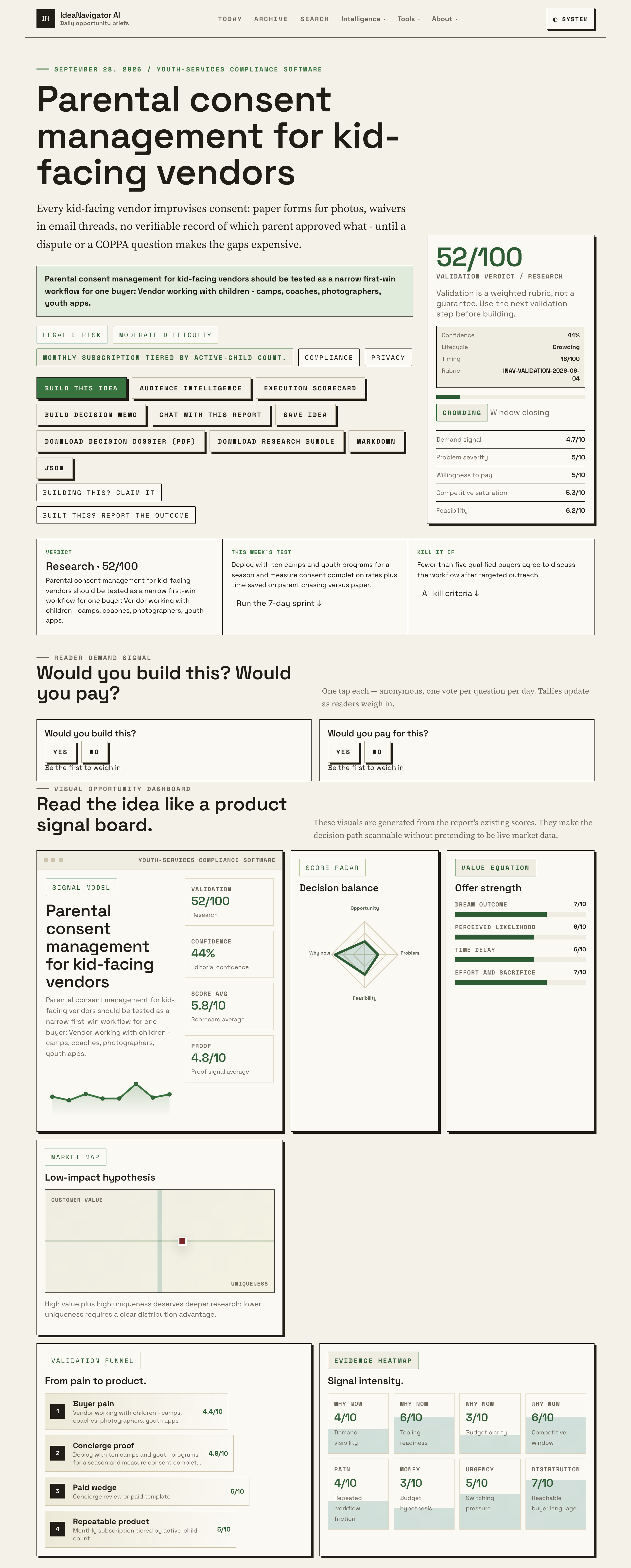
A product analysis from IdeaNavigator AI identifies parental consent management as an unmet need among youth-service vendors such as camps, coaches, photographers and youth apps, who rely on paper forms and email threads with no verifiable consent records. The proposal outlines a vendor-branded mobile consent platform with per-child ledgers, expiry tracking and audit export, monetized as a subscription tiered by active-child count.
A new product analysis from IdeaNavigator AI argues that youth-service vendors — camps, coaches, photographers and youth apps — are improvising parental consent through paper photo-release forms, waivers buried in email threads and records that cannot be verified after the fact, leaving them exposed when a dispute or a COPPA inquiry surfaces the gaps. The analysis proposes a narrow, testable fix: a consent-management workflow vendors can deploy for a single season with ten camps and youth programs to measure whether digital consent records outperform paper.
The analysis identifies the core problem as record-keeping, not paperwork volume. According to IdeaNavigator AI, kid-facing vendors typically have no verifiable record of which parent approved what — photo use, data collection, medical authorizations, liability waivers — until a parent challenges a photo’s use or a regulator asks a question under the Children’s Online Privacy Protection Act (COPPA). At that point, reconstructing consent from scattered forms and inboxes becomes expensive.
The proposed minimum viable product is a set of vendor-branded consent flows that parents complete on their phones, covering photo use, data collection, medical consent and liability. The specification calls for identity verification scaled to the risk tier of each consent type, a per-child consent ledger, expiry tracking so lapsed authorizations surface automatically, and an instant audit export a vendor can hand over when challenged.
The suggested business model is a monthly subscription tiered by active-child count, aimed at the youth-services compliance software market. Validation would involve deploying with ten camps and youth programs for a full season and measuring two metrics: consent completion rates, and time saved chasing parents compared with the paper baseline.
Why Small Youth Vendors Are Exposed
The proposal targets a segment that children’s-privacy regulation has historically reached unevenly: small, seasonal operators rather than large platforms. The analysis states that children’s privacy enforcement is expanding, through COPPA updates and a growing body of state law, and that parents increasingly challenge photo and data use directly with vendors. Both pressures push even small operators toward consent records they can actually defend.
If validated, the model matters because it converts consent from a filing-cabinet problem into a data problem — one with a measurable completion rate and an exportable audit trail. That reframing is what makes the niche testable: a camp can compare, within one season, how many consents its paper process captured versus a phone-based flow.
The Paper-and-Email Status Quo
Youth-service vendors have long handled consent manually. Photo releases circulate as printed forms collected at drop-off; medical and liability waivers travel through email threads; and the resulting paper trail, where one exists, is stored inconsistently across staff and seasons. The IdeaNavigator AI analysis describes this as a default state rather than a deliberate choice — vendors improvise because no purpose-built, affordable tool fits their scale.
That contrasts with the regulatory backdrop. COPPA, the U.S. federal framework governing children’s data online, has undergone rule updates that broaden what counts as personal data and how verifiable parental consent must be obtained. State-level children’s privacy laws add further requirements. Large youth apps already carry compliance infrastructure; the analysis’s point is that offline and semi-digital vendors do not.
Unproven Demand and Open Questions
No product described in the analysis has been built or deployed; the entire specification — the consent flows, the ledgers, the expiry tracking, the audit export — remains a proposal. The ten-camp validation has not been run, so there is no measured data on consent completion rates or time saved versus paper.
Whether small vendors will pay a recurring subscription tiered by active-child count is untested. Seasonal operators manage tight, fluctuating budgets, and the analysis does not provide pricing benchmarks or willingness-to-pay figures. It is also unclear how identity verification “appropriate to the risk tier” would work in practice for low-friction consent types, or how the proposed records would be received in an actual COPPA or state-law inquiry — the analysis asserts defensibility but cites no enforcement precedent involving comparable tools.
The Ten-Camp Season Test
The stated next step is validation: recruiting ten camps and youth programs for a single season’s deployment and tracking consent completion rates and administrative time saved against the paper baseline. According to the analysis, a successful run on those two metrics would justify building out the subscription product for the broader youth-services compliance market.
Beyond that, the trajectory depends on factors outside the analysis’s scope: how COPPA rulemaking and state children’s-privacy laws evolve, whether parents’ challenges to photo and data use continue to rise, and whether vendors treat audit-grade consent records as a purchase priority or a nice-to-have. Regulatory developments over the coming seasons will shape how urgent the demand proves to be.
Source: IdeaNavigator AI
Key Questions
What is the product being proposed?
A consent-management platform for vendors who work with children. Parents complete vendor-branded consent flows on their phones covering photo use, data collection, medical consent and liability, with the system maintaining per-child consent ledgers, expiry tracking and instant audit export.
Who is the target customer?
Small kid-facing vendors: camps, coaches, photographers and youth apps — operators who currently handle consent through paper forms and email and lack verifiable records.
How would the product make money?
Through a monthly subscription priced in tiers based on the number of active children on the vendor’s roster, according to the IdeaNavigator AI analysis.
Has this been built or tested?
No. The analysis is a product proposal. Its validation plan calls for deploying with ten camps and youth programs for one season to measure consent completion rates and time saved versus paper, but that test has not been run.
Why is this relevant now?
The analysis points to expanding children’s privacy enforcement — COPPA updates and new state laws — combined with parents increasingly challenging photo and data use, which pushes even small vendors toward consent records they can verify and defend.
Source: IdeaNavigator AI
Fall Picks
fall essentials
As an affiliate, we earn on qualifying purchases.