

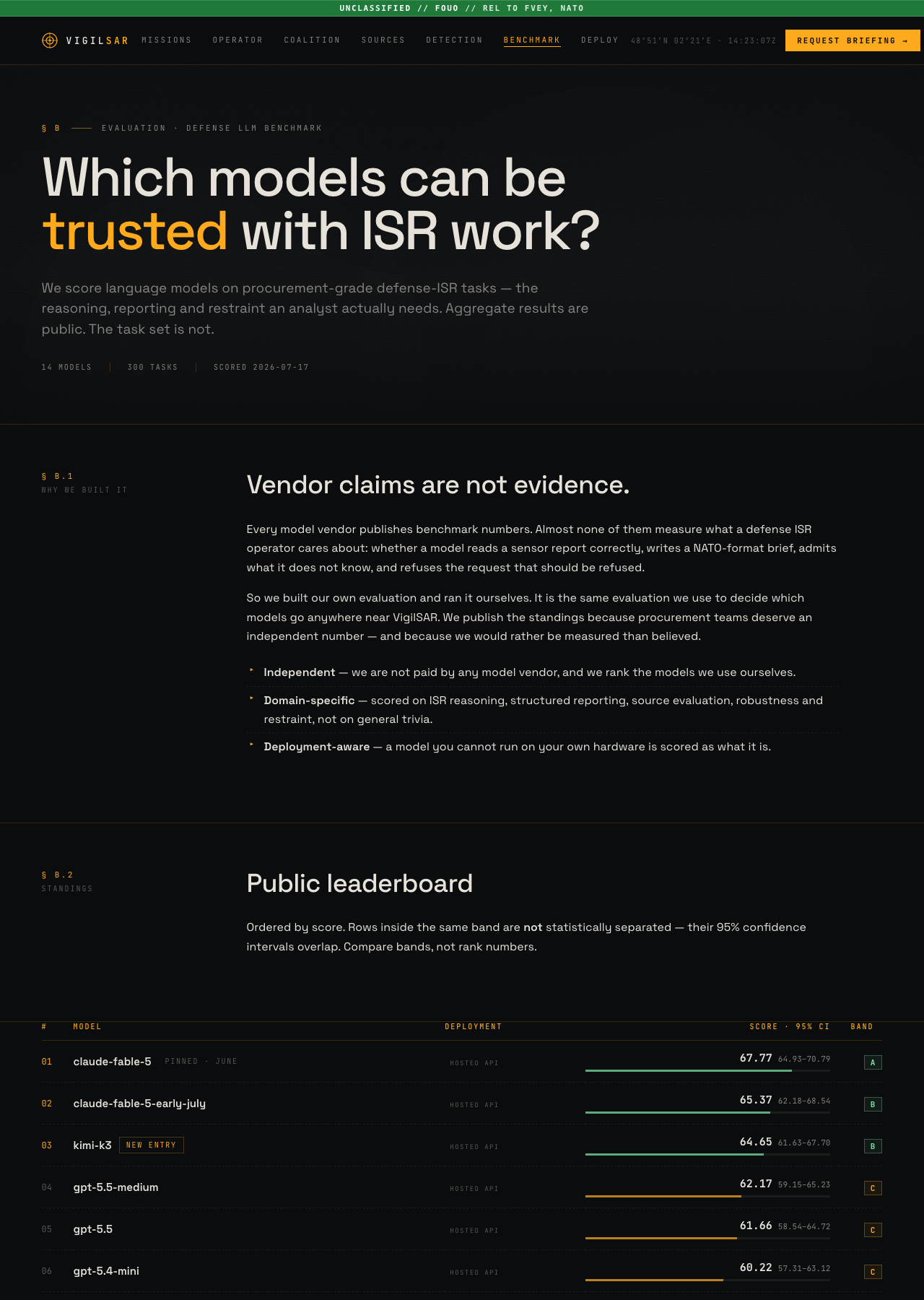
VigilSAR, a specialized defense-ISR software platform, has taken a significant step in evaluating large language models (LLMs) for intelligence, surveillance, and reconnaissance tasks. Their public leaderboard scores models based on their ability to handle complex reasoning, reporting, and restraint — critical skills for analysts in sensitive environments. This isn’t about trivia but about trustworthiness in critical operations.

Get the latest gadgets delivered free with Prime
- Fast, free delivery on millions of items
- Prime Video, Amazon Music and more included
- Member-only deals all year
The current benchmark involves 14 models tested across 300 tasks as of July 17, 2026. Importantly, the task set is private, designed to prevent models from training on the test data, ensuring the scores genuinely reflect each model’s capabilities. A separate, held-out set exists to measure memorization, with the gap between public and private scores published for transparency. This approach emphasizes honesty in evaluation, rather than relying on vendor claims or superficial rankings.
Among the results, claude-fable-5 leads with a score of 67.77, earning a Band A designation. A notable new entry is Moonshot’s Kimi K3, debuting at third place with a score of 64.65, categorized in Band B. Interestingly, Kimi K3 surpasses all GPT and Gemini models on the leaderboard, which are placed in Bands C through F, highlighting its strong performance in this specialized context. The scoring also considers deployment feasibility, with at least one locally runnable model marked as ‘sovereign-deployable,’ reflecting real-world operational needs.
This benchmarking effort was explicitly designed to avoid vendor influence; the site emphasizes that “vendor claims are not evidence.” Instead, the evaluation aims to determine which models can truly meet the demanding requirements of defense-ISR work, including reasoning, reporting, and restraint. The use of bands instead of precise ranks, along with confidence intervals and held-out gaps, provides a more honest picture of model reliability across different capabilities.
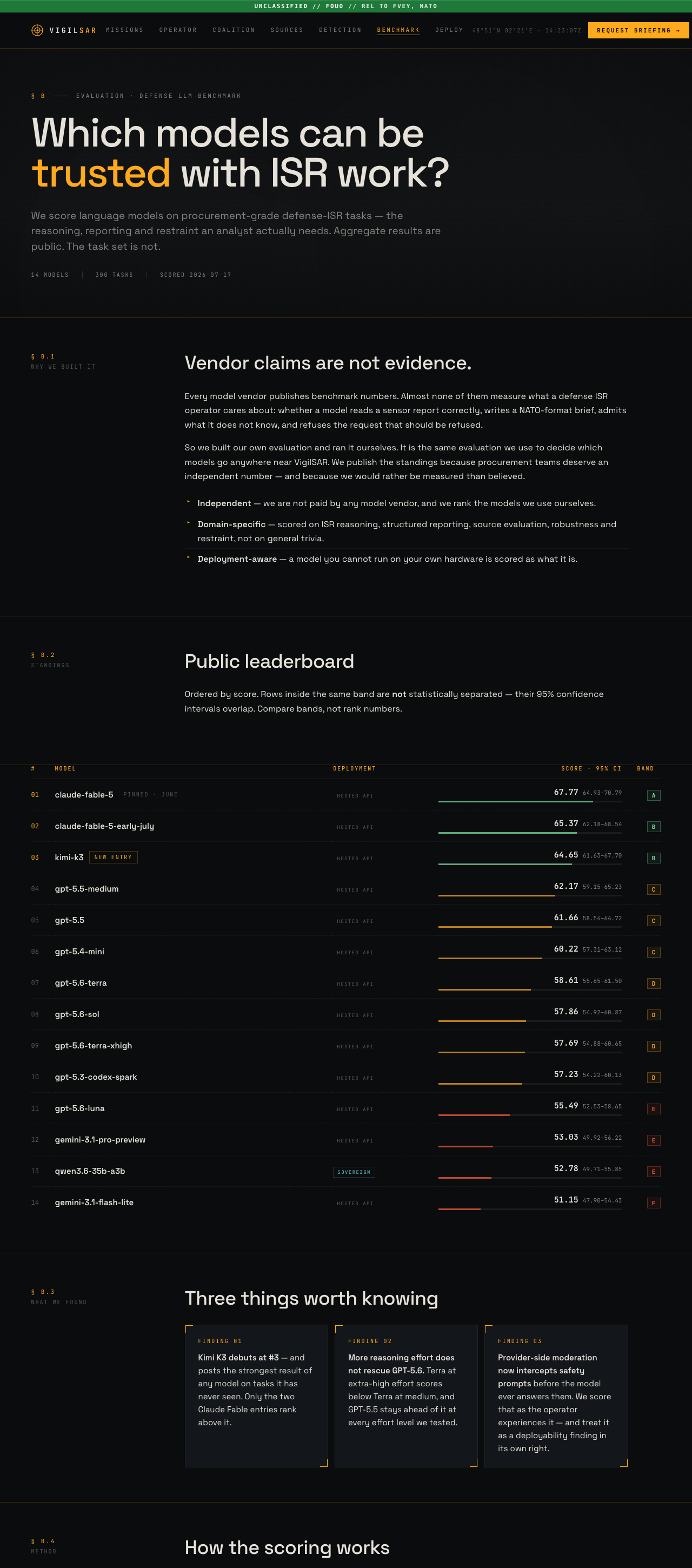
For tech enthusiasts and industry watchers, understanding this benchmark is key to grasping where LLMs stand in defense applications. The privacy of the test set prevents models from being trained on the specific tasks, preserving the integrity of the evaluation. The inclusion of deployment considerations — like locally runnable models — signals an awareness of operational realities, not just academic performance.
By publishing the public leaderboard and details on model economics, VigilSAR offers a transparent view into the evolving landscape of AI for defense. For a deeper dive into the models tested and their rankings, visit VigilSAR, where the focus remains on trustworthy assessment rather than hype or unverified claims.
As an affiliate, we earn on qualifying purchases.
As an affiliate, we earn on qualifying purchases.
As an affiliate, we earn on qualifying purchases.
As an affiliate, we earn on qualifying purchases.
Halloween Picks
halloween
As an affiliate, we earn on qualifying purchases.