🔍 Read the full analysis: A Chinese University Rented Nvidia H200 Servers. What Do The Records Say? on ThorstenMeyerAI.com

Get the latest gadgets delivered free with Prime
- Fast, free delivery on millions of items
- Prime Video, Amazon Music and more included
- Member-only deals all year
TL;DR
Archived procurement notices dated January 28, 2026, show Northwestern Polytechnical University awarded two contracts to rent servers listed with eight Nvidia H200 GPUs each. The notices document the rentals, but do not show where the servers or chips were located, how the chips reached China, or whether a U.S. license applied.
Northwestern Polytechnical University, a Chinese university on the U.S. Commerce Department’s Entity List, awarded two contracts in January 2026 to rent servers whose specifications list eight Nvidia H200 GPUs per server, according to archived procurement notices. The records show contracts worth 441,000 yuan and 441,700 yuan, but do not establish where the servers were located, how the chips reached China, or whether a U.S. export license covered them.
The notices were posted by the university’s School of Cyberspace Security on January 28, 2026. Copies saved by the Internet Archive’s Wayback Machine on March 15 show each contract was for server rental, rather than an outright purchase of the chips. The notices are no longer available on the school’s website, according to the source report.
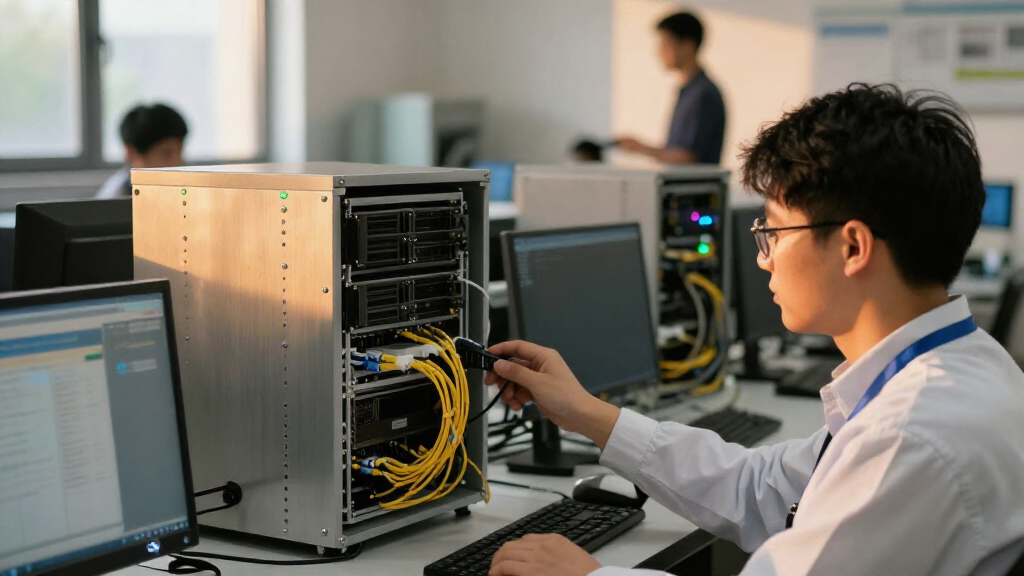
One contract covered a large-model reinforcement-learning fine-tuning computing service for 441,000 yuan, with service dates from February 16 to September 16, 2026. Its server description specified an “NVIDIA HGX H200 8-GPU SXM 141GB” system and said it could provide continuous access and operation. The second, for large-model multitask fine-tuning, cost 441,700 yuan and ran from February 1 to August 31. It also listed eight H200 GPUs, with 141GB of memory per card. Each notice named a Shenzhen-based supplier.
The notices identify the equipment configuration and the contract winners, but do not say who owned the chips or where the rented servers were physically operated. They also do not identify any export license or explain how the equipment entered the relevant supply chain. The source report does not name the suppliers, noting that the records alone do not establish the origin of their hardware.
Export controls · buying vs. renting
Shipping the chips is controlled. Renting time on them is the open question.
How a university on the US Entity List can use Nvidia H200 chips without owning them, step by step.
Schematic
export of chipsunknown or reportedremote access
What the records and rules show
- 1Buying: exporting chips to a listed buyer needs a US license. For this university the policy is a presumption of denial.
- 2Reported, not verified: Reuters and AFP describe H200 purchase notices that were removed. We found no archived copy.
- 3Renting: the chips sit in a supplier’s server. How they got there is not in the records.
- 4Remote access: two notices dated January 28, 2026 award server rentals with eight H200 chips per server, for 441,000 and 441,700 yuan.
- 5The January 2026 H200 rule bars Entity List parties from remote access, but only as a condition on licensed exports.
Sources: eCFR, 15 CFR 744.11 and Part 744 Supplement No. 4 (as of November 10, 2026); Federal Register, 91 FR 1684 (January 15, 2026); NWPU School of Cyberspace Security award notices of January 28, 2026 (Wayback Machine copies); Reuters, November 11, 2026; AFP, November 12, 2026. Schematic, not a map of real locations. Not legal advice.
Graphic: Powered by Thorsten Meyer AI
Export Rules Meet Server Rentals
The contracts draw attention to a distinction in technology controls: a customer may gain access to advanced chips through rented computing capacity without buying the chips outright. The notices document that the university contracted for server access, but they do not by themselves establish an export-control violation.
The university’s Entity List entry requires a license for all items subject to the U.S. Export Administration Regulations, with a review policy of “Presumption of denial.” The rules cover exports, reexports and certain transfers within a country when a listed entity is a party to a transaction. Whether those provisions apply to this particular rental depends on facts the notices do not provide, including the servers’ location, ownership and transaction structure.
The case also puts scrutiny on how restrictions apply when computing is supplied as a service. A rental contract can show that a customer was promised access to a particular system; it does not automatically reveal whether the chips were shipped to China, whether access was remote, or which party held any required license.
Products Worth Considering

Apple Watch SE 3 GPS 44mm Smartwatch

LG UltraGear 32-Inch QHD 180Hz Curved Gaming Monitor

Logitech MX Master 4 Ergonomic Wireless Mouse with Haptic Feedback, Graphite
As an affiliate, we earn on qualifying purchases.
What the Archived Notices Establish
Northwestern Polytechnical University, based in Xi’an, has appeared on the U.S. Commerce Department’s Entity List since 2001. The list entry cited in the source material covers “all items subject to the EAR” and carries a “Presumption of denial” license review policy. The regulatory text says a license is required, as specified in the list, for covered exports, reexports or in-country transfers when a listed entity is a party.
The source report says Reuters first reported on November 11 that the university had awarded the two H200 server-rental contracts and had also made H200 purchases. Reuters reported that five computing-rental contracts had been awarded during 2026, including rentals involving Nvidia A100 and A800 chips; the source author says they had not independently seen those other rental notices.
Reuters and Agence France-Presse also reported separate H200 purchases by university units. Reuters described an October 21 record for two chips costing 874,700 yuan; AFP reported a September 4 notice for two more chips costing 796,000 yuan. The notices had been removed, and the source author says no archived copies were found. Those purchase details are therefore attributed to the agencies and could not be independently checked against preserved records in the source report.
The source material also describes a January 15, 2026, change by the Commerce Department’s Bureau of Industry and Security to its review policy for certain semiconductor exports to China and Macau. It says the revised policy added conditions related to remote access and cloud infrastructure-as-a-service users for licensed shipments. The available procurement records do not show whether those conditions were relevant to these rentals.
““The system can guarantee 24-hour access and continuous operation.””
— Northwestern Polytechnical University School of Cyberspace Security procurement notice
Where the H200 Servers Were
The archived notices do not identify the servers’ physical location, their owner, the route by which the H200 chips were obtained, or whether U.S. authorities issued a license for any relevant transaction. They also do not clarify whether the university’s access was provided on-site or remotely, or how the rental arrangement was structured.
The two H200 purchase notices reported by Reuters and AFP are not independently confirmed by the preserved records cited here: the source author says the notices were no longer accessible and could not be found in the Internet Archive. The available material also does not establish whether the rental arrangements complied with applicable U.S. rules. The contracts alone are not evidence that the university or its suppliers violated export controls.
What Further Records Could Show
The next useful evidence would include procurement records that remain accessible or are preserved in an archive, along with documentation identifying server locations, equipment ownership and the parties to the rental arrangements. Records on any applicable export licenses would also help establish how the contracts fit within U.S. controls. No such documentation is identified in the source material, and no response from the university, suppliers or U.S. authorities is provided.
Until those details emerge, the strongest supported conclusion is limited: two archived notices show that the university contracted to rent servers listed with eight H200 GPUs each. The reported outright purchases remain agency-reported rather than independently verified in the source account, and the export-control status of both the rentals and purchases remains unresolved.
Key Questions
What did the archived notices show?
They show two contracts awarded by Northwestern Polytechnical University’s School of Cyberspace Security on January 28, 2026, for server rental. Each server specification listed eight Nvidia H200 GPUs; the contracts were worth 441,000 yuan and 441,700 yuan.
Did the university buy the H200 chips in these contracts?
No. The two archived notices describe server rentals. Separate H200 purchases were reported by Reuters and AFP, but the source author says those notices were unavailable and could not be independently verified from archived copies.
Do the records prove an export-control violation?
No. The records do not establish the servers’ location, how the chips reached China, whether a license applied or whether one was issued. The notices alone do not prove a violation.
Why does the Entity List matter here?
The university’s entry is reported to require a license for all items subject to the U.S. Export Administration Regulations, with a “Presumption of denial” review policy. The regulations address covered exports, reexports and in-country transfers involving a listed entity, but the available records do not show how those rules applied to these specific rental contracts.
Source: ThorstenMeyerAI.com