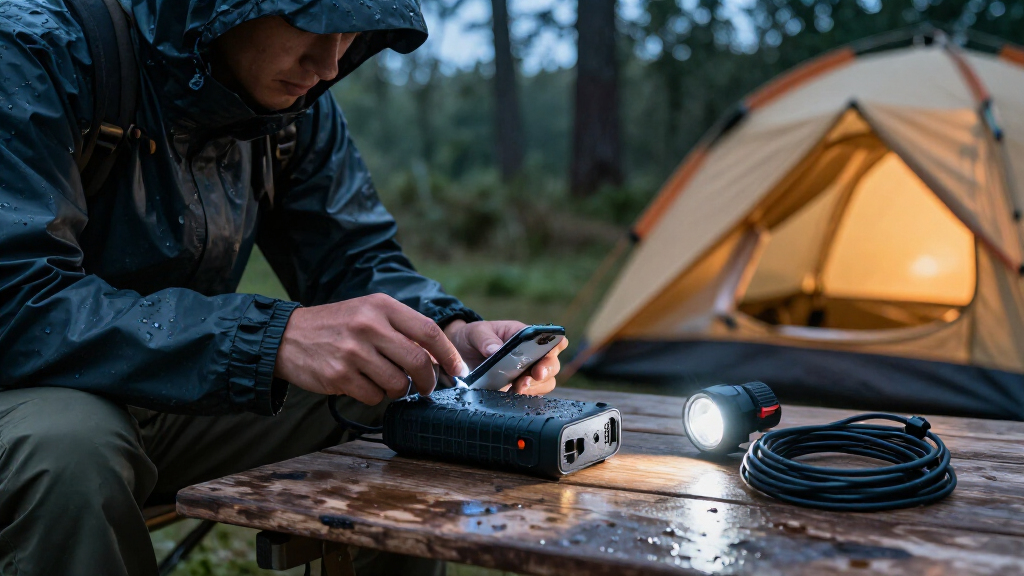

Military-grade portable power banks vary more in capacity, weather protection, and charging speed than the label suggests. I’d put the NESTOUT 15,000mAh IP67 model first for its balance of capacity, 32W USB-C PD, and water and shock protection; the BLAVOR LiFePO4 stands out for buyers prioritizing battery chemistry and IP67 protection, while the ToughTested 24,000mAh favors longer capacity between charges. The tradeoff is straightforward: larger packs can weigh more, while compact options may not carry enough energy for several devices or days away from an outlet. Some models add a flashlight or solar panel, but those extras do not replace checking charging output and weather ratings. Read on for how I rank all nine and which compromises make sense for your use.

Get the latest gadgets delivered free with Prime
- Fast, free delivery on millions of items
- Prime Video, Amazon Music and more included
- Member-only deals all year
Complete the kit



Key Takeaways
- The NESTOUT 15,000mAh combines the lineup’s strongest stated balance of capacity, 32W USB-C PD, and IP67 protection, making it the most versatile starting point.
- Capacity is not the only differentiator: the 24,000mAh ToughTested suits longer stretches between outlets, while the 5,000mAh NESTOUT trades endurance for a smaller, simpler carry.
- The BLAVOR is the only listed LiFePO4 option, giving battery chemistry a distinct role in the comparison alongside conventional capacity and output specs.
- Two INIU 10,000mAh models offer 45W charging, so buyers who need faster USB-C output should compare their exact feature sets rather than choosing by capacity alone.
- Built-in lights and solar panels add possible field utility, but charging speed, usable capacity, and water protection remain more central to dependable device power.
| ASWAYKE P20 20,000mAh Rugged Power Bank with 420-Lumen Camping Light |  | Best for Lighting and Long Trips | Battery capacity: 20,000mAh | Charging: USB-C PD fast charging | Ports: USB-C and USB-A | VIEW LATEST PRICE | See Our Full Breakdown |
| NESTOUT Rugged 15,000mAh Power Bank, 32W USB-C PD, IP67 Waterproof and Shockproof (Beige) |  | Best for Verified Drop Protection | Battery capacity: 15,000mAh | Maximum output: 32W | Ports: 3: USB Type-A and USB Type-C | VIEW LATEST PRICE | See Our Full Breakdown |
| Goal Zero Venture 35 9600mAh Power Bank with 18W USB-C PD |  | Best Compact Emergency Backup | Battery capacity: 9,600mAh | Charging: 18W USB-C PD | Ports: 3 total; 2 USB-A outputs | VIEW LATEST PRICE | See Our Full Breakdown |
| INIU Outdoor Rugged 10,000mAh 45W Portable Charger with Flashlight |  | Best Compact Fast-Charging Pick | Battery capacity: 10,000mAh | Maximum charging output: 45W | Battery type: Lithium polymer | VIEW LATEST PRICE | See Our Full Breakdown |
| BLAVOR 15,000mAh Rugged LiFePO4 Power Bank with IP67 Waterproof Protection |  | Best for Long-Cycle Battery Chemistry | Battery capacity: 15,000mAh | Battery chemistry: LiFePO4 (LFP) | Water and dust resistance: IP67 when lid is fully tightened | VIEW LATEST PRICE | See Our Full Breakdown |
| INIU Rugged 10,000mAh Portable Charger, 45W USB-C Power Bank |  | Best Lightweight Fast-Charging Pick | Battery capacity: 10,000mAh | Maximum output: 45W | Ports: 2 USB-C | VIEW LATEST PRICE | See Our Full Breakdown |
| NESTOUT Rugged 5,000mAh Outdoor Power Bank, USB-C Fast Charging, IP67 Waterproof and Shockproof |  | Best Compact Emergency Backup | Battery capacity: 5,000mAh | Maximum charging output: 15W | Ports: USB Type-A and USB Type-C | VIEW LATEST PRICE | See Our Full Breakdown |
| ELECOM NESTOUT 10,280mAh Rugged Power Bank with 20W USB-C PD |  | Best Balanced Rugged Pick | Battery capacity: 10,280mAh | USB-C PD output: Up to 20W | Ports: 2: USB Type-A and USB Type-C | VIEW LATEST PRICE | See Our Full Breakdown |
| ToughTested 24,000mAh Solar Power Bank with LED Flashlight and USB-C Fast Charging |  | Best for Extended Outings | Battery capacity: 24,000mAh | Ports: 3: USB-A QC 3.0, USB-C PD, and Micro input | USB-C Power Delivery: 18W | VIEW LATEST PRICE | See Our Full Breakdown |
| military grade portable power bank | Battery capacity | Ports | Dimensions | Weight |
|---|---|---|---|---|
| ASWAYKE P20 20,000mAh Rugged P | 20,000mAh | USB-C and USB-A | — | 1.5 lb |
| NESTOUT Rugged 15,000mAh Power | 15,000mAh | 3: USB Type-A and USB Type-C | 5 × 2.4 × 3 inches | 364g |
| Goal Zero Venture 35 9600mAh P | 9,600mAh | 3 total; 2 USB-A outputs | 4.41 × 2.68 × 1.1 inches | 0.29kg |
| INIU Outdoor Rugged 10,000mAh | 10,000mAh | — | 3.58 × 2.26 × 1.1 inches | — |
| BLAVOR 15,000mAh Rugged LiFePO | 15,000mAh | 2 USB-C ports | 17.7 × 5.2 × 4.1 cm | — |
| INIU Rugged 10,000mAh Portable | 10,000mAh | 2 USB-C | 3.6 × 2.3 × 1.1 in | 6.9 oz (160 g) |
| NESTOUT Rugged 5,000mAh Outdoo | 5,000mAh | USB Type-A and USB Type-C | 5.31 × 1.42 × 1.42 in | 4.9 oz |
| ELECOM NESTOUT 10,280mAh Rugge | 10,280mAh | 2: USB Type-A and USB Type-C | 5 × 2.4 × 1.4 in | 241 g |
| ToughTested 24,000mAh Solar Po | 24,000mAh | 3: USB-A QC 3.0, USB-C PD, and Micro input | 6.75 × 3.5 × 1.25 in | 16 oz |
More Details on Our Top Picks
ASWAYKE P20 20,000mAh Rugged Power Bank with 420-Lumen Camping Light
The ASWAYKE P20 is the most self-contained camp option here: its 20,000mAh capacity is paired with USB-C PD charging and a built-in 420-lumen light, so it can top up devices while illuminating a campsite or signaling in an emergency. The digital display also shows battery percentage and charging current, giving more at-a-glance information than the simpler Venture 35. Its IP68-rated power-bank body and stated 2m drop resistance suit rougher outings, though the light itself is described as IPX5, not IP68. The tradeoff is weight: at 1.5 lb, it is far less appealing for a light daypack than the compact INIU RG10000. Ports should be dried after submersion, too. I’d choose it when capacity and a useful area light matter more than carry weight.
Pros:- 20,000mAh capacity with USB-C PD fast charging for longer outings.
- Built-in 420-lumen light offers five modes, including SOS and strobe.
- IP68-rated power-bank body and stated drop resistance up to 2m.
- Digital display, tripod mount, and included hook support outdoor use.
Cons:- At 1.5 lb, it is substantially heavier than compact picks such as the INIU RG10000.
- The light is described as IPX5 even though the power-bank body is IP68-rated.
- Ports need to be dried after submersion.
Best for: Campers and emergency-kit builders who want a high-capacity charger with a bright built-in light and visible charge-status information.
Not ideal for: Hikers prioritizing low pack weight, or anyone who needs the light and power bank to share the same stated water-resistance rating.
- Battery capacity:20,000mAh
- Charging:USB-C PD fast charging
- Ports:USB-C and USB-A
- Water resistance:IP68 power-bank body; light described as IPX5
- Drop resistance:Up to 2m
- Camping light:420 lumens; High, Soft, SOS, Strobe, and Warm modes
- Weight:1.5 lb
- Additional feature:Standard tripod mount on base
Our verdict“Choose the ASWAYKE P20 for extended outdoor use when a bright built-in light and large capacity outweigh its heavy carry weight.”
NESTOUT Rugged 15,000mAh Power Bank, 32W USB-C PD, IP67 Waterproof and Shockproof (Beige)
For buyers who put documented impact protection ahead of extra capacity, the NESTOUT 15,000mAh has a useful distinction: its silicone-cushioned hard shell is stated to have passed the MIL-STD 810G 516.7 drop test. It also combines IP67 water and dust resistance with up to 32W USB-C PD output, making it a more evidence-led rugged pick than the ASWAYKE P20, whose listing gives a drop-height claim but no named test standard. Three ports offer flexibility for small devices, and the tripod mount can support compatible accessories. Compared with the 20,000mAh ASWAYKE, capacity is lower and there is no built-in light; compared with the Venture 35, it offers more capacity and faster stated output. The 364g weight is manageable, but accessories such as a tripod or light are not included.
Pros:- Silicone-cushioned shell is stated to pass the MIL-STD 810G 516.7 drop test.
- IP67-rated housing is specified for submersion up to 1m for up to 30 minutes.
- Up to 32W USB-C PD output supports faster charging than the Venture 35’s 18W.
- Three ports and a 1/4-20 tripod mount add connection and accessory options.
Cons:- 15,000mAh capacity is below the ASWAYKE P20’s 20,000mAh.
- Tripod and lights are not included.
- The manufacturer recommends an 18W-or-higher USB PD adapter; computer USB charging may be slow or unsupported.
Best for: Outdoor workers and campers who want a named drop-test claim, IP67 protection, and fast charging in one device.
Not ideal for: Buyers who need a built-in flashlight, the largest capacity in this group, or a complete lighting setup without extra accessories.
- Battery capacity:15,000mAh
- Maximum output:32W
- Ports:3: USB Type-A and USB Type-C
- Water and dust resistance:IP67; up to 1m for up to 30 minutes
- Drop protection:Silicone-cushioned hard shell; tested to MIL-STD 810G 516.7
- Weight:364g
- Dimensions:5 × 2.4 × 3 inches
- Tripod mount:1/4-20
Our verdict“Pick the NESTOUT when documented drop testing and 32W charging matter more than a built-in light or maximum capacity.”
Goal Zero Venture 35 9600mAh Power Bank with 18W USB-C PD
The Goal Zero Venture 35 is the straightforward choice for a small emergency backup, rather than a high-capacity expedition bank. At 0.29 kg and about 4.41 inches long, it is easier to stow than the ASWAYKE P20, while its IP67 rating, protective sleeve, and waterproof port plug add practical defenses against wet, dusty conditions. The integrated 50-lumen flashlight is useful for close-up tasks, but it cannot match the ASWAYKE’s 420-lumen camp lighting. Its 9,600mAh capacity and 18W USB-C PD output also trail the NESTOUT 15,000mAh and 32W combination, so this is better for keeping a phone alive than powering several devices over a long trip. Solar charging appears in the listing, but no panel is specified as included.
Pros:- Compact 0.29kg body is easier to carry than the ASWAYKE P20.
- IP67 design includes a protective sleeve and waterproof port plug.
- 18W USB-C PD and two USB-A outputs support different charging connections.
- Integrated 50-lumen flashlight adds a basic emergency light.
Cons:- 9,600mAh capacity is lower than the NESTOUT and ASWAYKE options.
- 18W output is below the NESTOUT’s 32W and INIU RG10000’s stated 45W.
- Solar charging is listed, but no solar panel is specified as included.
Best for: Day hikers, commuters, and emergency-kit owners who want a light, pocketable phone backup with water and dust protection.
Not ideal for: Multi-day campers or users charging several devices who need more capacity, higher output, or a brighter area light.
- Battery capacity:9,600mAh
- Charging:18W USB-C PD
- Ports:3 total; 2 USB-A outputs
- Water and dust resistance:IP67
- Flashlight:Integrated, 50 lumens
- Weight:0.29kg
- Dimensions:4.41 × 2.68 × 1.1 inches
- Battery type:Lithium-Nickel Manganese Cobalt (NMC)
Our verdict“Choose the Venture 35 for a compact, protected phone backup, not for high-capacity or high-output outdoor power.”
INIU Outdoor Rugged 10,000mAh 45W Portable Charger with Flashlight
The INIU RG10000 gives portability and stated output priority over marathon capacity. Its 10,000mAh battery and small 3.58 × 2.26 × 1.1-inch body make it easier to carry than the ASWAYKE P20, while its 45W maximum output is the highest stated figure among these five products. That can make it a better fit for compatible devices that benefit from faster charging, including some laptops, though the listing does not establish every device’s charging limits. It includes a flashlight, carabiner, and USB-C cable, but unlike the NESTOUT and Goal Zero listings, no IP rating or specific drop-test standard is supplied here. Capacity is also modest for extended trips. Port details are inconsistent: the listing says two USB-C outputs but also one port, so I would verify the connection layout before buying.
Pros:- 45W stated maximum output is higher than the other products in this batch.
- Compact dimensions and 160g listed battery weight favor easy carry.
- Includes a flashlight, carabiner, and USB-C cable.
- Listed as compatible with phones, tablets, laptops, and cameras.
Cons:- 10,000mAh capacity may be limiting on extended trips or when charging several devices.
- Port information conflicts: two USB-C outputs are listed alongside a one-port count.
- No specific IP rating or named drop-test standard is supplied in the provided product data.
Best for: Pack-light travelers and outdoor users with compatible devices who value a compact charger and high stated output over multi-day capacity.
Not ideal for: Buyers who require a clearly documented IP water-resistance rating, verified port layout, or enough capacity for extended multi-device use.
- Battery capacity:10,000mAh
- Maximum charging output:45W
- Battery type:Lithium polymer
- Listed connectors:2 USB-C outputs; port count also listed as 1
- Dimensions:3.58 × 2.26 × 1.1 inches
- Battery weight:160g
- Included accessories:Carabiner, USB-C cable, flashlight
- Warranty:5 years
Our verdict“Choose the INIU RG10000 for compact, high-output charging when its port layout and ruggedness details suit your needs.”
BLAVOR 15,000mAh Rugged LiFePO4 Power Bank with IP67 Waterproof Protection
The BLAVOR PN-W52 stands apart through its LiFePO4 battery, rated for more than 3,500 charge cycles, rather than unusually high output or integrated lighting. That cycle-life claim may appeal to frequent users who expect to recharge the bank often. Its 15,000mAh capacity sits between the ASWAYKE P20’s 20,000mAh and the Venture 35’s 9,600mAh, while two USB-C ports and an integrated cable lanyard simplify charging compatible devices without packing a separate lead. The 20W maximum output is more modest than the NESTOUT’s 32W and INIU’s 45W, so faster-charging-device owners should check their requirements. IP67 protection applies only when the lid is fully tightened, and the built-in cable is USB-C to USB-C, limiting convenience for gear that needs another connector.
Pros:- LiFePO4 battery is rated for more than 3,500 charge cycles.
- 15,000mAh capacity offers more reserve than the Venture 35.
- Two USB-C ports and an integrated USB-C cable lanyard support convenient charging.
- IP67 protection is specified when the lid is fully tightened.
Cons:- 20W maximum output is below the NESTOUT’s 32W and INIU RG10000’s 45W.
- IP67 protection depends on fully tightening the lid.
- The integrated USB-C-to-USB-C cable may not suit devices with other connector types.
Best for: Frequent outdoor users who value a long-cycle-life battery, a built-in USB-C cable, and midrange capacity for compatible devices.
Not ideal for: People who need higher-wattage charging, a built-in flashlight, or water protection that does not depend on closing a lid correctly.
- Battery capacity:15,000mAh
- Battery chemistry:LiFePO4 (LFP)
- Water and dust resistance:IP67 when lid is fully tightened
- Ports:2 USB-C ports
- Maximum charging power:20W
- Integrated cable:USB-C to USB-C cable lanyard
- Dimensions:17.7 × 5.2 × 4.1 cm
Our verdict“Pick the BLAVOR for frequent charging and a long-cycle-life battery, provided 20W output and USB-C-only cable convenience meet your needs.”
INIU Rugged 10,000mAh Portable Charger, 45W USB-C Power Bank
For a day hike where weight and charging speed matter more than carrying a large reserve, this INIU pairs 10,000mAh with up to 45W output in a 6.9-ounce body. Its IP67 protection and built-in mounting thread give it a more trail-focused setup than a standard pocket bank, while the detachable D-ring and included carabiner make it easier to attach to a pack. Compared with the ELECOM NESTOUT 10,280mAh, it offers higher stated output and weighs less; ELECOM, however, lists both USB-A and USB-C ports, while this model lists two USB-C ports. The main compromise is capacity: it is better suited to topping up a phone than powering several devices through a long trip. I’d skip it if you need multiple connector types or a bigger energy reserve.
Pros:- IP67-rated protection against water and dust
- Up to 45W output in a compact 6.9-ounce body
- Built-in 1/4-inch mounting thread, detachable D-ring screw, and included carabiner
- Two USB-C ports and a five-year warranty
Cons:- 10,000mAh capacity is limited for extended trips or frequent multi-device charging
- Only USB-C ports are listed, which may not suit USB-A accessories
Best for: Hikers and travelers who want a lightweight, water- and dust-protected bank with fast USB-C charging for a phone or compact device.
Not ideal for: Multi-day users who need repeated device recharges, or buyers who rely on USB-A accessories and want that port listed.
- Battery capacity:10,000mAh
- Maximum output:45W
- Ports:2 USB-C
- Ingress protection:IP67
- Dimensions:3.6 × 2.3 × 1.1 in
- Weight:6.9 oz (160 g)
- Mounting:Built-in 1/4-in thread
- Warranty:5 years
Our verdict“Choose this INIU for lightweight outdoor carry and fast USB-C charging, but pick a higher-capacity model for extended trips.”
NESTOUT Rugged 5,000mAh Outdoor Power Bank, USB-C Fast Charging, IP67 Waterproof and Shockproof
The NESTOUT is the small-capacity, protective option in this group: at 4.9 ounces, it is easier to reserve space for than the 10,000mAh INIU or the much larger ToughTested. Its IP67-rated shell, silicone shock cushion, and stated MIL-STD 810G 516.7 drop-test protection suit a phone backup carried in exposed outdoor settings. USB-C Power Delivery adjusts output for the connected device, and the USB-A port adds flexibility that the INIU’s listed USB-C-only setup lacks. The tradeoff is the 5,000mAh capacity, which limits how much charge it can provide, especially to larger devices. It also has a one-year warranty, shorter than the INIU’s five years. I’d choose it for a compact emergency top-up, not as the main power source for a long outing.
Pros:- IP67-rated protection with a shock-cushioned hard shell
- Stated MIL-STD 810G 516.7 drop-test protection
- USB-C Power Delivery with automatic output adjustment
- USB-A and USB-C ports plus a 1/4-20 tripod mount
Cons:- 5,000mAh capacity limits charging for larger devices and longer outings
- One-year warranty is shorter than the five-year warranty listed for the INIU and ToughTested
- Charging from a PC USB port may be slow or may not work
Best for: Day hikers, cyclists, and emergency-kit planners who want a lightweight backup for occasional phone charging in wet or rough conditions.
Not ideal for: Travelers who need multiple full phone recharges, want a longer warranty, or plan to power several devices on a trip.
- Battery capacity:5,000mAh
- Maximum charging output:15W
- Ports:USB Type-A and USB Type-C
- Ingress protection:IP67; submersion up to 1 meter for 30 minutes
- Drop protection:MIL-STD 810G 516.7 drop test
- Dimensions:5.31 × 1.42 × 1.42 in
- Weight:4.9 oz
- Warranty:1 year
Our verdict“Pick the NESTOUT when compact, protected emergency backup matters more than capacity or extended-trip charging.”
ELECOM NESTOUT 10,280mAh Rugged Power Bank with 20W USB-C PD
The ELECOM NESTOUT takes a middle-ground approach: its 10,280mAh capacity is nearly double the smaller NESTOUT’s, while the 20W USB-C PD output and two-port setup suit everyday phones and small electronics. Its IP67 rating covers dust and temporary submersion, and the silicone-cushioned housing is stated to pass the MIL-STD 810G 516.7 drop test. Compared with the INIU 10,000mAh, it offers a listed USB-A port alongside USB-C, but the INIU’s maximum output is higher at 45W and its listed weight is lower. The ELECOM’s built-in tripod mount is useful for compatible accessories, though the tripod and lights are not included. Its 241g weight and one-year warranty are less appealing for ultralight travel or buyers who prioritize longer coverage.
Pros:- 10,280mAh capacity with USB-C Power Delivery up to 20W
- USB-A and USB-C ports with automatic power allocation
- IP67 housing and stated MIL-STD 810G 516.7 drop-test protection
- Built-in 1/4-20-inch tripod mount
Cons:- At 241g, it is heavier than the INIU 10,000mAh model
- Tripod and lights are not included
- One-year warranty is shorter than the INIU’s five-year warranty
Best for: Outdoor users who want roughly 10,000mAh, USB-A and USB-C connectivity, and a rugged body with a tripod mount.
Not ideal for: Ultralight hikers seeking the lowest weight, buyers needing higher output for demanding devices, or anyone expecting tripod accessories in the box.
- Battery capacity:10,280mAh
- USB-C PD output:Up to 20W
- Ports:2: USB Type-A and USB Type-C
- Ingress protection:IP67; submersion up to 1 meter for up to 30 minutes
- Drop protection:MIL-STD 810G 516.7
- Dimensions:5 × 2.4 × 1.4 in
- Weight:241 g
- Warranty:1 year
Our verdict“Choose the ELECOM for a balanced capacity, mixed-port setup, and rugged mounting option, rather than maximum output or minimum weight.”
ToughTested 24,000mAh Solar Power Bank with LED Flashlight and USB-C Fast Charging
With 24,000mAh capacity, three charging ports, and an integrated four-mode flashlight, the ToughTested is built for carrying more backup power than the compact NESTOUT models. It can charge up to three devices at once, and its 18W USB-C PD output supports faster charging than the smaller NESTOUT’s stated 15W. Solar panels add a possible supplemental charge source when sunlight is available, but I would treat them as a backup rather than a dependable replacement for charging from a power source. At 16 ounces, this is a heavier choice than the INIU or either NESTOUT. Its protection rating is also listed inconsistently as IP66/IP67, so buyers who need a clearly specified submersion rating may prefer the ELECOM or NESTOUT. It suits longer outings where capacity and a light matter more than pack weight.
Pros:- 24,000mAh capacity for extended backup power
- Can charge up to three devices at once through three ports
- 18W USB-C Power Delivery and a four-mode LED flashlight
- Integrated solar panels and a five-year limited warranty
Cons:- Solar charging depends on sunlight and is not a dependable primary recharge method
- At 16 ounces, it is substantially heavier than the INIU and NESTOUT options
- Product data lists both IP66 and IP67 protection ratings
Best for: Campers and travelers carrying several small devices who want high capacity, multiple ports, a flashlight, and supplemental solar charging.
Not ideal for: Ultralight hikers, buyers relying on solar as their primary recharge method, or users who need an unambiguous water-resistance rating.
- Battery capacity:24,000mAh
- Ports:3: USB-A QC 3.0, USB-C PD, and Micro input
- USB-C Power Delivery:18W
- Flashlight:4-mode LED
- Dimensions:6.75 × 3.5 × 1.25 in
- Weight:16 oz
- Warranty:5-year limited manufacturer’s warranty
Our verdict“Choose the ToughTested for higher-capacity group or multi-device trips, but skip it if low weight or a clearly stated ingress rating is your priority.”
How We Picked
I ranked these military-style rugged power banks by the details that change how they work outdoors: stated capacity, USB-C output, weather and impact protection, battery chemistry, and useful extras such as lighting or solar charging. I gave more weight to a balanced combination of capacity, charging performance, and protection than to a single headline feature. A high capacity is less useful if a unit is awkward for a short outing, and a rugged shell alone does not tell a buyer how quickly it can charge a phone or tablet.
The order reflects the intended buyer, not a claim that one model wins every scenario. The NESTOUT 15,000mAh ranks first for its mix of capacity, 32W PD, and IP67 protection; the BLAVOR and ToughTested earn distinct places for battery chemistry and extended capacity. Compact and lower-capacity models rank lower for all-day reserve, while the 45W INIU options suit buyers who prioritize output. I treat “military grade” as a marketing description unless a specific test standard and result are supplied, so I prioritize stated protections and practical tradeoffs rather than assuming the phrase proves ruggedness.
Factors to Consider When Choosing Military Grade Portable Power Banks
Choosing a rugged power bank is less about finding the toughest-sounding label and more about matching its limits to your trip. I’d start with the devices you need to charge, then weigh how long you’ll be away from a wall outlet against carry weight and exposure to water or dirt.
Match Capacity to the Whole Trip
Capacity figures describe the battery pack, not the exact energy that reaches your devices, so expect less usable charge than the printed mAh number suggests. A compact 5,000mAh unit can make sense as an emergency phone reserve, but it is a poor substitute for a larger pack when several people need power. For multi-day use, estimate how many charges each device needs and leave room for cold conditions, navigation, and unexpected calls. Avoid buying capacity you will rarely carry: a heavy pack left at home offers no backup. The 15,000mAh and 24,000mAh options in this lineup illustrate the choice between a flexible middle ground and a bigger reserve.
Check Output Against Your Devices
Capacity tells you how much energy a pack stores; output tells you how quickly it can deliver that energy. Check the power requirements for your phone, tablet, headlamp, or other USB-C device before prioritizing a high-wattage number. The 45W INIU models are more compelling for devices that can use stronger USB-C charging, while a lower-output bank may be perfectly adequate for a phone. Also check port count and whether charging multiple devices reduces available output, since a shared limit can slow a group’s setup. A common mistake is buying for capacity alone and then finding the power bank charges a demanding device more slowly than expected.
Read Protection Ratings Literally
Water resistance, dust protection, and shock resistance address different hazards; a rugged appearance does not establish performance in every one of them. An IP67 rating can be useful around rain, splashes, and dust, but check the maker’s conditions and care instructions rather than treating it as permission for any kind of submersion. Shockproof claims also vary, and a drop rating or published test is more useful than a general toughness statement. Ports and covers can be weak points, especially after repeated use or exposure to grit. If your route includes water crossings or rough handling, prioritize clear, specific protection details over the phrase “military grade.”
Decide Whether Extras Earn Their Space
A built-in flashlight can save room in a day kit, and solar charging may provide some backup when you are away from outlets. Neither feature should be treated as a guaranteed power source: light output, panel size, and available sunlight affect what those extras can do. Solar is often better viewed as a slow supplement than as a dependable way to refill a large battery on a tight schedule. Compare the extra functions with the weight and bulk they add, and ask whether you would carry a separate light anyway. If fast, reliable charging is the main goal, a simpler power bank may serve you better than a model with features you rarely use.
Choose Battery Chemistry for Your Use
Battery chemistry can affect longevity, performance, and the conditions a product is designed to handle, but the chemistry name alone does not settle which power bank is best. The BLAVOR’s LiFePO4 construction gives buyers a clear point of difference, while the other listed models compete through capacity, output, size, or protection. Check the manufacturer’s guidance on operating temperatures, storage, and recharge cycles rather than assuming one chemistry makes a device indestructible. For occasional emergency use, portability and charge readiness may matter more than theoretical cycle life. For a kit that gets frequent use, documented care guidance and warranty terms deserve a close read.
Plan for Recharging, Not Just Discharging
A power bank is only useful on a long trip if you have a workable plan to refill it. Higher capacity can mean longer recharge times, and the input speed may differ from the USB-C output speed advertised for charging devices. Check whether the unit supports USB-C input and what charger is needed to refill it efficiently before departure. Solar-equipped models may reduce dependence on wall power in suitable conditions, but panel performance and weather make them an uncertain sole source. For regular trips, a charging routine at home or in a vehicle is usually more dependable than hoping to recover a large pack outdoors.
Frequently Asked Questions
Does “military grade” mean a power bank passed a specific test?
Not by itself. The phrase can describe a product’s positioning without naming a military standard, test method, or result. I would look for specific details such as an IP rating, a published drop-test claim, and operating guidance from the manufacturer. If a listing does not identify what was tested, treat the label as a broad durability claim rather than proof of a defined level of protection. That distinction matters most when you are choosing gear for harsh or safety-sensitive conditions.
Is an IP67 power bank the right choice for kayaking or heavy rain?
An IP67 rating gives a more specific basis for comparing water and dust protection than a general rugged claim, but it does not remove the need to check the manufacturer’s limits. Port covers, seals, and wear can affect protection over time, and water exposure may not be covered by warranty. For kayaking, use a dry bag or another secondary barrier if losing power would create a safety problem. Also keep the bank and its cable connections dry while charging, since protection ratings do not make every use condition safe.
Should I choose the 24,000mAh model or a smaller power bank?
Choose the larger capacity if you expect several device charges, share power with other people, or will be away from outlets for an extended stretch. A smaller pack is easier to carry and can be the better choice for a day hike or as a lightweight backup. The printed capacity is not the amount delivered directly to a phone, so plan for conversion losses and the needs of every device. If you are unsure, estimate a typical day’s charging needs first rather than buying the biggest option by default. The right balance is the largest reserve you will consistently bring along.
Will a 45W power bank charge every phone faster?
No. A phone draws power according to its own charging capabilities and the charging protocol supported by both devices. A 45W output can be useful for compatible tablets or other higher-demand USB-C devices, but it does not force a phone to accept 45W. Cable quality and port choice can also affect charging speed. Check the phone maker’s stated charging limit and the power bank’s supported output before paying extra for wattage you may not use.
Can I rely on a solar power bank as my only backup on a multi-day trip?
I would not rely on a compact solar-equipped power bank as the only charging plan for a trip where device power is important. Solar input depends on sunlight, angle, shade, and weather, and a small panel may replenish a large battery slowly. Treat it as a possible supplement, not a guaranteed way to refill the bank each day. Start with enough stored capacity for your planned use and bring a practical way to recharge before departure. For remote travel, consider redundancy and conserve device power rather than counting on solar alone.
Conclusion
For most outdoor buyers, I’d choose the NESTOUT 15,000mAh as the best overall because it brings together useful capacity, 32W USB-C PD, and IP67 protection. The BLAVOR LiFePO4 is my best premium-style pick for shoppers who specifically value its chemistry and IP67 protection, while the INIU 10,000mAh 45W is a strong value fit when faster USB-C output matters more than a larger reserve. Beginners who want a simple, smaller carry can start with the NESTOUT 5,000mAh, provided its limited capacity suits their needs. For longer trips, I’d look at the ToughTested 24,000mAh; for a light with backup charging in one unit, compare the ASWAYKE P20 and the flashlight-equipped INIU. Whichever you choose, verify the protection details and charging requirements rather than relying on “military grade” alone.
Fall Picks

DJI Osmo Action 4 Essential Combo Waterproof 4K Action Camera
As an affiliate, we earn on qualifying purchases.