
TL;DR

Get the latest gadgets delivered free with Prime
- Fast, free delivery on millions of items
- Prime Video, Amazon Music and more included
- Member-only deals all year
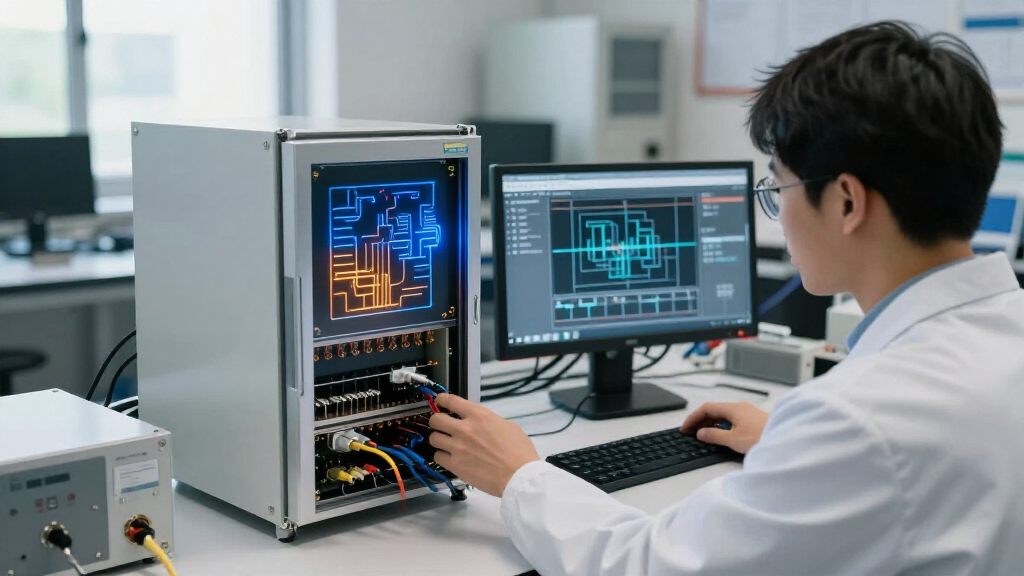
Researchers from Anthropic and Harvard report using Claude to design quantum circuits for eight computational tasks. Their preprint estimates lower resource requirements for seven designs, including about 12 times fewer Toffoli gates for one decoder, but the circuits were not demonstrated on quantum hardware.
Anthropic and Harvard researchers say they used Claude to design more resource-efficient circuits for eight quantum-computing tasks, with seven designs reducing both estimated costly operations and qubit requirements against the study’s comparison designs. The results, posted as a preprint, are computational checks and resource estimates—not demonstrations on a working quantum computer.
One redesigned decoding circuit was estimated to use about 440,000 Toffoli gates, compared with 5.1 million in the study’s baseline, while reducing peak qubit needs from 1,938 to 1,837. Toffoli gates are a costly operation in many proposed error-corrected quantum-computing systems, so reducing their number can lower the estimated work a circuit requires. The figures describe the designs and comparison used in the paper, not measured performance on a machine.
The eighth task produced a different kind of result: an arithmetic design with improved choices between gate count and qubit use, rather than a reduction in both measures. The researchers say the work covered building blocks relevant to chemistry, optimization, physics simulation and number theory. Such routines can form parts of larger algorithms, but their standalone resource estimates do not establish how much an entire application would improve.
The team gave the model programming tools and an evaluator to check proposed circuits and score their resource requirements. It could use the feedback to revise its designs. Anthropic’s accompanying blog identifies the model as Claude Mythos 5 and says work on elliptic-curve arithmetic took 53 hours, with researchers providing initial instructions and occasional prompts to expand the search. Those details are Anthropic’s account of the process.
Lower Costs for Quantum Subroutines
The results address a practical bottleneck: useful quantum algorithms rely on smaller routines whose operations and qubit needs add to the demands placed on a machine. Reducing those estimates could make some future computations more feasible, especially where expensive gates dominate a circuit’s cost. The decoder’s reported reduction is substantial within the study’s comparison, though it does not by itself show that a complete application can run sooner or on smaller hardware.
The work also offers an example of AI being used as a design partner rather than only as a source of suggestions. Here, the model’s candidate circuits were evaluated with tools, and resource scores guided revisions. That approach may help researchers search a large design space, but the reported gains still need scrutiny and integration into full algorithms and hardware systems. Practical impact remains conditional on those next steps.
quantum computing circuit design tools
As an affiliate, we earn on qualifying purchases.
As an affiliate, we earn on qualifying purchases.
How Reversible Circuits Use Resources
A quantum circuit applies a sequence of operations to qubits, the units that hold quantum information. Many algorithms are built from smaller routines for arithmetic, data retrieval or numerical calculations. A more efficient routine can reduce the resource burden of a larger computation, but the circuit must preserve information in ways ordinary software does not.
In reversible computation, intermediate results generally cannot simply be overwritten. Designers may retain temporary information, using more qubits, or clear it through uncomputation, which can require additional operations. The paper describes the model finding designs that recover information from a calculation’s current state, share arithmetic across computational paths, and limit resources allocated to rare inputs where the task permits a small failure probability. These choices involve trade-offs, not just deleting redundant gates.
The reported decoder is used within decoded quantum interferometry, an algorithmic approach to optimization. The study’s description says the decoder handles checks in a curve-fitting problem; it is not being presented as a circuit that corrects faults in the quantum computer itself. In the design discussed, the researchers replaced an extended Euclidean algorithm approach with one based on Berlekamp–Massey, while limiting storage for rare inputs. The paper reports a 19-qubit allocation for a storage need that could otherwise reach 665 qubits in the worst case, accepting failure on exceptional inputs.
“The model could then revise its designs in response to concrete feedback.”
— Anthropic’s accompanying blog post, as described in the report
As an affiliate, we earn on qualifying purchases.
Hardware Performance Still Untested
The source material describes a preprint and resource estimates, not a hardware demonstration. It does not establish whether the proposed circuits can be implemented as designed on available quantum machines, or whether their estimated savings would persist after accounting for real hardware constraints and error correction. The results also do not show the effect on a complete end-to-end quantum algorithm.
For the decoder, the design accepts failure on rare inputs to reduce storage. The supplied report says a second stored entry was needed with a probability of about one in 10,000, but the available excerpt ends before explaining the full treatment of that case. Further details about the probability assumptions, evaluation scope and independent review are not provided in the source material. The work is posted as a preprint, so its review status should not be inferred from the reported results.
As an affiliate, we earn on qualifying purchases.
From Estimated Circuits to Applications
The next test is whether the designs can be incorporated into complete quantum algorithms and produce useful resource savings under realistic machine constraints. The research team’s preprint provides circuit-level estimates; the supplied report does not announce a hardware trial or a schedule for one. Further technical review and replication could clarify how robust the designs are across assumptions and implementations.
Readers should watch for published peer review, additional details on the arithmetic trade-offs, and demonstrations that compare full algorithms using the new circuits against established alternatives. Until then, the supported conclusion is narrower: the team reports that Claude helped find designs with lower estimated resource use on several tasks, while their practical performance remains unconfirmed.
As an affiliate, we earn on qualifying purchases.
Key Questions
What did Claude help design?
Researchers from Anthropic and Harvard used Claude to search for circuits covering eight computational tasks, including routines relevant to chemistry, optimization, physics simulation and number theory.
How much smaller was the reported decoder?
The paper’s estimate for one decoder was about 440,000 Toffoli gates, down from 5.1 million in its comparison design. Estimated peak qubit use fell from 1,938 to 1,837.
Was the circuit run on a quantum computer?
No hardware demonstration is reported in the supplied material. The results are based on computational checks and resource estimates.
Did all eight designs reduce both gates and qubits?
No. The report says seven of the eight reduced both measures against the study’s baselines. The eighth offered improved trade-offs between gate count and qubit requirements.
What remains uncertain?
It is not yet clear whether the estimated savings will carry over to complete algorithms and real quantum hardware. The supplied source also does not provide a schedule for a hardware test.
Source: rss
Fall Picks
fall essentials
As an affiliate, we earn on qualifying purchases.