📊 Full opportunity report: The Strategic Role Of Benefit Check Bots In Public Benefits Ecosystem on IdeaNavigator AI — validation score, market gap, and execution plan.
Listen free for 30 days with Audible
Thousands of audiobooks and originals — cancel anytime.
Start your free trialAs an affiliate, we earn on qualifying purchases.
TL;DR
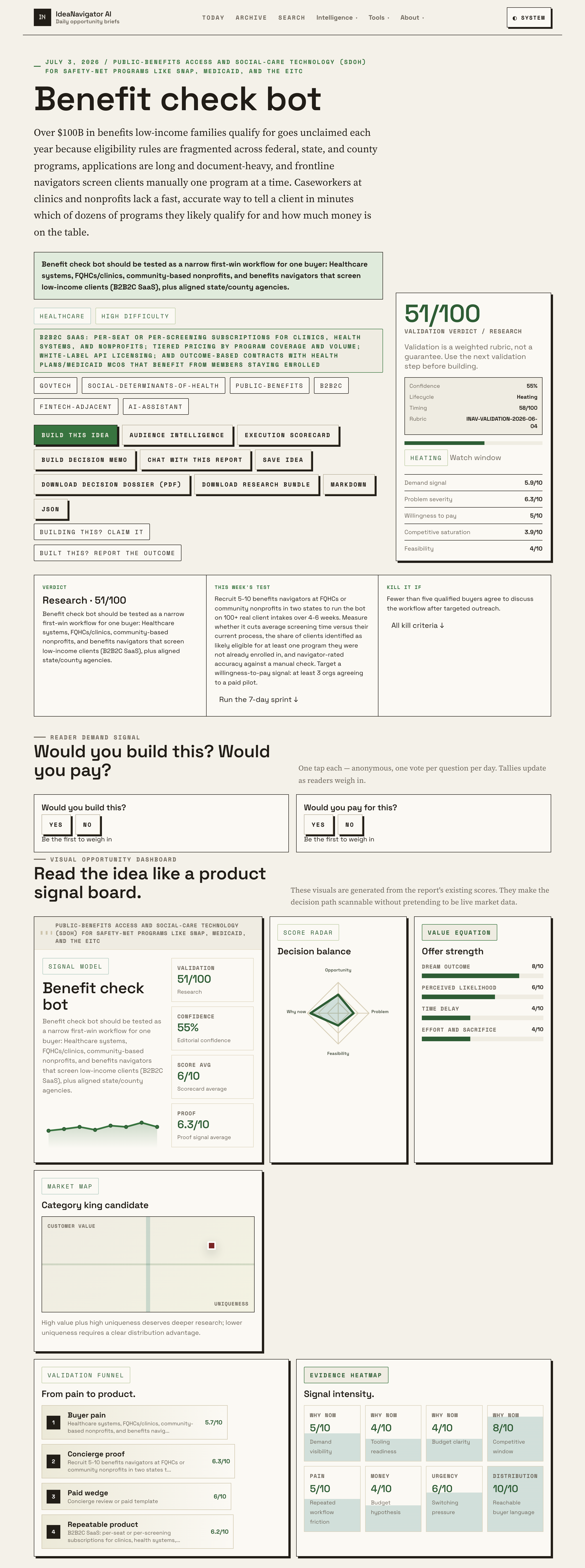
Benefit check bots are emerging as a key tool to improve access to public benefits for low-income families. They address current gaps caused by nonprofit shutdowns and eligibility complexity, offering a scalable, automated screening solution. Validation trials are underway to assess their effectiveness.
Benefit check bots are being developed as a new tool to help healthcare systems, clinics, and nonprofits quickly identify low-income clients’ eligibility for multiple public benefits programs. This innovation aims to fill a significant gap left by the 2024 shutdown of Benefits Data Trust, a major nonprofit that previously managed benefits enrollment for millions across seven states. The bots leverage conversational AI to deliver near-instant, multilingual eligibility assessments, potentially transforming how safety-net providers serve their communities.
The benefit check bot is a white-label, conversational screening tool that can be embedded on websites or used via SMS. It asks a short series of yes/no and multiple-choice questions to determine likely eligibility for programs such as SNAP, Medicaid, EITC/CTC, WIC, and LIHEAP. After the screening, it provides an estimate of benefits and next-step application links, along with document checklists. The initial version targets 2-3 states, focusing on simplifying the process for frontline navigators and reducing manual screening time.
This technology responds to a critical need: over $100 billion in benefits go unclaimed annually due to fragmented eligibility rules and cumbersome application processes. With the recent closure of Benefits Data Trust, health systems and state agencies face a widening gap in capacity to assist low-income populations. The conversational AI-based bots are designed to address this by offering scalable, low-cost, multilingual screening that can be deployed across multiple programs simultaneously.
Early validation involves pilot programs with 5-10 benefits navigators at federally qualified health centers and community nonprofits in two states. These pilots will measure reductions in screening time, the increase in identified eligible clients, and accuracy compared to manual checks. The goal is to demonstrate that the bots can deliver reliable, rapid assessments at a cost-effective scale, encouraging broader adoption across safety-net providers.
The introduction of benefit check bots could significantly improve access to public benefits for millions of low-income families. By automating the eligibility screening process, these tools can reduce the time and resources required for caseworkers and navigators, allowing them to focus on higher-value tasks such as application assistance and advocacy.
Moreover, the automation enables multilingual, near-instant assessments, which are especially critical in diverse communities where language barriers often hinder access. This could lead to a substantial increase in benefits uptake, addressing the current gap where over $100 billion in benefits remains unclaimed annually. The potential for cost savings and improved equity makes benefit check bots a strategic asset for health systems, state agencies, and nonprofits working to reduce disparities in social determinants of health.
However, the success of these tools depends on validation results and acceptance by frontline staff. If proven effective, they could become a standard component of social service workflows, complementing existing manual processes and expanding the reach of public benefits programs.
As an affiliate, we earn on qualifying purchases.
Context of Benefits Access Challenges and Recent Developments
For over two decades, Benefits Data Trust has played a pivotal role in screening and enrolling eligible populations across multiple states. Its 2024 shutdown leaves a notable gap in outsourced benefits access capacity, especially affecting safety-net providers relying on such services. Concurrently, the post-pandemic Medicaid ‘unwinding’ redeterminations have triggered a surge in eligibility checks, straining existing systems and personnel.
This environment underscores the urgency for scalable, automated solutions. Conversational AI has advanced rapidly, making it feasible to deliver accurate, multilingual screening at near-zero marginal cost, a stark contrast to traditional, labor-intensive call centers. Several pilot programs are now exploring how these bots can be integrated into existing workflows, with initial focus on Medicaid, SNAP, and other income-based programs.
The broader market for social determinants of health (SDOH) technology is increasingly recognizing the importance of streamlined benefits access as a component of holistic care. The emerging benefit check bot aligns with this trend, aiming to improve health outcomes by reducing barriers to essential services.
public benefits eligibility screening tool
As an affiliate, we earn on qualifying purchases.
As an affiliate, we earn on qualifying purchases.
Uncertainties Surrounding Pilot Outcomes and Adoption
It remains unclear how quickly benefits navigators and agencies will adopt the bots at scale. The validation pilots will provide initial data, but broader implementation will depend on demonstrated accuracy, user acceptance, and integration with existing systems. Additionally, questions about data privacy, language coverage, and handling complex eligibility scenarios are still being addressed.
Furthermore, the long-term impact on benefits uptake and cost savings remains to be proven through comprehensive studies and real-world deployment results.
multilingual benefits screening chatbot
As an affiliate, we earn on qualifying purchases.
As an affiliate, we earn on qualifying purchases.
Next Steps for Pilot Testing and Broader Deployment
In the coming weeks, pilot programs involving 5-10 navigators at selected clinics and nonprofits will begin collecting data on screening efficiency and accuracy. Success metrics include reduced screening time, increased identification of eligible clients, and positive navigator feedback. Pending positive results, developers plan to expand the bot’s deployment across additional states and programs.
Further refinement of the technology, addressing identified challenges such as language support and complex eligibility rules, will be ongoing. Stakeholders will also evaluate potential integration with existing case management and benefits administration systems to maximize impact.
Policy discussions around funding and scaling these tools at state and federal levels are expected to intensify as pilot data becomes available, potentially shaping future benefits access strategies.
automated social service screening platform
As an affiliate, we earn on qualifying purchases.
As an affiliate, we earn on qualifying purchases.
Key Questions
How does the benefit check bot determine eligibility?
The bot asks a series of yes/no and multiple-choice questions about a client’s income, household size, and other relevant factors. It then cross-references this information with program rules to estimate likely eligibility and benefits.
Can the benefit check bot handle multiple languages?
Yes, the AI technology supports multiple languages, making it suitable for diverse communities. Language options are being expanded based on pilot feedback.
Will this replace human navigators?
Not entirely. The bots are designed to augment, not replace, human staff by handling initial screening and freeing up resources for application assistance and advocacy.
What programs can the bot screen for?
The initial focus is on programs like SNAP, Medicaid, EITC/CTC, WIC, and LIHEAP. Future updates may include additional benefits depending on pilot outcomes and user feedback.
What are the main challenges in deploying these bots?
Challenges include ensuring accuracy in complex eligibility scenarios, handling multiple languages effectively, integrating with existing systems, and gaining acceptance from frontline staff.
Source: IdeaNavigator AI
Fall Picks
fall essentials
As an affiliate, we earn on qualifying purchases.