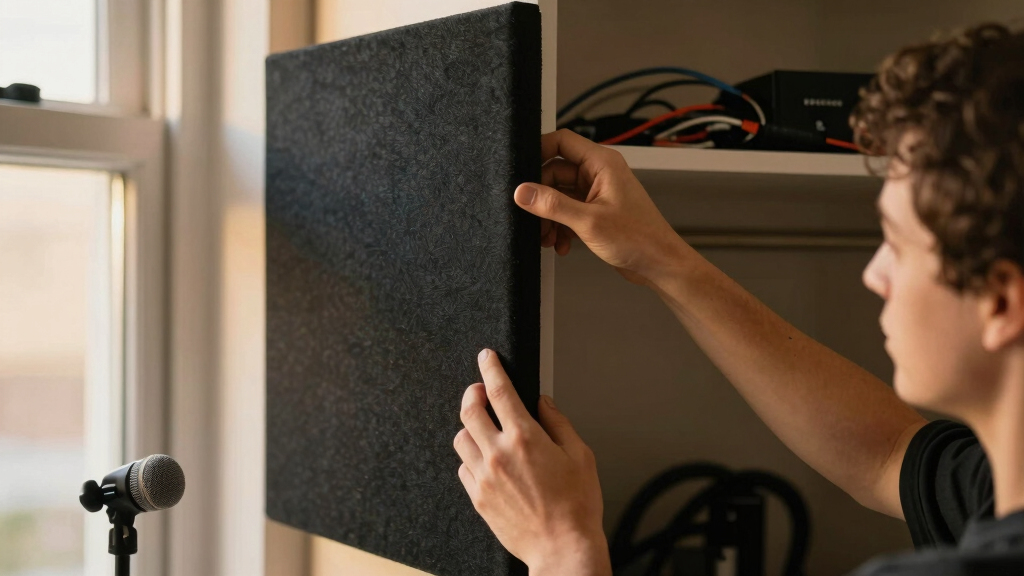

📊 Full opportunity report: Acoustic Dampening, Placement, and the “Rig in the Closet” Setup on ThorstenMeyerAI.com — validation score, market gap, and execution plan.

TL;DR

Moving your high-power rig into a closet significantly reduces noise and reflections when combined with proper placement, sealing, and ventilation. This practical guide explains effective strategies for creating a quiet, controlled workspace.

Moving a high-powered computer rig into a closet is confirmed as the most effective method to drastically reduce noise and reflections, according to industry experts. Proper placement, sealing gaps, and using absorption materials create a controlled acoustic environment, making a closet a practical workspace for audio recording or AI development.Research and expert opinions indicate that relocating a noisy rig into a closet can cut down sound levels more effectively than foam treatments alone. Strategic placement of acoustic panels at reflection points—behind the microphone, side walls, and ceiling—substantially reduces echo and harshness. Sealing gaps around doors and walls with weatherstripping or blankets prevents sound leaks and external noise intrusion. Additionally, heat buildup is a critical concern; installing ventilation such as exhaust fans or ducted airflow solutions helps maintain safe operating temperatures without compromising soundproofing efforts. Materials like foam, blankets, rugs, and bass traps are recommended for treatment, with about 20-30% wall coverage typically sufficient to improve acoustics while avoiding an overly dead sound. Experts emphasize that dampening and sealing are distinct but complementary; dampening absorbs internal reflections, while sealing prevents sound leakage. Proper placement and treatment of a closet space can turn it into a professional-quality environment for both recording and high-performance computing.
Acoustic Dampening & Placement — Interactive Infographic
ThorstenMeyerAI.com · AI Workstation Guides
Lever 5 of 5 · Placement · Interactive
The last lever · move it out

Acoustic dampening
& the rig in the closet.

The most powerful noise fix isn’t a material — it’s a floor plan. A rig you can’t hear because it’s in another room beats any amount of foam. Tap the approaches in Part 1 to see what actually works.

1 The hierarchy people get backwards
Distance beats foam — by a lot
Acoustic treatment has a clear order of effectiveness. Most people buy foam first — it’s last. Tap a row for why.
1Distance & isolation
(another room)
most
2Reduce at the source
(levers 1–4)
high
3Block transmission
(door / barrier)
medium
4Absorb reflections
(acoustic foam)
least
#1 · Distance & isolationThe best soundproofing is a wall. Move the rig to another room and run it headless — the noise problem disappears instead of being mitigated.
2 Two kinds of noise, two fixes
Foam and pads solve different problems
Pick the wrong fix and you treat noise that was never going to respond to it.
Airborne
The whoosh of fans, the GPU hum — traveling through air.
Foam absorbs it (less echo in the room)
A barrier blocks it (stops it leaving)
×Foam alone won’t stop it passing through a wall
Structure-borne
The low hum the machine sends into the desk, floor & walls.
Anti-vibration pads / rubber feet decouple it
Soft-mount drives, or use silent SSDs
×Foam does nothing for this — it’s mechanical
3 The rig in the closet
Great noise fix — with one catch
Enclosing a hot rig works beautifully for noise. But a sealed space traps heat — the same trap as a sealed case, scaled to a room.
GPU rig cool in hot out (fan) it must breathe

Contain the noise, not the heat

Vent it — a passive path, or a quiet exhaust fan pulling hot air out.
Soundproof cabinets do both: foam lining + thermostat-controlled exhaust.
An AIO helps here — it exports CPU heat out a radiator.
⚠ Never fully seal a 24/7 rig. Trapped 600W+ of heat = the GPU breathing its own exhaust = throttling & roaring fans.
4 The few products worth it
Mostly free technique — a handful of items help
Anti-vibration pads
Best value here. Kills structure-borne hum for a few dollars.
Soundproof server cabinet
The engineered quiet + cool answer, with built-in exhaust.
Acoustic foam panels
Tames reflections in the room — not for blocking transmission.
Quiet exhaust fan
Ventilates a closet or cabinet so the heat can leave.
5 The numbers
What containment can buy
Counts animate to typical figures.
Soundproof cabinet cuts
~36%
of perceived noise — while still dissipating kilowatts.
Serious enclosures reach
30 dB
of reduction — up to 5× quieter than an open rack.
A wall between you & it
100%
of the problem, gone — the cheapest fix there is.
Acoustic principles from server-room and quiet-PC soundproofing references; cabinet figures from manufacturer specs (StarTech, SysRacks, UCoustic). Figures vary by enclosure and environment. Affiliate disclosure on page.
ThorstenMeyerAI.com

Why Proper Closet Setup Matters for Noise Reduction and Hardware Safety

This approach provides a practical solution for users with high-noise rigs who need a quiet workspace without expensive soundproof rooms. Effective placement, dampening, and ventilation not only improve sound quality but also protect hardware from overheating, enabling longer, safer operation. Understanding these techniques helps hobbyists, content creators, and AI developers optimize small spaces for professional results, reducing noise pollution and enhancing productivity.
12in Acoustic Panels for Walls, High Density Soundproof Wall Panels

12in Acoustic Panels for Walls, High Density Soundproof Wall Panels

【Excellent Quality】: This wall soundproofing foam board is made of high-quality 100% polyester, odorless and flame retardant. There...

As an affiliate, we earn on qualifying purchases.

As an affiliate, we earn on qualifying purchases.

The Evolution of Small-Space Acoustic Optimization

Traditionally, soundproofing and acoustic treatment required dedicated rooms with complex barriers. Recently, experts have highlighted that relocating noisy rigs into closets or small rooms, combined with strategic placement and sealing, offers a cost-effective alternative. This shift is driven by the need for compact, versatile setups that balance sound control and hardware safety. Prior advice focused mainly on foam panels; current best practices emphasize the importance of sealing gaps and proper ventilation to prevent heat buildup and sound leaks. The concept of a 'rig in the closet' has gained popularity among hobbyists and professionals seeking efficient, manageable acoustic environments for recording, streaming, or high-performance computing.

"Relocating your rig into a closet, combined with proper placement and sealing, can drastically reduce noise and reflections, often more than just adding foam treatments."

— Thorsten Meyer, acoustic expert

Amazon

acoustic dampening materials for high-power computers

As an affiliate, we earn on qualifying purchases.

As an affiliate, we earn on qualifying purchases.
Uncertainties Around Optimal Ventilation and Material Effectiveness

While general strategies are established, specific optimal configurations for ventilation, material types, and coverage percentages remain somewhat variable depending on room size, rig power, and acoustic goals. The effectiveness of DIY materials like blankets and rugs also varies based on placement and thickness, and long-term durability is not fully documented.
Easy Cloud Computer Fan with AC Plug, 120mm Variable Speed Axial Muffin PC Fan with Controller 120V 110V 220V Small 12V Case Cooling for PC Server Cabinet DVR TV Router Receiver Xbox Greenhouse

Easy Cloud Computer Fan with AC Plug, 120mm Variable Speed Axial Muffin PC Fan with Controller 120V 110V 220V Small 12V Case Cooling for PC Server Cabinet DVR TV Router Receiver Xbox Greenhouse

【Speed Controllable】Easy Cloud axial fan 120v allows you to freely adjust the computer cooling fan speed according to...

As an affiliate, we earn on qualifying purchases.

As an affiliate, we earn on qualifying purchases.

Next Steps for DIY Closet Rig Setups and Acoustic Optimization

Further research and experimentation are expected to refine guidelines on ventilation solutions, material choices, and treatment placement. Manufacturers may develop specialized products for small-space acoustic treatment and heat management. Users are encouraged to document their setups and share results to build a more detailed knowledge base. Additionally, integration of smart ventilation and temperature monitoring systems could become standard for closet rigs, ensuring safety and performance.
118” Wedge-Shape Foam Window Weather Stripping Door Seal Strip,Soundproofing Frame Winter Insulation Tape for Exterior Front Door,Noise Cancelling Window Inserts,Door Gap Filler Light Blocker,White

118” Wedge-Shape Foam Window Weather Stripping Door Seal Strip,Soundproofing Frame Winter Insulation Tape for Exterior Front Door,Noise Cancelling Window Inserts,Door Gap Filler Light Blocker,White

Upgraded Wedge Design: This window draft stopper features an upgraded wedge design, tapering from 5/32" to 11/32" (0.16"–0.35")...

As an affiliate, we earn on qualifying purchases.

As an affiliate, we earn on qualifying purchases.

Key Questions

Can I use household items like blankets and rugs as acoustic treatment?

Yes, thick blankets, rugs, and quilts can absorb reflections and reduce echo when placed strategically. However, their effectiveness depends on coverage and placement; they are best used in combination with dedicated acoustic panels for optimal results.

How do I prevent my hardware from overheating in a closet setup?

Proper ventilation is essential. Installing exhaust fans, passive vents, or ducted airflow with exhaust ducts can help maintain safe temperatures. Using an exhaust fan at the top and intake at the bottom creates a gentle airflow that removes hot air without creating noise or reflections.

How much acoustic treatment do I need for a small closet?

Generally, covering about 20-30% of the walls with absorption panels is sufficient to significantly improve acoustics. Focus on reflection points—behind the mic, side walls, and ceiling—and add bass traps in corners if low-frequency issues are present.

Is sealing gaps enough to soundproof a closet?

No. Sealing gaps prevents sound leakage but does not eliminate reflections inside the space. Combining sealing with dampening materials provides better overall sound control and isolation.

What are the best materials for DIY acoustic treatment in a closet?

High-density foam panels, moving blankets, thick rugs, and quilts are effective. For bass trapping, denser, thicker panels placed in corners help absorb low-frequency rumble. Proper placement is key to maximizing their effectiveness.

Source: ThorstenMeyerAI.com

You May Also Like

How to Think About Guest Access Codes More Safely

Consider encryption and strong authentication methods to protect guest access codes, but discover additional strategies to ensure your security remains intact.

What Happens to Smart Locks During Internet Outages

Forgetting internet outages, discover how smart locks stay secure and functional, and why understanding offline features is essential for your home’s safety.

Mechanical Locks vs Electronic Locks: Failure Modes Explained

Keen insights into mechanical and electronic lock failures reveal crucial tips to prevent security issues and ensure reliable access.

How Package Zones and Motion Zones Affect Doorbell Alerts

Learn how customizing package and motion zones can enhance your doorbell alerts, ensuring you receive only the most relevant notifications and…