
📊 Full opportunity report: Liquid vs Air Cooling for 24/7 Inference Rigs on ThorstenMeyerAI.com — validation score, market gap, and execution plan.

Get the latest gadgets delivered free with Prime
- Fast, free delivery on millions of items
- Prime Video, Amazon Music and more included
- Member-only deals all year
TL;DR
For most 24/7 AI inference rigs, air cooling is preferred due to its reliability, lower cost, and quieter operation. Liquid cooling offers benefits for high thermal loads but introduces complexity and potential failure points.
For continuous AI inference rigs running 24/7, air cooling remains the most reliable, cost-effective, and quiet option, according to current industry assessments and expert opinions.
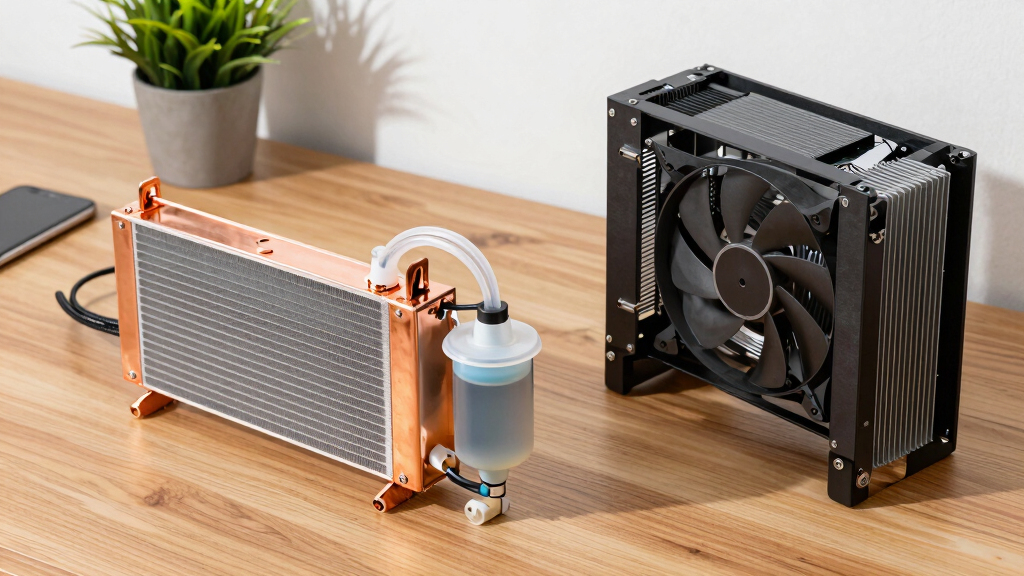
Most AI inference systems operating continuously benefit from air cooling because it has fewer failure points and lower long-term costs. High-quality dual-tower air coolers can effectively dissipate 200–250W of heat, rivaling mid-size liquid coolers in performance, while offering greater reliability and simpler maintenance.
Liquid cooling, particularly all-in-one (AIO) units, can handle higher thermal loads—up to 360W with larger radiators—making them suitable for CPUs that run hot under sustained loads or in compact cases where large air coolers won’t fit. However, AIOs include a pump, which is a single point of failure, and their sealed loops can degrade over time, typically lasting 5–7 years. Leaks, though rare, remain a risk, and the need for eventual replacement increases total cost of ownership.
Industry testing shows that quality air coolers operate at lower noise levels (around 40–45 dBA) compared to AIOs, which often produce a constant pump hum, potentially impacting user comfort during long, unattended runs. Maintenance for air coolers involves dust removal and thermal paste reapplication, generally straightforward and infrequent.
Liquid vs air
for a 24/7 inference rig.
For an always-on machine the question isn’t “which cools better” — it’s which one still works in three years without you thinking about it. That reframing makes air the default for most rigs. Answer three questions in Part 2 to find yours.
- Nothing to fail — fan swaps in minutes
- Lasts a decade+; lower total cost
- Quieter floor — no pump hum (~40–45 dBA)
- Trivial maintenance — wipe & repaste
- Tall — can block RAM, dumps heat in case
- Best headroom — ~360W TDP sustained
- Compact block — fits tight cases, clears RAM
- Exports heat out the radiator & room
- Pump fails at 5–7 yrs; replace whole unit
- Costs 2–3× more over its life; pump hum
- You run it 24/7 and want set-and-forget.
- Your CPU is mainstream-to-high-end (or power-capped).
- A big tower fits your case.
- You value lower cost and a quieter floor.
- Your CPU is too hot for air under sustained all-core load.
- A big tower won’t fit (compact / multi-GPU case).
- You need to export heat out of a warm room.
- RAM clearance is tight.
Why Reliability and Cost Matter for AI Rigs
For AI inference rigs that run continuously, reliability and low maintenance are critical. An air cooler’s single moving part and durable heatsink reduce failure risk over years of operation, ensuring consistent performance without intervention. Additionally, lower initial and long-term costs make air cooling the practical choice for most users, especially when considering total cost of ownership.
While liquid cooling can provide higher thermal headroom, its complexity and potential for failure mean it is better suited for specialized applications or high-performance overclocked systems rather than standard inference servers. The noise advantage of quality air coolers also benefits users working in proximity to these systems.
As an affiliate, we earn on qualifying purchases.
Understanding Cooling Choices in AI Workstations
Most discussions about cooling focus on gaming PCs, where peak temperatures and benchmark performance are the priorities. For AI inference systems, which often operate unattended for extended periods, the emphasis shifts to long-term reliability, ease of maintenance, and total cost of ownership.
Traditional air coolers like the Noctua NH-D15 have proven capable of handling the heat generated by high-end CPUs under sustained load, making them a dependable choice for AI workstations. Conversely, AIO liquid coolers, while offering superior thermal headroom, introduce complexity with pumps and sealed loops that degrade over time, especially under continuous operation.
"For 24/7 inference rigs, the simplicity and durability of air cooling often outweigh the thermal advantages of liquid solutions."
— Thorsten Meyer, AI hardware expert
As an affiliate, we earn on qualifying purchases.
Unresolved Questions About Long-Term Liquid Cooling Reliability
While modern AIO liquid coolers are considered reliable today, their lifespan under continuous operation beyond 5–7 years remains less certain. The rate of coolant permeation, seal degradation, and leak risk over extended periods is not fully documented, leaving some uncertainty about their long-term suitability for dedicated inference servers.
quiet 24/7 AI inference cooling fan
As an affiliate, we earn on qualifying purchases.
As an affiliate, we earn on qualifying purchases.
Future Trends in Cooling for AI Inference Systems
As AI workloads grow and hardware demands increase, testing and real-world deployment will clarify whether liquid cooling can match the reliability of air cooling over the long term. Manufacturers may introduce more durable, repairable liquid cooling solutions, but currently, most experts recommend air cooling for stable, unattended operation. Ongoing industry evaluations and user experience reports will shape best practices in the coming years.
As an affiliate, we earn on qualifying purchases.
Key Questions
Is liquid cooling necessary for AI inference rigs?
Not typically. Most high-quality air coolers can handle the thermal loads of standard AI CPUs under continuous operation, offering greater reliability and lower maintenance.
What are the main risks of using AIO liquid coolers in 24/7 systems?
The primary risks include pump failure, coolant permeation, and potential leaks, which can cause system downtime or damage. These issues are less common but are significant considerations for unattended systems.
How long do AIO liquid coolers last in continuous operation?
Manufacturers typically warranty them for 5–6 years, but their effective lifespan may be shorter due to pump wear and coolant degradation, especially when run constantly.
Can air coolers handle high thermal loads better than liquid coolers?
High-end air coolers can dissipate around 200–250W, comparable to mid-size liquid coolers, but for CPUs exceeding this, larger AIOs with bigger radiators may be necessary.
What should I consider when choosing cooling for a dedicated AI server?
Focus on reliability, ease of maintenance, total cost of ownership, and noise levels. For most, quality air cooling offers the best balance of these factors.
Source: ThorstenMeyerAI.com
Halloween Picks
halloween
As an affiliate, we earn on qualifying purchases.